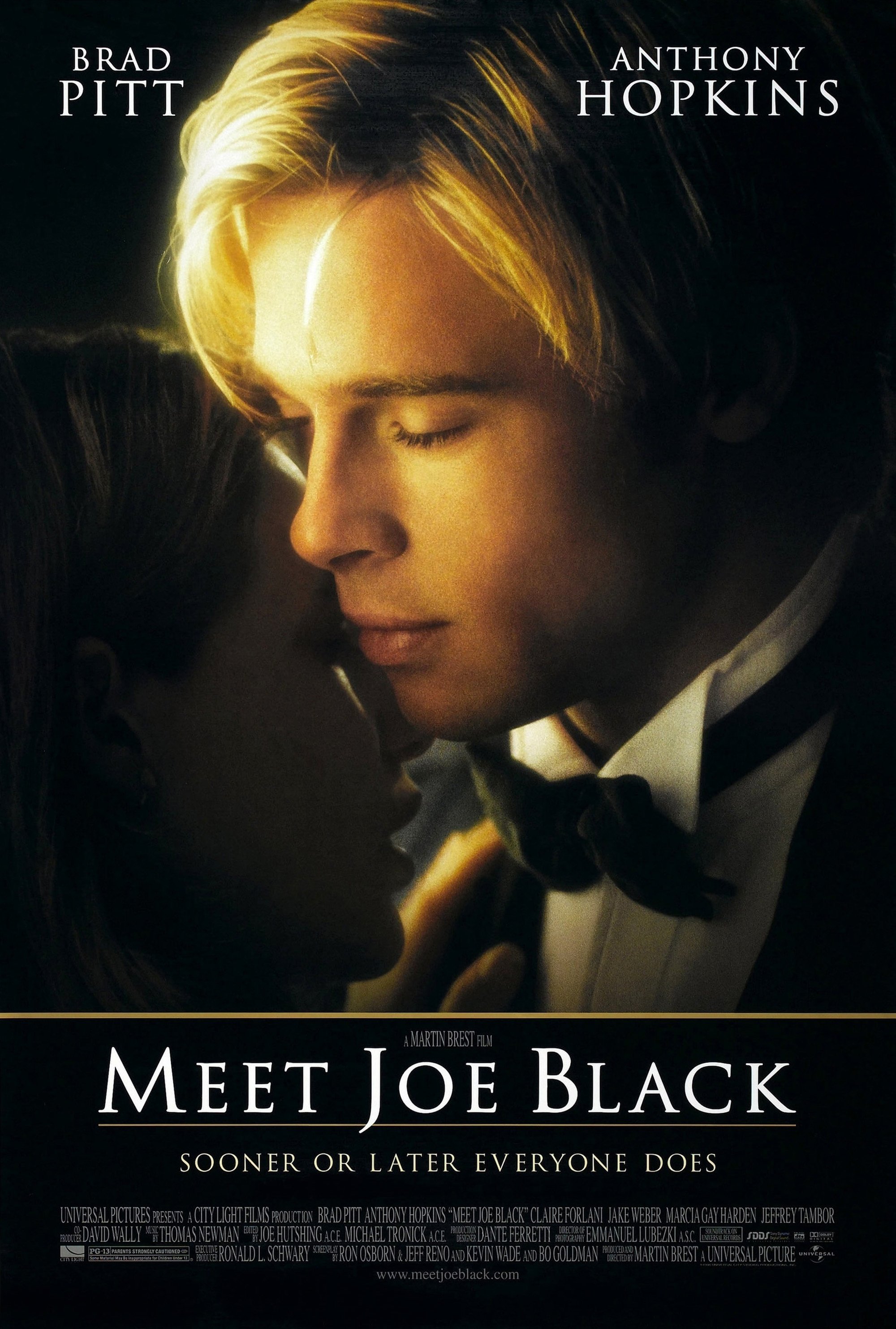
Meet Joe Black
On the eve of his 65th birthday, powerful media mogul Bill Parrish finds himself navigating an unusual arrangement after a mysterious visitor arrives, forcing him to confront profound questions about legacy, love, and mortality while his daughter faces a connection that challenges everything she understands about life, loss, and the people we find ourselves drawn to.
Meet Joe Black — Plot Summary
The Voice Before the Threshold
William Parrish has built an empire worth envying and a life worth keeping. A media mogul of considerable refinement and moral backbone, Bill is on the cusp of turning sixty-five — a milestone his eldest daughter Allison is orchestrating into a grand estate celebration. But birthdays, it turns out, carry weight when you're standing at the edge of something larger than a calendar year. One morning, while surveying the skyline from his New York penthouse, Bill experiences sharp chest pains. In the silence that follows, he hears a voice — his own voice, somehow — whispering a single, cryptic word: Yes.
He doesn't tell anyone. He files it under the category of things a man reckons with quietly.
Lightning in a Coffee Shop
His younger daughter Susan is a doctor by vocation and a romantic by temperament, though she hasn't quite found the match to justify the latter. She's been dating Drew, a sharp-edged board member at her father's company, but Bill has reservations about him — reservations he voices with characteristic elegance, urging Susan to stay open. Lightning could strike, he tells her.
It does, almost immediately. That very morning, Susan stops for coffee near the hospital and finds herself in conversation with a stranger — a young man with a warmth that seems almost too immediate to be ordinary. They talk. They flirt. There's the rare electricity of two people recognizing something in each other before the words have caught up. She leaves without learning his name. He steps off the curb to watch her go. And then, in a terrible instant, he is struck by multiple cars and killed.
The Arrival
That evening, the voice returns. It pulls Bill into a room of his own home, and there — impossibly, undeniably — stands the dead man from the coffee shop. The voice that has been haunting Bill now speaks from that borrowed mouth: it is Death, and it has come to collect him. But there is a proposal. Bill's impassioned counsel to Susan earlier that day — the speech about love and possibility — caught Death's attention. It found itself curious. In exchange for serving as a guide through the human world, Death will let Bill live a while longer.
Backed into an agreement with the inevitable, Bill gives his new companion a name on the spot at the family dinner table: Joe Black. Joe doesn't know how to eat. He holds cutlery like a foreign instrument, tastes peanut butter as though it were a sacred revelation, and stares at people with the unblinking attentiveness of someone who has observed humanity from the outside for all of recorded time and is now, bewilderingly, sitting at a table with it.
The Man Who Follows
Joe begins accompanying Bill everywhere — board meetings, medical appointments, family meals. He absorbs everything with the detached fascination of a student encountering a subject they can finally touch. Bill, for his part, plays the dutiful guide, managing the strangest houseguest in human history while also navigating the fractures forming at his company. Drew, calculating and ambitious, has been pushing hard for a corporate merger that would fold Parrish Communications into a larger conglomerate. Bill opposes it on principle — merging, he believes, would compromise the journalistic independence he built his legacy around. The two men are increasingly at odds.
Susan, meanwhile, is baffled. The man her father has introduced as an old friend is clearly the man she met in the coffee shop — same face, same posture — but he doesn't remember her. He is stilted where the stranger was warm. He is fascinated by her in a way that feels observational rather than intimate. She is drawn to him despite herself, or perhaps because of the ghost of the morning still clinging to his borrowed skin.
The Jamaican Woman
Joe takes a particular interest in a dying Jamaican patient at Susan's hospital — a radiant, ancient woman named Jamaican Woman who, unlike everyone else, seems to know exactly what he is. She greets him without fear, with the easy familiarity of someone who has been expecting a familiar face. Their exchange is the one conversation in the film where Joe doesn't need to perform humanity. She already sees through the performance. It is brief, but the encounter lodges something in him.
The Temptation of the Living
Inevitably, proximity becomes feeling. Joe begins visiting Susan at the hospital. Their conversations deepen. She tells him things she doesn't tell other people. He tells her, in his strange, too-earnest way, exactly what he means. There is no artifice in Death — no social performance, no strategic deflection — and in a world full of men like Drew, this is extraordinary. Susan falls in love. Joe, to his own evident surprise, falls in love back.
When Bill discovers them together, he is furious. His anger isn't possessive so much as terrified: Death has fallen for his daughter, and the implications are catastrophic. Their agreement never covered this. He confronts Joe directly, and Joe's response is chillingly simple — he intends to take Susan with him when he goes.
The Company Under Siege
While the household navigates this impossible domestic complication, Drew is executing a corporate coup. He has quietly built support among the board members, leveraging Bill's erratic behavior — a man who shows up everywhere with a mysterious stranger, who seems distracted, who has started making unusual decisions — as evidence of incompetence. Allison's husband Quince, well-meaning and bumbling, inadvertently feeds Drew the information he needs. The board votes. Bill is removed as chairman. The merger is approved. His life's work, the institution he spent four decades building with care, is about to be sold off and stripped for parts.
Drew's endgame, revealed to Quince in a moment of gloating candor, is to liquidate Parrish Communications entirely — breaking it into sellable pieces once the larger acquisition goes through. He doesn't want to run the company. He wants to dismantle it.
The Education of Death
In the days before his birthday, Bill sits with Joe in the genuine conversations of a man who knows he is running out of time. He speaks about love — not the romantic abstraction of it, but the demanding, sacrificial truth of it. Real love, Bill tells him, is not possession. It is not the desire to keep something close because losing it would wound you. Real love is wanting the beloved to flourish, even if flourishing means living without you. It means honesty, and sacrifice, and letting go.
Joe listens. He is learning to be human and discovering, too late, that being human is largely the practice of accepting what you cannot keep.
The Birthday Party
The party is lavish — the Parrish estate lit against the night, champagne and strings and the whole complicated architecture of a life assembled around a man for one final evening. Bill moves through it with the grace of someone who has already said goodbye internally and is now only managing the outward ceremony.
Joe arrives in a different guise. Posing as an IRS agent, he corners Drew and the board with the calm authority of someone who genuinely holds every card. He lays out the full scope of Drew's betrayal — the hidden business dealings, the orchestrated removal, the plan to gut the company — and delivers it with the quiet finality of a verdict. Drew resigns. The board reinstates Bill. Parrish Communications survives.
The Bridge
Bill has been given everything he needed to leave. His company is intact. His daughters are safe. His conscience is clear. He says goodbye to Allison — acknowledges the distance between them, the favoritism she long suspected, and holds her in the warmth she deserved all along. He dances with Susan. He makes his rounds like a man who has lived well and knows it.
At the edge of the garden, as fireworks bloom above the estate, Joe and Bill walk together toward a stone bridge. Susan watches them go. They cross it — and vanish.
Then, emerging from the other side: not Joe Black. The young man from the coffee shop. Confused, slightly dazed, carrying no memory of any of it. Susan runs toward the bridge. She looks at him. He smiles. Quite a party, he says.
She knows. She understands everything in that moment — what her father gave her, what was taken and returned, what she is being offered now. She reaches for him.
Meet Joe Black — Ending Explained
The ending's central act of grace is Joe's decision to release Susan. Throughout the film, Joe approaches love the way he approaches everything human — with fascination and without precedent, which means without the wisdom to understand what love actually costs. His plan to take Susan into death with him is not villainous; it is naïve in the most cosmic sense. He has learned to want her but hasn't yet learned that wanting someone is not the same as loving them. It is Bill's patient, unflinching counsel that completes Joe's education — the argument that love is fundamentally about sacrifice, about releasing the thing you want most because keeping it would diminish it. Joe's final act of humanity is, paradoxically, to step back out of humanity entirely.
The ending's structural bittersweet quality rests on an important ambiguity: Susan spent the film falling in love with Death wearing a dead man's face, while the young man she actually connected with — the one in the coffee shop — had no awareness of any of it. Her feeling for Joe Black is real, but the object of that feeling is borrowed. When the young man returns, disoriented and unknowing, Susan is not exactly reuniting with someone she loves. She is meeting him for the first time again, equipped now with everything she learned about love and loss and presence from a relationship that technically never existed.
The ending's thematic architecture mirrors its opening. Bill's advice to Susan — lightning could strike — was spoken before any of this happened, and it becomes, retroactively, the film's thesis. Lightning did strike, twice: once in a coffee shop that ended in tragedy, and once at a birthday party that ended in a funeral. The young man crossing back over the bridge is the third strike — the one that might finally land cleanly, in an ordinary life, without the interference of the extraordinary.
The ending's treatment of Bill himself is perhaps the most quietly radical thing the film does. He doesn't die in anguish or resistance. He walks into it with the unhurried composure of a man who settled his affairs and loved well and is now simply ready. The film's argument is not that death is good or that grief is wrong — it is that a life consciously lived, with integrity and love at its center, earns a peaceful crossing. Bill modeled that for Joe, and Joe, in turn, honored it.
The ending's final image — Susan running toward the bridge, toward the stranger who is also somehow the man she has been waiting for — refuses to resolve cleanly into happiness or sadness. It holds both. The audience knows what she lost. They also know what she found. The film trusts its viewers to carry that tension without resolution, which is, perhaps, the most honest thing it could offer.
Meet Joe Black — FAQ
Is Meet Joe Black based on a true story or an original screenplay?
The film is loosely adapted from the 1934 movie Death Takes a Holiday, which was itself based on a 1929 stage play by Walter Ferris, translated from the 1924 Italian play La morte in vacanza by Alberto Casella. The concept of Death taking human form to experience mortal life is therefore nearly a century old by the time Brad Pitt stepped into the role. The 1998 film significantly expanded the corporate subplot and the romantic arc between Joe and Susan, giving it a distinctly modern, American flavor compared to the more theatrical European original.
Why does the young man at the end have no memory of being Joe Black?
The film's internal logic holds that Death temporarily inhabited the body of the man killed in the accident, using it as a vessel for his earthly visit. When Death departs with Bill at the end of the film, the soul of the original young man is returned to his body — alive once again, with no memory of the time in between. This is why he seems slightly disoriented at the party, making small talk about fireworks as though he has simply surfaced from a fog. He and Joe Black are technically the same physical person but entirely different beings, which is precisely why Susan's reunion with him is so emotionally complicated.
What was Drew's actual plan with Parrish Communications?
Drew, played by Jake Weber, was not merely angling for a promotion. His scheme was to engineer a hostile takeover of Parrish Communications through a merger that Bill had opposed, oust Bill as chairman, and then systematically dismantle the company — selling its parts to outside buyers for maximum personal profit. He had been operating as a double agent, conspiring with outside interests while presenting himself as a loyal executive. Quince inadvertently provided Drew with the leverage he needed when he mentioned that any business decisions would have to wait for Joe's approval, giving Drew the opening to portray Bill as incompetent and reliant on a mysterious outsider.
Did Brad Pitt and Anthony Hopkins actually get along on set?
By most accounts, Hopkins and Pitt had a warm working relationship, though Pitt has since been candid about his own struggles with the role. He has described his performance in Meet Joe Black as one of the low points of his career, admitting in interviews that he lacked directorial guidance and felt he underperformed. Hopkins, by contrast, was almost universally praised — critics who dismissed the film generally carved out exceptions for Hopkins, with Roger Ebert describing his performance as the emotional center of the movie. The film's director, Martin Brest, deliberately pursued long, slow takes and extended dialogue scenes, which contributed to both the film's meditative tone and its divisive three-hour runtime.