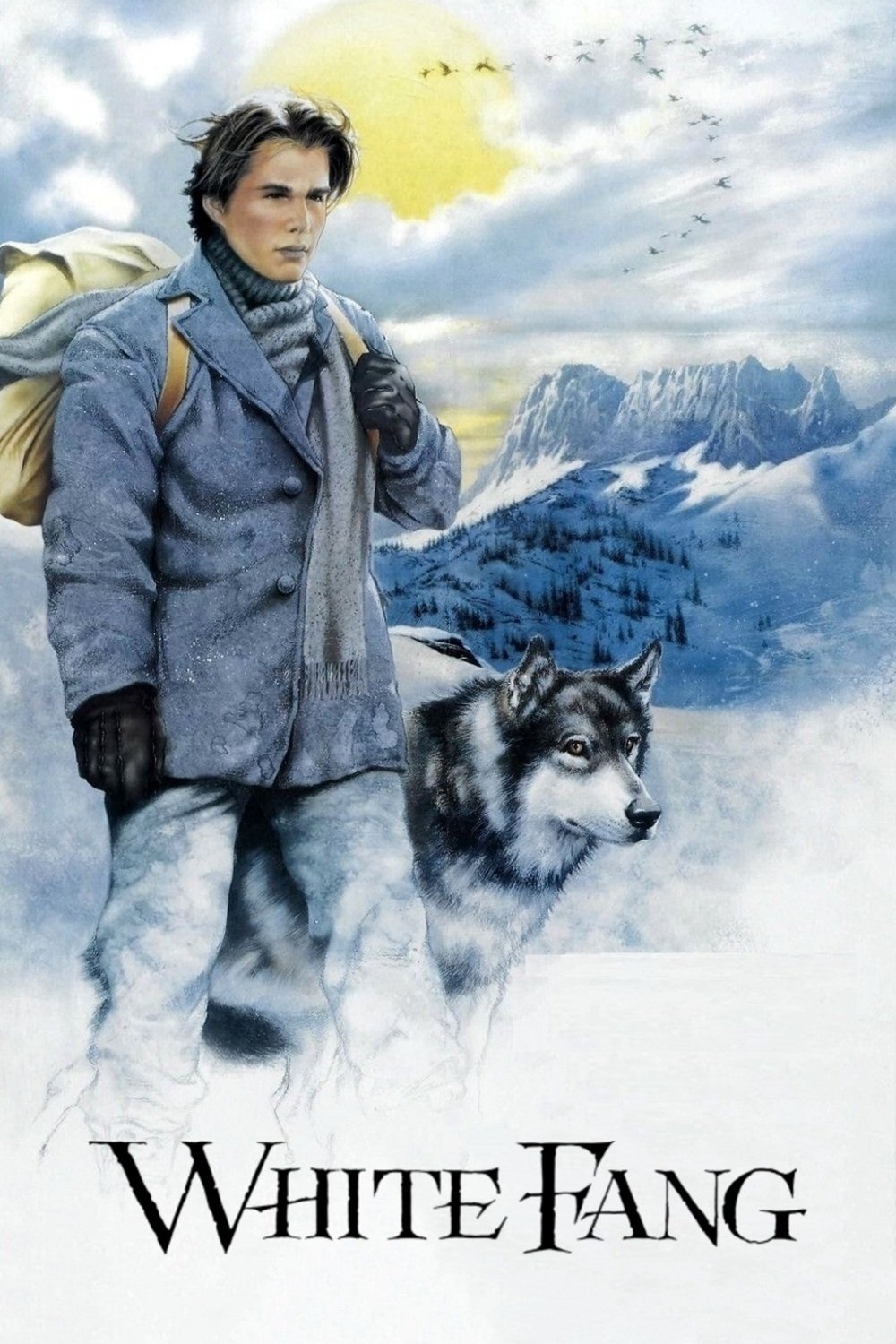
White Fang
Young San Francisco explorer arrives in Alaska during 1898 Gold Rush seeking father's mining claim, befriends orphaned wolfdog raised by Indigenous chief then tortured by dogfighter, rescues wolfdog from illegal fighting ring, strikes gold with wolfdog's help, defends homestead from criminal attack, chooses to remain in wilderness with wolfdog rather than returning to civilization.
White Fang — Plot Summary
Journey to the Klondike
1898, during the Klondike Gold Rush. Young explorer Jack Conroy arrives in Alaska from San Francisco, seeking his deceased father's mining claim in the harsh wilderness. Jack meets two experienced mushers—Clarence "Skunker" Thurston and Alex Larson—who reluctantly agree to guide the inexperienced young man through the dangerous territory.
While traveling through the frozen wilderness with their dog sled team, the group becomes stalked by a wolf pack. One night while resting at their campfire, a wolf lures one of the sled dogs away from the protective circle of the group. Another wolf then chases the separated dog into the woods, isolating it from help.
Skunker attempts to save his dog from the wolves but is killed by the pack during the rescue attempt. His death demonstrates the lethal danger of the Alaskan wilderness and establishes the wolves as a serious threat.
Later that same night, the wolves return to attack the remaining men and dogs. Jack and Alex defend themselves by using burning branches from the fire to scare off the pack. The flames force the wolves to retreat temporarily.
The following morning, the wolves attack again with greater coordination. However, Jack and Alex are saved when another sled team arrives and joins the fight. During the ensuing battle between humans and wolves, a female wolf named Kiche is mortally wounded by gunfire.
The Orphaned Cub
Kiche, grievously wounded, hobbles back to her den where her young cub waits. The cub remains loyally by his mother's side as she weakens. Kiche eventually dies from her wounds, leaving the pup alone to fend for himself in the unforgiving wilderness with no pack to protect or teach him.
Jack and Alex reach a frontier town where they plan to wait out the brutal winter before continuing their journey to the mining claim.
Meanwhile, a Hän Indigenous band traveling through the area discovers the orphaned wolf pup. Grey Beaver, the chief of the band, examines the young animal closely. Realizing from the color and structure of the pup's teeth that he is a wolfdog—a hybrid of wolf and domestic dog rather than a purebred wolf—Grey Beaver decides to keep him. He names the wolfdog White Fang.
Meeting White Fang
When spring arrives and travel becomes possible again, Jack and Alex resume their quest to reach Jack's father's mining claim. However, they stop at the Hän settlement where Grey Beaver's band has made camp.
Grey Beaver explains his philosophy regarding White Fang: the wolfdog has been raised to obey commands and perform work, not to be friendly or affectionate. White Fang has been trained as a working animal according to Grey Beaver's cultural practices and survival needs.
However, Jack believes that White Fang deserves more than strict obedience training. He seeks to change the wolfdog's relationship with humans by showing him kindness and attempting to build trust.
Jack's opportunity to connect with White Fang comes when Jack is suddenly attacked by a massive grizzly bear while exploring near the settlement. The bear chases Jack through the forest until Jack takes cover under a woodpile, trapped and defenseless.
White Fang, witnessing Jack in mortal danger, makes a choice. Rather than remaining passive, White Fang intervenes and defends Jack from the grizzly bear. The wolfdog engages in a dangerous standoff with the much larger predator. The confrontation ends with the bear deciding to leave rather than continue fighting the fierce wolfdog.
Jack's life has been saved by White Fang's intervention. Shortly after this incident, Jack and Alex leave the Hän settlement to continue their journey toward the mining claim.
Beauty Smith's Cruelty
Not long after Jack and Alex depart, White Fang's life takes a dark turn. He is unfairly traded away from Grey Beaver to Beauty Smith, a sadistic dogfighter who is also a business rival of Alex Larson.
Smith's associates had previously stolen money from Jack, establishing Smith as an antagonist connected to Jack's story. Smith blackmails Grey Beaver into surrendering White Fang by asserting that ownership of a wild animal is considered illegal—using legal threats to force the transaction despite Grey Beaver's reluctance.
Smith and his gang systematically train and brutally abuse White Fang, transforming the wolfdog into a ferocious killing machine. Their goal is to enter White Fang into illegal dogfighting rings where spectators bet on violent matches between animals. The training involves starvation, beatings, and conditioning White Fang to attack any living creature placed before him.
White Fang becomes a successful fighting dog, winning match after match through his hybrid strength and the vicious training Smith has imposed. However, White Fang eventually meets his match in a brutal fight against a bulldog. The bulldog's fighting style and tenacity create a dangerous situation for White Fang.
Jack happens upon the illegal dogfight just as White Fang is in serious danger. He intervenes at the last possible moment, stopping the fight and freeing White Fang from Smith's control. Jack also swears to expose Smith for his crimes—both the illegal dogfighting operation and the stolen money.
Transformation
Having earlier reached his father's mining claim and begun the work of excavating for gold, Jack returns to the Larson homestead with White Fang. Jack is determined to transform White Fang's vicious and territorial nature—the result of Smith's abuse—back into something resembling the natural animal Grey Beaver once raised.
Jack's attempts to tame White Fang and undo the trauma of the dogfighting abuse take considerable time and patience. Eventually, Jack succeeds in helping White Fang heal psychologically. The two develop a close bond based on trust rather than fear or obedience.
Alex and Jack work the mining claim together, digging for gold in the harsh conditions. They strike it rich, discovering significant gold deposits. White Fang assists in the mining operation, proving valuable beyond his companionship.
Smith's Revenge
One morning, Jack travels to the frontier town to officially claim proper legal ownership of the gold they have discovered. While in town, Luke—one of Beauty Smith's henchmen—notices White Fang at the Larson homestead.
Seeking retaliation for Jack's interference in his dogfighting operation and planning to steal the gold for himself, Beauty Smith organizes an attack. Smith and his men assault the Larson homestead with guns and explosives, intending to kill anyone present and take the gold.
White Fang attacks the invaders, defending the homestead. During the fight, White Fang attacks Tinker, one of Smith's men. Tinker accidentally discharges his gun in the struggle, wounding his accomplice Luke with friendly fire.
White Fang continues fighting until he subdues Beauty Smith himself, pinning the criminal. However, when Jack arrives and orders White Fang to back down, the wolfdog obeys—demonstrating both his bond with Jack and that he has regained control over his violent impulses rather than being consumed by them.
Jack and Alex take Smith and his men prisoner. Rather than simply turning them over to authorities, Jack forces Smith and his gang at gunpoint to haul the heavy gold ore into town themselves as punishment and humiliation.
Belonging
After securing their fortune and dealing with Smith, Alex and his wife Belinda prepare to return to San Francisco. They offer to take Jack back to civilization with them.
However, Alex warns Jack that city life is no place for a wolf or wolfdog. White Fang belongs in the wild, running free in his natural environment. Despite their bond, Jack must let White Fang return to the wilderness where he belongs.
Though White Fang cannot understand why Jack is trying to leave him, Jack uses extreme measures to drive the wolfdog away. He picks up a stick—which has become White Fang's worst fear from his time being beaten by Beauty Smith—and uses it to scare White Fang off. The betrayal of using White Fang's trauma against him succeeds in making the wolfdog flee in terror.
Jack boards the ship preparing to sail back to San Francisco with Alex and Belinda. However, at the last moment, Jack realizes that his rightful place is not in the city but in the Yukon wilderness. He has grown to love the harsh land and the independent life it offers.
Jack decides to stay behind, choosing to live alone off the land rather than returning to civilization. Alex congratulates him on the decision, saying that living in the wilderness and working the land is what Jack's father would have wanted—honoring his father's legacy by continuing his life in Alaska.
After a short time living alone at the cabin site, White Fang overcomes his fear and trauma. He returns to find Jack, and the two happily reunite. White Fang and Jack will remain together in the Yukon, both having found where they truly belong.
White Fang — Ending Explained
The ending validates Jack's transformation from naive city explorer to wilderness man capable of thriving in harsh conditions, with his decision to stay in Alaska representing completion of his father's unfinished legacy rather than abandoning it. His choice to remain honors both his father's life and Jack's own growth into someone who belongs in the wilderness rather than civilization.
White Fang's return after being driven away demonstrates that genuine bonds survive betrayal and trauma when built on consistent love rather than abuse, with his ability to overcome the stick's terror showing psychological healing from Smith's conditioning. His choice to return rather than remaining in the wild suggests that his connection to Jack has become as essential as wilderness freedom.
The film's conclusion that Jack and White Fang both belong together in Alaska rather than either returning to their origins (San Francisco for Jack, pure wilderness for White Fang) presents found family and chosen belonging as superior to birthright or nature. Their partnership creates third option beyond civilization or wilderness—a life integrating both.
Alex's statement that Jack's decision is "what his father would have wanted" reframes the mining claim quest from financial inheritance to spiritual one, suggesting Jack's father wanted to pass down love of wilderness and independent life rather than merely gold. The successful mining becomes means to staying rather than reason to leave.
Jack's use of White Fang's trauma (the stick) to drive him away provides morally complex moment where causing psychological harm serves protective purpose, demonstrating that love sometimes requires inflicting pain to prevent greater harm. The ending validates this choice by having White Fang return, suggesting the wolfdog understood or forgave Jack's protective cruelty.
White Fang — FAQ
Is White Fang based on a true story?
No, the film is based on Jack London's 1906 novel "White Fang," which is a work of fiction though inspired by London's own experiences during the Klondike Gold Rush. London drew on his time in Alaska and his observations of dogs, wolves, and the brutal realities of frontier life to create the story, but the specific characters and events are invented.
What is a wolfdog and why does it matter that White Fang is one?
A wolfdog (also called wolf-dog hybrid) is the offspring of a wolf and a domestic dog. White Fang's hybrid nature makes him stronger, more intelligent, and more adaptable than either purebred wolves or domestic dogs, explaining his survival as an orphan and his success in dogfights. His hybrid status also symbolizes his ability to exist between wilderness and civilization—he's neither fully wild nor fully domesticated, much like Jack becomes neither fully a city man nor purely a wilderness survivalist.
Why does Grey Beaver give up White Fang to Beauty Smith?
Beauty Smith blackmails Grey Beaver by claiming that ownership of a wild animal is illegal, threatening Grey Beaver with legal consequences if he doesn't surrender the wolfdog. This exploitation reflects historical power dynamics where Indigenous peoples were often forced to comply with laws imposed by colonial legal systems, with Smith weaponizing legal threats to take what he wants regardless of rightful ownership or ethical considerations.
Could White Fang actually survive fighting a grizzly bear?
While the film dramatizes the encounter, real wolves and large dogs generally avoid confronting grizzly bears due to the massive size and strength difference—adult grizzlies can weigh 800+ pounds compared to a wolfdog's 100-150 pounds. The standoff likely works because White Fang's aggression and willingness to fight convinces the bear that the meal isn't worth the injury risk, not because White Fang could actually win such a fight. Bears often retreat from determined opposition rather than risking injury.