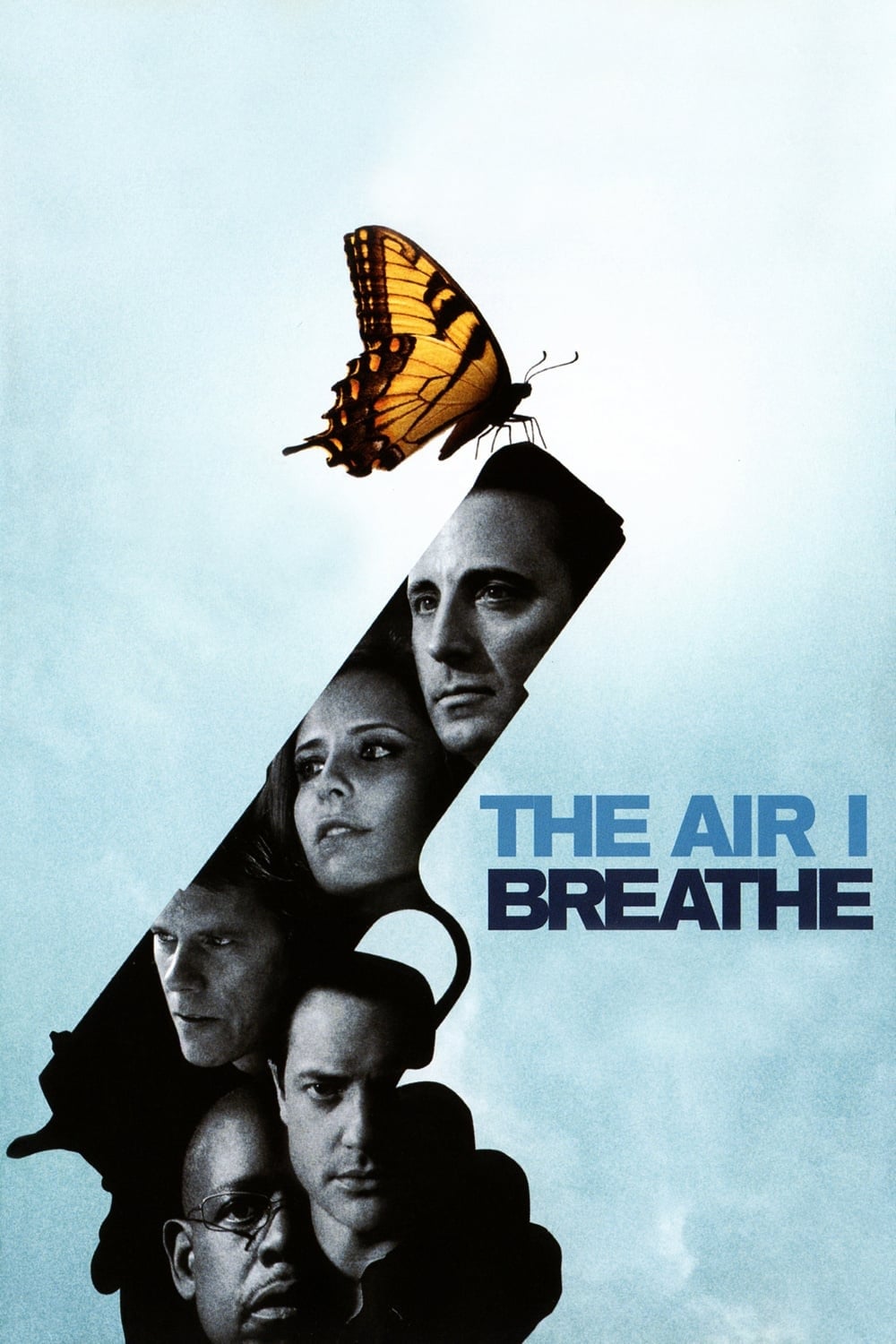
The Air I Breathe
Four interconnected stories explore Chinese proverb's four emotions: bank employee robs workplace after losing borrowed money on horse race dies butterfly-like; mob enforcer with precognitive abilities killed protecting singer from bookie; pop singer escapes criminal contract using dead robber's money; doctor saves comatose love using singer's rare blood type.
The Air I Breathe — Plot Summary
Happiness
Forest Whitaker plays a meek bank employee who loves butterflies and lives a quiet, modest life. One day, he accidentally overhears acquaintances discussing a fixed horse race—inside information suggesting a certain winner. Seeing this as an opportunity to transform his life, the bank employee decides to make a substantial bet of $50,000, borrowing the money from a bookie to place the wager.
Unfortunately, the supposedly fixed race does not go as predicted, and the bank employee loses the entire $50,000 bet. He now owes a massive debt to a dangerous criminal.
The bookie he borrowed from is known as Fingers, a nickname derived from his brutal habit of cutting off the fingers of people who fail to repay their debts. Fingers threatens the bank employee, making clear the violent consequences of non-payment. Fingers sends his mob enforcer to the bank employee's home to collect the debt.
The mob enforcer, upon meeting the bank employee, feels pity for the terrified man. Rather than beating him or cutting off his fingers, the mob enforcer gives the bank employee a revolver and leaves, perhaps hoping the man can use it to defend himself or find another way out of his situation.
In desperation, the bank employee makes a radical decision: he robs his own bank, stealing enough money to repay his debt. While fleeing the bank robbery, the bank employee is slightly hit by a moving vehicle but manages to escape. He makes his way to the top of a building.
Police surround the building and order the bank employee to drop his weapon. The bank employee does not comply with police commands. Instead, he throws the bag of stolen money off the roof. Police shoot and kill the bank employee. When his body hits the ground, his coat spreads out around him, making him look like a butterfly—the creature he loved throughout his life.
Pleasure
Brendan Fraser plays the mob enforcer who works for Fingers. The enforcer has a tragic past and possesses an unusual ability: he can see the future of the people he meets. This supernatural gift shows him glimpses of what will happen to others, but it deprives him of the pleasure of enjoying surprises in life. Everything becomes predictable, robbing ordinary experiences of spontaneity and joy.
When the mob enforcer was young, he was forced to defend his younger brother in a street fight against two teenagers. The mob enforcer won the physical fight, defeating the attackers. However, when he turned around, he found his younger brother lying dead—killed during the confrontation despite the mob enforcer's efforts to protect him. This traumatic memory haunts the mob enforcer throughout his life, with flashbacks recurring throughout the film.
Later in life, the mob enforcer joins Fingers' criminal organization and becomes one of Fingers' favorite enforcers, valued primarily because of his ability to foresee future events, which proves useful in the criminal underworld.
However, the mob enforcer discovers a significant limitation to his power: he cannot see the future of Trista, a somewhat morose up-and-coming pop singer and dancer. She is the only person whose future remains hidden from him, making her uniquely mysterious and appealing.
The mob enforcer is assigned to look after Tony, Fingers' visiting nephew. The mob enforcer has a vision showing Tony climbing a fence and falling back. To avoid the trouble this vision suggests, the mob enforcer decides to leave Tony at a nightclub while he goes to work collecting protection money from local businesses.
Unfortunately, while the mob enforcer is away, one of the girls Tony is with becomes extremely intoxicated or high on drugs. She staggers into an adjacent room. When Tony follows her to help or continue partying, they struggle over a gun. During the struggle, an older mobster is accidentally shot.
The mob enforcer returns and rescues Tony from the dangerous situation. They run from the victim's henchmen who are pursuing them for revenge. The chase ends at the fence from the mob enforcer's earlier vision. Tony manages to climb the fence and escape. However, it is the mob enforcer who gets caught by the pursuing henchmen. They severely beat him as punishment for the shooting.
The mob enforcer is treated for his injuries by Dr. Love at a hospital.
Sorrow
Sarah Michelle Gellar plays the pop singer and dancer who performs under the stage name Trista. In flashback sequences, the film reveals that as a young child, Trista witnessed her father's death. Her father had just promised to "be there for her"—a commitment of ongoing presence and protection. Immediately after making this promise, her father was accidentally hit by a moving car and killed. The traumatic loss of her father and the broken promise affect Trista deeply throughout her life, creating a persistent sense of abandonment and sorrow.
Trista's career manager is deeply indebted to Fingers the bookie. In desperation, the manager embezzles money from Trista's accounts to pay off his gambling debts to Fingers. However, even stealing Trista's money is not enough to cover what he owes. As additional payment, the manager assigns Trista's performance contract to Fingers, essentially selling her career and person to the mobster.
When Trista learns that her manager has betrayed her and that she is now owned by a violent criminal, she is incensed. She escapes from Fingers and meets the mob enforcer (Pleasure). The mob enforcer, sympathetic to Trista's situation and unable to see her future (making her uniquely interesting to him), helps her by allowing her to stay at his house. He knows his home is the only place Fingers would not search for her, since Fingers trusts his favorite enforcer.
Trista and the mob enforcer become lovers, finding solace in each other despite their troubled circumstances. However, Fingers eventually discovers where Trista has been hiding. Enraged by his enforcer's betrayal, Fingers kills the mob enforcer, causing Trista even more profound sorrow—she has lost another person she loved, adding to the trauma of losing her father.
During a television interview, the interviewer asks Trista what is special about her. She reveals that her blood type is Kp(a-b-)—an extremely rare blood type. This seemingly trivial information becomes crucial when Dr. Love happens to see the interview on television. He has been desperately searching for this exact rare blood type to save someone's life.
Love
Kevin Bacon plays Dr. Love, a physician who is in a long-term relationship with his longtime friend Gina, played by Julie Delpy. However, their relationship is complicated: Dr. Love never confessed his romantic love to Gina. Because of his silence and hesitation, Gina instead married Dr. Love's best friend, leaving Dr. Love with unspoken feelings and regret.
Gina is bitten by a venomous snake and requires an immediate blood transfusion to survive. The critical problem is that Gina has an extremely rare blood type. Dr. Love searches desperately for a donor with the matching blood type but cannot locate one.
When Dr. Love sees Trista's television interview where she mentions having blood type Kp(a-b-)—the same rare type as Gina—he realizes Trista is the only available donor who can save Gina's life. Dr. Love races to the location where Trista is filming the interview, hoping to convince her to donate blood.
However, Trista's assistant is simultaneously trying to help Trista escape from Fingers and his organization. When Dr. Love approaches Trista urgently, her bodyguards mistake him for a crazed stalker fan and grab him. During the confusion and struggle, Trista is accidentally knocked down. She hits her head and ends up hospitalized with injuries.
When Trista awakens in the hospital, Fingers is there. He informs her that doctors have discovered she is pregnant—Trista has just learned she is carrying the mob enforcer's baby. Fingers tells her she will have to abort the baby. The pregnancy represents the last remaining connection to the man Trista loved, and being forced to terminate it causes her overwhelming sorrow.
In her despair, Trista sneaks out of her hospital room and makes her way to the roof. She intends to jump off the building and commit suicide, unable to face losing the baby and continuing her life of sorrow and entrapment.
By chance, Dr. Love sees Trista heading to the roof. He races upstairs and arrives just in time to see her step off the ledge. Dr. Love grabs the bed sheet that Trista had wrapped around herself like a cape, catching her before she falls to her death.
With Trista dangling from the sheet, Dr. Love tells her she will have to reach up and grab his hand for him to be able to pull her back to safety. Trista makes the choice to live—she reaches up and grabs Dr. Love's hand.
The film flashes to Gina, who has been saved by Trista's blood donation. Gina awakens from her coma, alive because of Trista's sacrifice. Dr. Love, grateful that Trista saved Gina's life despite her own suffering, loans Trista his car as a gift. Trista leaves the hospital in Dr. Love's vehicle.
Ending
Fingers searches for Trista at the hospital, determined to reclaim his property and enforce his control over her. However, his efforts to find her are unsuccessful—Trista has already left the hospital in Dr. Love's car.
As Trista escapes in the borrowed vehicle, she slightly hits the bank employee (Happiness) as he runs in front of her car during his desperate dash from the bank robbery. This is the same collision shown from the bank employee's perspective earlier in the film—the interconnected narratives revealing how the characters' lives intersect.
Trista sits at an intersection, processing everything that has happened to her—the loss of her lover, the pregnancy, the near-suicide, and her narrow escape from Fingers. As she sits contemplating her future, the money bag that the bank employee threw from the top of the building before being killed by police lands on her car's rooftop.
The film closes with Trista at an airport, traveling away to start a new life. The money bag from the bank robbery provides her with all the financial resources she needs to escape from Fingers permanently and create a new life abroad for herself and her unborn baby. She is finally free from the mobster's control and can begin healing from her accumulated sorrows.
The Air I Breathe — Ending Explained
The ending demonstrates how interconnected seemingly separate lives become, with the bank employee's desperate robbery and death inadvertently providing Trista the financial means to escape—his tragic death creating her liberation. The money landing on her car transforms the bank employee's failed happiness into Trista's path toward freedom, suggesting that one person's tragedy can become another's salvation through random circumstance.
Trista's escape with the stolen money raises moral ambiguity—she benefits from theft and the bank employee's death, yet she is a victim who deserves freedom from Fingers's criminal control. The ending avoids judging whether Trista keeping the money is theft or justified appropriation, instead presenting it as pragmatic survival for someone with no other resources to escape violence.
The bank employee's butterfly-like death connects to Trista's transformation and escape—both characters sought freedom from entrapment (him from debt, her from Fingers), with his death inadvertently enabling her metamorphosis into a new life. The butterfly imagery suggests that beauty and transformation can emerge from tragedy, though at terrible cost.
Dr. Love's gift of his car to Trista despite never receiving explicit thanks or recognition represents selfless love—he enables her escape knowing he will likely never see her again, finding satisfaction in having saved Gina and helped Trista rather than expecting reciprocation. His arc completes by acting on love (saving Gina through Trista) rather than remaining passive as he did when failing to confess feelings earlier.
The interconnected narrative structure—where the bank employee's slight collision with Trista's car and the money bag's landing occur at the intersection of all storylines—suggests that lives touch in ways invisible to participants, with small actions (the mob enforcer's pity in giving the gun, Dr. Love's pursuit of Trista, Trista's presence at that intersection) creating cascading consequences that determine survival or death for strangers.
The Air I Breathe — FAQ
What do the title and segment names mean?
The title and four segment names—Happiness, Pleasure, Sorrow, and Love—reference a Chinese proverb stating these are the four emotions that make up human experience or "the air we breathe." The film explores how these fundamental emotional states interconnect and how pursuing one (happiness, pleasure) can lead to others (sorrow, love) in unexpected ways.
Is the mob enforcer's future-seeing ability ever explained?
No. The film presents his precognitive ability as supernatural fact without scientific or mystical explanation. The power functions primarily as metaphor for how anticipating future pain or loss prevents enjoying present moments—the mob enforcer's curse is knowing what will happen but being unable to prevent tragedies, robbing him of spontaneity that gives life pleasure.
Why couldn't the mob enforcer see Trista's future?
The film never explains why Trista is immune to his precognitive ability. This mystery makes her uniquely appealing to him—she represents the unknown and possibility in a life where everything else is predetermined. Her opacity to his power allows genuine surprise and connection, explaining why they fall in love despite his ability to foresee most relationships' outcomes.
Does Trista keep the baby?
The ending strongly implies Trista keeps the pregnancy—she is traveling abroad to start a "new life for herself and her baby," suggesting she defied Fingers's order to abort and will raise the mob enforcer's child. The baby represents both connection to her lost love and hope for future happiness, motivating her escape and survival.