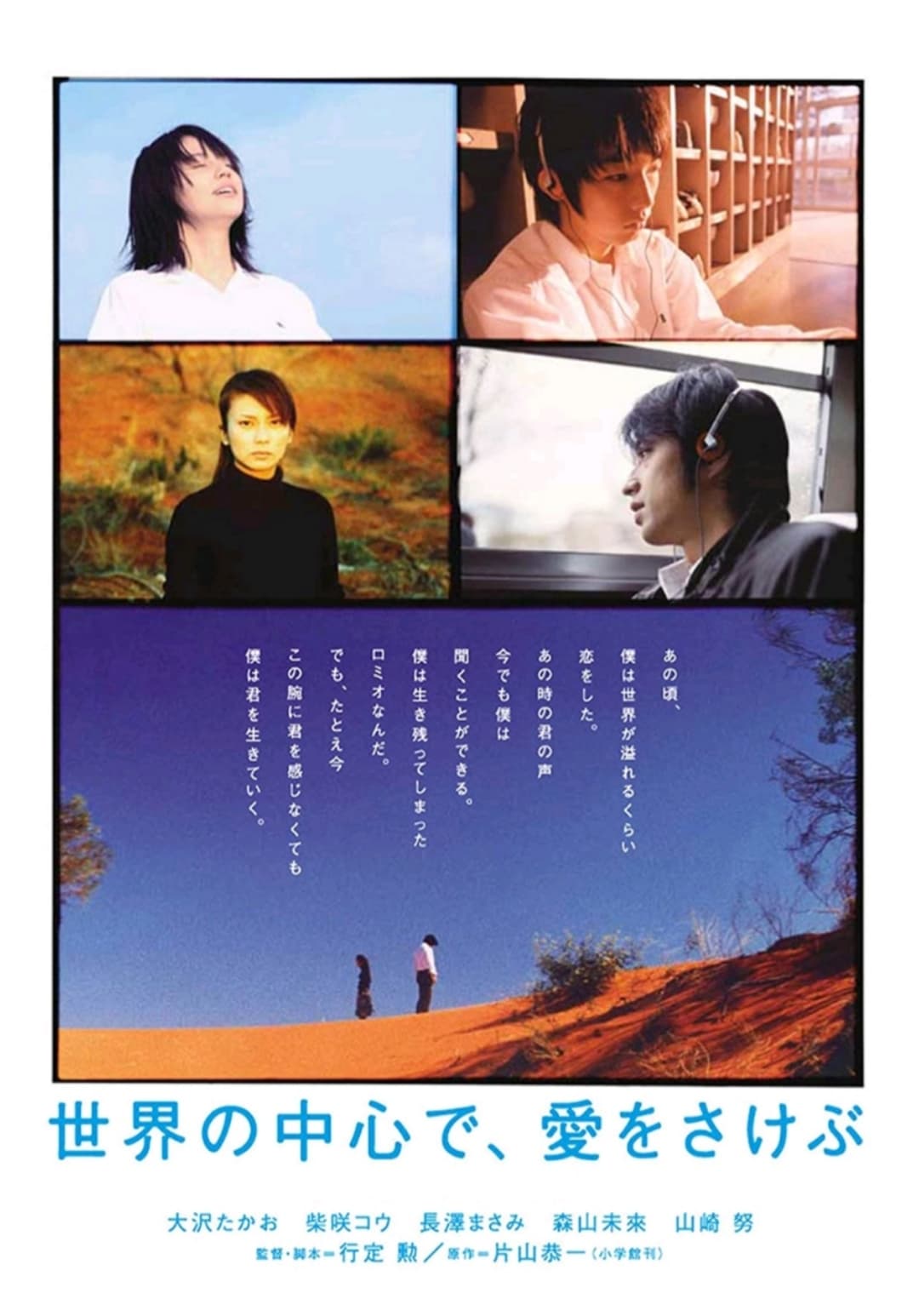
Crying Out Love in the Center of the World
Man follows his fiancée to their hometown after she disappears with an old cassette tape, uncovering recordings from his teenage years that force him to confront memories of an intense first love and the summer that shaped his life.
Crying Out Love in the Center of the World — Plot Summary
The Cassette in the Box
Present day, Tokyo. In a quiet apartment, a woman named Ritsuko opens a forgotten box and discovers an old audio cassette inside. The label is handwritten and faded, hinting at something deeply personal. Curiosity compels her to listen. She realizes the recording is an audio diary made by a teenage girl from years ago.
Without fully understanding why or explaining her actions to anyone, Ritsuko packs the tape and suddenly disappears from Tokyo. She travels to her hometown in Shikoku, drawn by something in the recording she cannot ignore.
Her fiancé, Saku, happens to see Ritsuko on a televised news segment about an approaching typhoon threatening Takamatsu Airport. The brief image on the screen strikes him deeply. Recognizing the location and sensing the emotional weight behind her sudden journey, Saku follows her back to Shikoku—to their shared past.
Returning to his family home as the storm approaches, Saku discovers a box of old cassette tapes tucked away in a closet. As storm clouds gather outside, he begins listening to the recordings. Each tape, made decades earlier when he was a teenager, transports him back to a time of youth, first love, and devastating loss.
Love and Rebellion in 1986
The year 1986. Young Saku attends the funeral of his high school principal. During the solemn ceremony, his eyes meet those of Aki—the school's star track athlete and an admired beauty among their classmates. An unexpected connection forms between them, and a relationship begins to bloom.
Saku's uncle, Shigezou, is an eccentric photographer who confides a secret to his nephew: he had once been the principal's lover. Their relationship had been hidden from the conservative community. At Shigezou's urging, Saku and Aki perform a bold and rebellious act—they steal the principal's ashes from the cemetery to deliver them to Shigezou, allowing him to grieve properly. The shared transgression binds Saku and Aki closer together.
Seeking excitement and wanting to win prizes, Saku and Aki begin writing fabricated letters to a local radio program that shares tragic love stories from listeners. One of their submissions—a story they invented about a girl suffering from leukemia—wins them a Sony Walkman as a prize.
When Aki discovers that Saku made up the tragic leukemia story, she records a chastising message on tape, scolding him for lying about such a serious illness. The confrontation, rather than driving them apart, deepens their bond. They begin a new ritual: exchanging heartfelt cassette tapes filled with their genuine thoughts, dreams, and feelings for each other.
Their adventures together lead them to explore an uninhabited island. There, they find an abandoned camera containing undeveloped film—a mysterious artifact left by an unknown photographer.
Shortly after their island adventure, Aki collapses unexpectedly. She is rushed to the hospital. Saku's carefree world suddenly shifts as he confronts the reality that something is seriously wrong with the girl he loves.
Revelations from the Past
As the typhoon approaches Shikoku in the present day, Ritsuko seeks shelter in Shigezou's old photography studio. While waiting out the storm, she notices a framed photograph on the wall: a wedding photo featuring the young Saku and Aki dressed in formal wedding attire.
Shigezou, sensing Ritsuko's unspoken questions about the photograph and understanding why she has returned, explains that he took the picture shortly before Aki's death years ago.
Back in those final months in 1986, Aki revealed her diagnosis to Saku: she has leukemia—the same disease they had invented in their fake radio story, now cruelly real. Despite the devastating prognosis, Aki is determined to hold onto life and experience as much beauty as possible in the time she has remaining.
Inspired by the mysterious undeveloped film roll they found on the island, Shigezou takes it to be developed. The photos reveal stunning images of Uluru (Ayers Rock) in Australia—the massive red rock formation in the heart of the continent. The striking landscape captures Aki's imagination completely. She becomes fixated on the idea of seeing Uluru in person.
Saku makes a heartfelt promise: they will travel to Uluru together. No matter what happens, he will take her to see the place in those photographs.
With Aki's condition worsening, she asks Shigezou to take a photograph that people will remember her by—something beautiful that will preserve her as she wants to be remembered. Together, Saku, Aki, and Shigezou stage a faux wedding ceremony and photoshoot. Shigezou captures images of the young couple in wedding clothes, preserving their love in photographs.
Aki's health declines rapidly. She loses all her hair from the aggressive treatments. She is moved to a sterile isolation ward to protect her compromised immune system. Despite these devastating physical changes and the grim prognosis, Saku proposes marriage to Aki. Their love remains unshaken by illness.
The Night That Changed Everything
One night, determined to fulfill his promise before it's too late, Saku arrives at Aki's hospital window with a plan to take her to Uluru immediately. However, the airport is closed due to a typhoon—the same meteorological barrier that will later bring Ritsuko back to this place.
Unable to travel and weakened by the stress of the attempted escape, Aki collapses shortly after their failed departure. She is rushed back to intensive care.
Knowing that her time is running out and that she will likely never see Uluru in person, Aki records a final farewell message for Saku on one of their cassette tapes—her last words to the boy she loves.
Aki asks a younger Ritsuko, who was a schoolgirl at the time and knew of their relationship, to deliver the final tape to Saku. Ritsuko accepts this crucial responsibility.
However, tragedy compounds tragedy: while attempting to deliver the tape, young Ritsuko is struck by a car in an accident. The tape is lost or damaged in the incident. Aki's final message never reaches Saku. He never receives her goodbye.
Echoes of Goodbye
Years later, in the present day, Saku sits in the same school building where his story with Aki began. He is surrounded by the cassette tapes he has been listening to, lost in the sound of Aki's voice from decades ago.
Ritsuko arrives quietly at the school. She stands in the doorway watching Saku relive his past through the recordings, but she says nothing. She understands the profound meaning these tapes hold for him—they are all he has left of Aki.
Later, Ritsuko contacts Saku from Shigezou's photography shop. She finally admits the truth that has burdened her for years: she failed to deliver Aki's final message. The tape that was meant to be Aki's goodbye was never given to Saku because of the accident.
Ritsuko leaves the recovered tape behind for Saku at the shop. When Saku finds it and listens, the sound of Aki's voice once more fills the room—this time her final words, recorded knowing she would never see him again. In her message, love and goodbye are intertwined, giving Saku the closure he never received.
Saku confesses to Shigezou that he has never truly moved on from Aki—that for all these years, a part of him has remained in 1986 with the girl he loved and lost. Shigezou, who has observed Saku's grief for decades, offers what comfort he can.
When Saku and Ritsuko reunite at the storm-struck Takamatsu Airport—the same airport that was closed the night Saku tried to take Aki to Uluru—their relationship has fundamentally changed. The grief that Saku carried silently for years now stands acknowledged in the open between them. Ritsuko understands that she has been living with a man who never had the chance to properly say goodbye.
Ashes at Uluru
Together, Saku and Ritsuko travel to Australia—finally making the journey that Saku promised Aki they would take together. They travel to Uluru, the massive red rock formation in the center of the continent that Aki had dreamed of seeing.
The red earth of Uluru welcomes them under the vast open sky of the Australian outback. With Aki's final words still echoing in his memory—her voice preserved on the cassette tape that traveled across decades to reach him—Saku scatters Aki's ashes over the sacred land she had once longed to see.
The journey that began with Ritsuko discovering an old cassette in a forgotten box ends with the fulfillment of a promise made by a teenage boy to a dying girl. Love that was lost has not been forgotten. Instead, it is honored—finally, properly—in the place Aki had dreamed of reaching but never could in life.
Crying Out Love in the Center of the World — Ending Explained
The ending validates Saku's decades-long inability to move forward as genuine love rather than pathological inability to accept loss, with the journey to Uluru representing not moving on but properly honoring what was lost. His scattering of Aki's ashes fulfills the promise that defined their relationship, positioning fidelity to the dead as completion rather than obstacle to future happiness.
Ritsuko's role in facilitating Saku's closure despite being his fiancée demonstrates selfless love that prioritizes his healing over her own needs, though the film leaves ambiguous whether their relationship can survive his finally saying goodbye to Aki. Her discovery of the tape and journey to Shikoku suggests she understood Saku needed to confront his past before he could truly be present in their future together.
The cassette tapes functioning as time capsules preserving Aki's voice creates tangible connection across decades, suggesting that physical artifacts of lost loved ones provide more genuine presence than fading memories. The technology's obsolescence by the present day emphasizes how the past becomes increasingly inaccessible as time passes and the means to access it disappear.
Aki's final message being delivered decades late rather than immediately before her death transforms the closure from expected farewell into unexpected gift, demonstrating that grief processes don't follow timelines and that healing can occur years after loss. Ritsuko's childhood accident preventing delivery suggests that some messages arrive only when recipients are ready to receive them.
The film's conclusion at Uluru rather than in Japan positions the journey to the literal center of the world as necessary pilgrimage to honor transcendent love, with the sacred Aboriginal site serving as appropriate resting place for ashes representing love that defied mortality. Saku and Ritsuko traveling together suggests that honoring the past doesn't require abandoning the present.
Crying Out Love in the Center of the World — FAQ
Is Crying Out Love in the Center of the World based on a true story?
No, the film is based on Kyoichi Katayama's 2001 novel "Socrates in Love" (Sekai no Chūshin de, Ai o Sakebu), which is a work of fiction. However, the novel and film resonated deeply with Japanese audiences, becoming a cultural phenomenon that sparked renewed interest in tragic romance stories and the preservation of memories through analog technology like cassette tapes.
Why are cassette tapes so important to the story?
The cassette tapes serve as physical artifacts preserving Aki's voice and personality across decades, creating a tangible connection to the past that photographs or written letters cannot provide. In Japanese culture of the 1980s, exchanging cassette tapes was a common romantic practice among teenagers, making the medium culturally specific to that era and emphasizing how Saku and Aki's relationship is frozen in that time period.
What is the significance of Uluru (Ayers Rock)?
Uluru is a sacred site for Aboriginal Australians and literally located near the geographic center of Australia, making it symbolically the "center of the world" referenced in the title. For Aki, who will never travel beyond Japan due to her illness, Uluru represents the ultimate unreachable destination—exotic, beautiful, and impossibly distant. Saku's eventual journey there transforms the impossible dream into fulfilled promise.
Why did Ritsuko disappear without telling Saku?
Ritsuko's sudden departure suggests she discovered the tape and understood its significance—that Saku had been carrying unresolved grief throughout their relationship and needed to confront it before they could move forward. Her journey to Shikoku may represent both delivering the tape she failed to deliver as a child and giving Saku the space to properly grieve without her presence complicating his emotions.