Solanin
Stuck in a dead-end Tokyo office job and restless with the life she has drifted into, Meiko begins questioning everything, including the future she shares with her boyfriend Taneda, a part-time illustrator with an unfinished dream, setting both of them on a path neither is fully prepared for.
Solanin — Plot Summary
The Weight of What Comes After
Tokyo hums indifferently around Meiko Inoue. She rides the train to work, files whatever she is handed, answers the phone, and rides home again. Two years have passed since she graduated from university, and each day inside the office feels like wearing clothes that no longer fit. She is not miserable in any dramatic way, which is almost worse. She is simply invisible to herself, performing a version of adulthood that belongs to someone else. Her boyfriend Naruo Taneda occupies a parallel limbo from the apartment they share near the Tama River. He sketches as a freelance illustrator and picks up part-time work, but what he actually is, or wants to be, is a guitarist. He used to play in a university band called Roche alongside his friends Billy and Kato. That version of his life feels like something left in a box he cannot quite bring himself to open.
The Resignation
On a day no different from any other, Meiko quits. The decision is not strategic. It arrives the way small acts of desperation sometimes do, as a reflex dressed up as courage, and by the time she has handed over her notice she is already outside wondering what she has done. The relief and the terror arrive together. Back at the apartment, the freedom feels briefly real. She is done performing the routine. She is also, immediately, without structure or income or clarity about what comes next. Taneda does not push back. He understands something about wanting out, even if he has never quite managed the wanting enough to act on it himself.
What Meiko Sees in Taneda
Living without a job creates a particular kind of exposure. The noise of a working week used to absorb what was unresolved between them. Now there is nothing to absorb it. Meiko watches Taneda and realizes she has been waiting for something from him that he has not delivered, a willingness to want his own life loudly enough to pursue it. He talks about music, always in a soft half-conditional tense, as though the dream is something that happens to other people. Meiko's frustration is not selfish. She loves him precisely because she can see the musician inside him more clearly than he can. After a conversation with Billy that confirms she is not imagining the gap between who Taneda is and how he is living, she goes to him directly. She tells him she wants him to take the band seriously. Not as a hobby, not as a fond memory. She wants him to choose it.
Roche Reconvenes
The conversation unlocks something. Taneda reaches out to Billy and Kato, and Roche reassembles in rehearsal rooms and cramped living spaces. The renewed energy between them is genuine. Taneda writes a new song and names it "Solanin," after the naturally occurring toxin found in nightshade plants and in greening potatoes. The word has a kind of double meaning hovering at its edges: something that grows quietly inside ordinary things and can, under the right conditions, poison them. The band records the song, burns it onto demo CDs, and sends it out to record companies and live houses with the guarded hopefulness of people who know the odds but cannot stop themselves hoping anyway.
The Record Company's Offer
A major label responds. It is the call they needed to believe the work was worth something. The offer, however, is an insult dressed in industry language. The label wants the band to serve as backup musicians for a swimsuit idol, their music reduced to décor for someone else's commercial image. Taneda is still processing the reality of the offer when Meiko answers for both of them and turns it down. She does not hesitate. It is the right decision and also a costly one. For Taneda, the rejection that follows lands differently than if they had never been contacted at all. To be seen, evaluated, and found useful only as furniture, forces him to sit with a possibility he had been avoiding: that talent and sincerity do not guarantee anything. That the path may simply close.
The Boat and the Breaking Point
Something shifts in Taneda that Meiko cannot fully reach. The pressure that has been building between them surfaces during a scene on the water, quiet on the surface but edged with the particular despair of two people who have been talking past each other's real fears. Taneda tells Meiko they should end things. Her expectations, he says, have become too heavy. The conversation falls apart into something messier and more painful than either of them planned. Afterward, Taneda leaves without a clear plan and does not come back for several days. Meiko is left alone in the apartment, cycling through the song "Solanin" on repeat, and realizing as she listens that it sounds less like a rock song and more like a farewell. She cannot tell whether he has abandoned her or gone somewhere to find a way back.
The Call That Ends Too Soon
Taneda finally calls. The conversation is brief and loaded, both of them trying to say something that the format of a phone call is not built to hold. The line cuts out before it resolves. What Taneda was feeling in those last moments belongs to the film's most painful uncertainty: he was moving toward something, perhaps toward home, perhaps toward Meiko, perhaps toward a version of himself that had finally decided. While riding his motorbike, with all of that still unresolved inside him, Taneda accelerates and is killed in a motorcycle accident. His death arrives without announcement or ceremony. The film does not slow down for it. One moment he is in motion and the next the story has a hole in it where he used to be.
The World After
Grief does not organize itself neatly. For Meiko, it comes in waves that are also arguments she can no longer finish. She runs every decision through an inventory of regret: what if she had not quit the job, what if she had said different things on the boat, what if she had never pushed him toward the band at all. The apartment becomes a place full of his absence rather than her life. Billy comes to check on her and finds the degree of her unraveling, sits with it rather than trying to fix it. The shape of her days has no structure anymore, not because she quit her job, but because the person who shared her structure with her is gone.
The Guitar Stays
When Taneda's father arrives to collect his belongings, the transaction threatens to be clinical. Boxes packed, objects distributed, a life converted back into inventory. When Taneda's guitar is about to be discarded, Meiko intervenes. She keeps it. The guitar is not a trophy or a memorial. It is the physical form of everything Taneda wanted and never quite arrived at, the dream that was still in progress when the story cut off. Holding onto it is not the same as refusing to grieve. It is a way of insisting that what he was building had value even incomplete.
Standing in His Place
Meiko asks Billy and Kato to play with her. She will sing and play guitar. She will perform "Solanin" at a live show in the place where Taneda should have stood. The motivation is not to become a musician in her own right or to complete his legacy in any formal sense. It is simpler and more necessary than that. The song exists. He wrote it. Someone has to sing it, and she is the person who loved him, and she is the person who pushed him to make it, and she is the person still standing. The performance is not about talent. It is about witness.
Song: Solanin
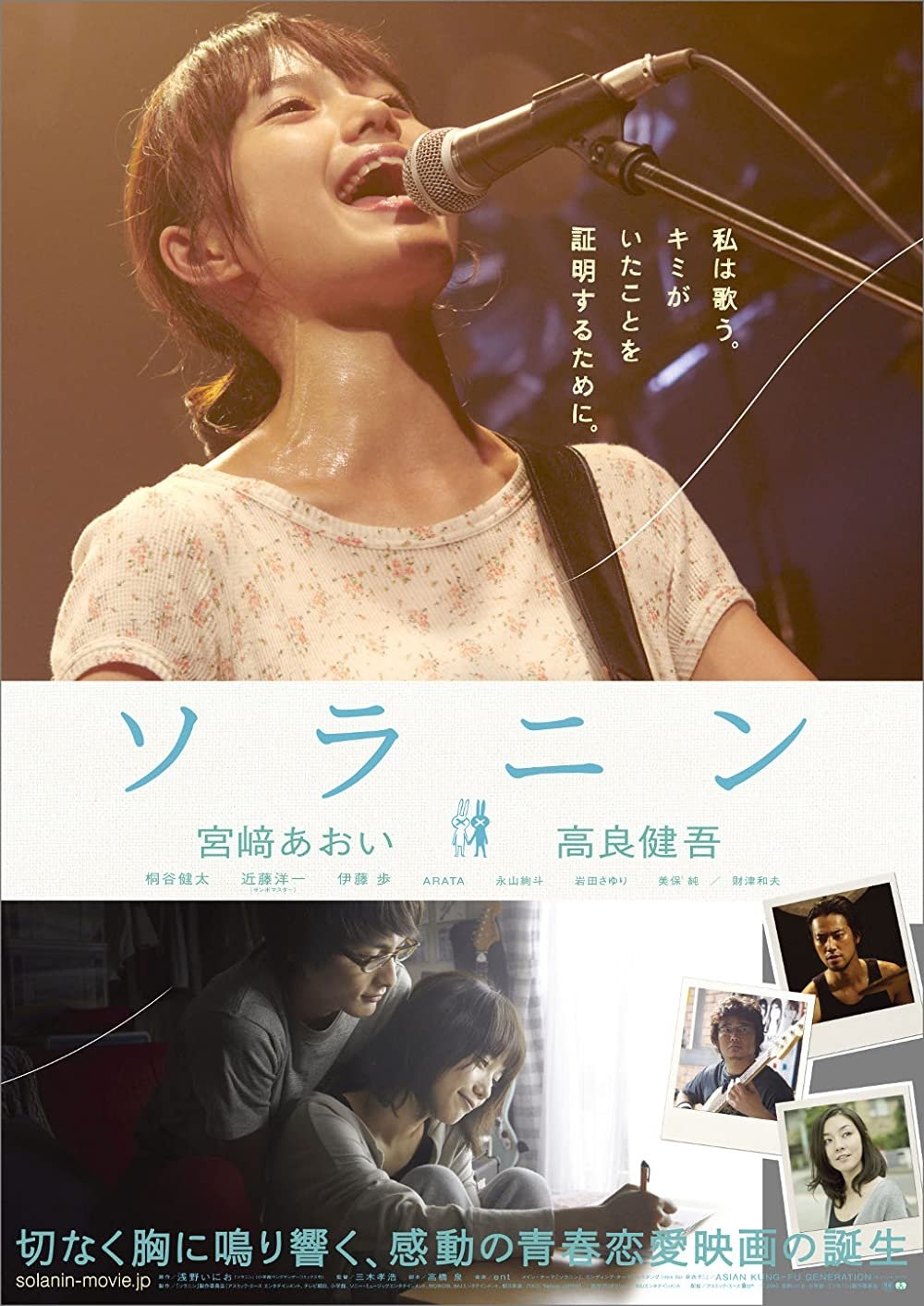
The show happens. Meiko stands at the microphone in a small venue with the band behind her, and she sings the song. It is not a triumphant moment in the way that movie performances often are. There is no crowd ignition, no cinematic swell that converts pain into victory. What happens is smaller and truer. She sings the song that Taneda left behind, and in singing it she does the one thing grief rarely allows: she finishes something. Not his story, which cannot be finished. But the specific, unresolved act of performing the music he cared about in front of people who are there to hear it.
Spring, and the Door
The film ends quietly. Spring arrives in Tokyo, which is not a metaphor so much as a fact the city offers regardless of who has died or how. Meiko begins to prepare to leave the apartment. The guitar remains. The amp remains. The evidence of shared time remains. But Meiko is no longer frozen inside it. She is not healed, and the film makes no argument that she should be. She is simply in motion again, carrying what she carries, stepping out of the space that grief made of the place where she used to live, into whatever comes after, without pretending she knows what it will be.
Solanin — Ending Explained
The ending's central act is a performance, and what makes it devastating is how deliberately it refuses to be redemptive in any conventional sense. The crowd does not erupt. A record deal does not materialize. When she stands at the microphone and sings "Solanin," the film is not arguing that art heals grief or that dreams can be inherited. It is arguing something more precise: that completing an unfinished act of love is itself a form of survival. Meiko performs because Taneda wrote a song, and the song deserves to exist in the world as a sound even in his passing. The performance is her testimony that he was real.
The ending's handling of the guitar carries a weight the film builds toward carefully. When Taneda's belongings are being gathered and the guitar nearly discarded, Meiko's intervention is not theatrical. It is quiet and absolute. The guitar is not a relic or a shrine piece. It is the material remainder of an intention, a dream that was still in process when the accident ended it. By keeping it, and then by learning to play it, Meiko does not preserve Taneda in amber. She extends what he started into her own hands, transforming grief into something that requires skill and effort and presence.
The ending's most uncomfortable insight is about the cost of pushing someone toward their dream. Meiko was the one who confronted Taneda. She was the one who insisted he take music seriously, who turned down the record label offer on his behalf, who created the conditions under which he finally committed to the band. The film never punishes her for this, but it does not look away from the irony either. Taneda was on his motorbike, in an emotionally overwhelmed state, at least in part because the path Meiko helped clear for him had also clarified how much he stood to lose. His death carries her fingerprints not as culpability but as the tragic entanglement of love and agency.
The ending's final images, spring arriving, Meiko preparing to leave the apartment, the equipment staying behind, resist the pull toward either closure or collapse. The film has spent its second half arguing that grief is not a problem to be solved but a condition to be inhabited and gradually moved through. The apartment is not abandoned because Meiko is over Taneda. It is left because remaining stationary inside a space saturated with someone's absence is not the same as honoring them. She takes the memory with her. She takes the guitar. What she leaves behind is the stuck version of herself.
The ending's deepest theme is the one the film shares with its title. Solanine is a toxin that develops in ordinary, familiar things when they are left too long in the wrong conditions. The film has been quietly building an argument that ordinary life, unexamined, uninterrupted, lived only by default, is its own kind of slow poisoning. Taneda and Meiko both felt it, which is why they both quit the things they were doing. The tragedy is not that they tried to find something better. The tragedy is that trying, in the messy real world, does not come with guarantees.
Solanin — FAQ
Is Solanin based on a manga? Yes, the film is a direct adaptation of the two-volume manga series by Inio Asano, serialized in Weekly Young Sunday between 2005 and 2006. The screenplay was written by Izumi Takahashi, and the film is generally regarded as a faithful adaptation of the source material, preserving the manga's emotional texture and its unsparing approach to the collapse of post-university idealism.
What does the title "Solanin" actually mean? Solanine is a naturally occurring toxic compound found in plants from the nightshade family, including potatoes that have been left too long and begun to sprout or green. In the film, the reference surfaces when Meiko's mother sends vegetables that are left to rot in the apartment. The title operates as quiet symbolism: something ordinary that becomes harmful through neglect or the wrong conditions, which maps directly onto the film's portrait of youth slowly poisoned by inertia, compromise, and deferred living.
Did Asian Kung-Fu Generation write the song "Solanin" specifically for the film? The song was written and performed by Asian Kung-Fu Generation with lyrics by Inio Asano, the manga's original creator, and released as a single in 2010 alongside the film. The band also provided the ending theme. Their involvement gives the film's final performance sequence a particular authenticity, as the version of "Solanin" audiences hear carries the texture of a real song from a real band rather than a constructed movie prop.
Why does Taneda speed up before the accident? The film leaves the moment deliberately ambiguous rather than offering a clinical explanation. Taneda has just made an emotionally loaded phone call to Meiko that was cut short before resolution. He is in a state of overwhelm, caught between the failure of the band's prospects and the larger question of what his life is for. Whether the acceleration was intentional, impulsive, or simply the physical expression of emotional turbulence is never confirmed. The ambiguity is the point: it cannot be categorized neatly as accident or choice, and the film refuses to let either reading fully settle.