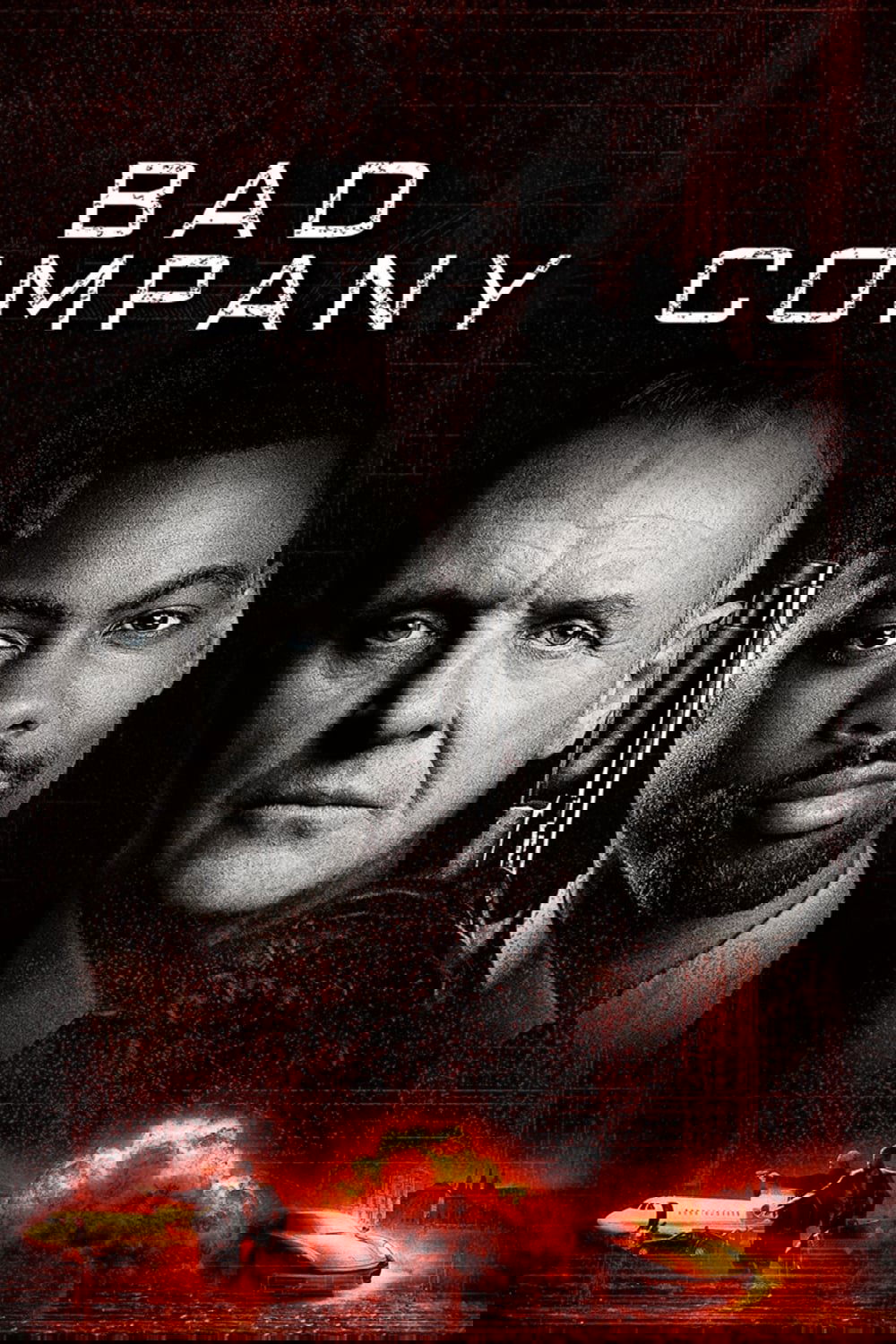
Bad Company
When a decorated CIA operative is killed mid-mission in Eastern Europe, his handlers discover he has a twin brother, a fast-talking Jersey City hustler with no training and even less patience, forcing the agency to recruit him as a stand-in and race against a ticking clock to complete a dangerous nuclear arms deal before rival terrorists can detonate a catastrophic weapon in the heart of New York City.
Bad Company — Plot Summary
The Dead Man in Prague
The cobblestone streets of Prague have seen their share of quiet betrayals, and this one is no different. CIA operative Kevin Pope moves through the city under the alias Michael Turner, posing as a high-end antiquities dealer with taste refined enough to fool anyone. He's spent two years building trust with Adrik Vas, a former Russian Army colonel turned black market arms merchant with connections deep inside the Russian mafia. The prize at the end of this long con is a suitcase-sized nuclear device, portable enough to vanish into a crowd and devastating enough to level a city block. Pope has arranged the terms: thirty million dollars, a down payment already delivered, a burner phone in hand, and ten days until final pickup.
But someone else wants that bomb. As Pope and his CIA handler Gaylord Oakes leave the meeting, rival buyers move on them in the street. Pope dies shielding Oakes from the ambush, shot dead before the ink on the deal has time to dry. Oakes survives. The mission does not.
The Hustler from Jersey City
Across the Atlantic, Jake Hayes has no idea any of this is happening. He runs chess hustles in the park, scalps concert tickets outside venues in Jersey City, and bounces between odd jobs that barely keep the lights on. He is quick-witted, loud, and completely unpolished, a man who has spent his whole life improvising because the alternative was giving up. His girlfriend Julie has run out of patience. She's moving to Seattle, and unless Jake can show her something resembling a future, she's leaving without him.
What Jake does not know is that he was separated at birth from a twin brother. Their mother died during delivery, and infant Jake developed a severe lung infection so dire that doctors split the boys up, assuming he wouldn't survive. He did survive, but without a family, without money, and without any knowledge that somewhere out there a mirror image of himself was earning a Harvard degree and running covert operations for the Central Intelligence Agency.
The Recruitment
The CIA finds Jake through the kind of bureaucratic accident that only works in movies. His face is identical to Kevin's. His fingerprints, his DNA, his voice cadence when he's relaxed enough not to put on a show. Oakes recognizes the opportunity immediately. Vas and his people never knew Kevin's real identity. As far as they're aware, Michael Turner is still breathing. If Jake can be trained to pass as his dead brother, the mission can continue.
The pitch to Jake is not subtle. CIA officers descend on him in the middle of a chess hustle and pull him into a world he's never imagined. Oakes, steely and unreadable, tells Jake the bare minimum: show up, follow instructions, and walk away with enough money to marry Julie and give her the life she's been waiting for. What Oakes leaves out, under pressure from his superiors, is how genuinely dangerous all of this is.
Nine Days to Be Someone Else
The training sequence that follows is where the film finds its rhythm. Jake is transplanted into Kevin's immaculate Manhattan apartment, surrounded by classical music, a wardrobe of tailored suits, and CIA tutors who want him to learn basic Czech from a paperback dictionary and identify cognac vintages by smell. Jake finds none of this amusing, and the gap between who Kevin was and who Jake is stretches wide enough to drive a truck through.
Oakes watches all of it with barely contained frustration. He's a man who has spent decades operating in the world's most dangerous rooms, and now his mission rests on a ticket scalper who can't sit still. But something unexpected surfaces during those nine days. Jake is sharp. Stubborn, chaotic, and allergic to authority, but genuinely sharp. His street instincts are not the liability his handlers assume they are. When assassins connected to the rival organization track the scent of Kevin's alias to the Manhattan apartment, Jake escapes through a bedroom window on pure reflex, no training required.
The near miss rattles him badly enough that he tries to walk away entirely, retreating to the home of his foster mother. Oakes finds him there and makes a more honest case than the CIA brass would prefer. Jake agrees to see it through.
Michael Turner Lives Again
Prague wraps Jake in Old World grandeur he has no framework for. The hotel suite alone is worth more than everything he has ever owned. He wears the suit, he answers to Michael Turner, and he holds himself together long enough to sit across from Adrik Vas and play the part. Vas, a man who respects performance and understands that men reveal themselves under pressure, seems satisfied.
The situation grows complicated when Kevin's ex-girlfriend Nicole arrives at the hotel. She works as a CNN correspondent covering the Balkans and knew Kevin intimately. Believing she's looking at the man she loved, she joins Jake for dinner and returns to his suite that night. The deception doesn't hold. Nicole has spent enough time with Kevin to notice the small tells, the way Jake moves, what he reaches for, how he responds to her. She puts the pieces together, keeps it to herself, and slips back to her assignment without blowing his cover. It's a grace he doesn't deserve, and he knows it.
The Double Cross
With Oakes positioned as the money man, Jake and the CIA move to close the deal with Vas. The negotiation goes well enough that they manage to lift the arming codes from Vas's operation, leaving the bomb technically inert. Then the structure falls apart all at once.
Vas's men, working in coordination with the rival buyer, a multi-national terrorist organization led by a brutal operator named Dragan Ađanić, spring the trap the moment the transaction closes. The deal becomes a double cross, then a triple cross, moving too fast for anyone to get their footing. Ađanić's organization seizes the bomb. When they realize the arming codes are missing, their leverage calculation shifts immediately. They take Julie.
She has flown to Prague to find Jake, alarmed by his sudden disappearance and the growing sense that something is wrong. Her timing is catastrophic. The terrorists use her as the pressure point to get the codes back, and Jake, who would rather save her than win, gives himself up to get to her. The codes change hands. The bomb becomes operational.
Race to Grand Central
What follows is a race conducted across multiple continents on a brutal clock. Oakes, working with the CIA's field team including agents Seale, Swanson, and the rest of the operation's skeleton crew, tracks the movement of the bomb as Ađanić's people smuggle it into the United States. The destination turns out to be Grand Central Station, New York City, a target chosen for its density and its symbolism.
The decision to bring a nuclear device through international air freight with a quick line of dialogue is the film's most conspicuous shortcut, but the tension of the chase papers over it well enough. Oakes's people pull location intelligence from a captured terrorist and converge on the station.
The Final Code
Grand Central is chaos contained only by the narrow tunnel vision of people who know how to function inside it. Oakes cuts through two of Ađanić's men to reach Jake as the countdown is already running. Jake gets his hands on the bomb's access panel. And then Ađanić resurfaces with Julie.
There is a beat here where Jake has to choose between the code and his girlfriend, and the film understands that the answer was never really in question. He pretends to shoot Oakes as a distraction, which is either the most reckless thing anyone has ever done during a live nuclear countdown or the most inspired, depending on how you feel about improvisation under fire. Ađanić is shot repeatedly in the chaos. Jake enters the final sequence of digits and kills the timer with seconds to spare.
After the Bomb
The dust settles in ways both solemn and unexpectedly warm. Jake visits the CIA's memorial wall, where Kevin Pope's name has been added to the roster of agents who died without recognition. He stands there long enough to understand something about the brother he never knew, the parallel life that was always running alongside his own.
Later, at Jake and Julie's wedding, Oakes appears at the reception. He pulls Jake aside with the casual gravity of a man delivering bad news and tells him a dangerous criminal connected to Kevin's old cover identity has escaped prison and is coming for Michael Turner. Jake goes pale. Then Oakes smiles, and the whole thing dissolves into a joke. He came for the wedding. Nothing more. The two men, who spent the better part of three weeks barely tolerating each other, share a moment that doesn't need a name. Oakes leaves, and Jake goes back to his new wife.
Bad Company — Ending Explained
The ending of Bad Company works on two registers simultaneously, and the film earns the lighter of the two more honestly than the heavier one. The bomb defusal at Grand Central is a set piece the genre has deployed a hundred times, but what gives it a flicker of something real is that the key variable isn't training or expertise. It's Jake's willingness to fake-shoot the man who has been his reluctant guardian for nine days, trusting that Oakes will understand the move in real time and play along. That small trust, improvised under the worst possible pressure, is the clearest expression of what their odd partnership has actually become.
The ending's treatment of Jake's grief is the film's most understated beat. His visit to the CIA memorial wall sits completely apart from the action that surrounds it. He stands in front of a name he only learned existed weeks ago, and the film doesn't editorialize. There is no swelling score, no monologue. Jake simply absorbs the fact of a life lived in parallel to his own, a brother who was educated and refined and cautious in all the ways Jake is not, and who still died trying to protect someone. The film suggests, quietly, that the distance between Kevin and Jake was always more circumstance than character.
The ending's final joke, Oakes's fabricated warning about a vengeful criminal, is doing more work than a comedy button typically does. Throughout the film, Oakes has maintained professional distance from Jake with a rigidity that reads as contempt. He shows up to the wedding not because protocol demands it, and not because Jake has become an asset worth monitoring. He shows up because something genuine passed between them, and the joke is the only language he has for saying so. A man like Oakes does not do warmth directly. He does it in the shape of a prank that costs nothing and says everything.
The ending's broader thematic statement is about identity as something lived rather than assigned. Jake spent the entire film pretending to be Kevin Pope, and by the end he has become neither Kevin nor the version of himself that preceded Prague. He is someone new, someone who has seen what discipline and stakes look like from the inside, and who chose to stay in the room when the room got dangerous. The wedding that closes the film is not just a happy ending. It is evidence of a different kind of man than the one hustling chess games in Jersey City at the start.
Bad Company — FAQ
Was the suitcase nuclear bomb plot based on real technology?
The suitcase bomb, sometimes called an SADM (Special Atomic Demolition Munition), was a real class of device developed during the Cold War by both the United States and the Soviet Union. These portable nuclear devices were designed for battlefield use and demolition of strategic targets. The concept of black-market post-Soviet weapons falling into terrorist hands was a genuine security concern throughout the 1990s and early 2000s, which made the film's central threat feel more grounded than purely fictional at the time of its release.
Why was the film's release delayed from Christmas 2001 to June 2002?
Bad Company was originally scheduled for a Christmas Day 2001 release, but the September 11 attacks prompted Touchstone Pictures to push it to the following summer. The film's plot, written years before the attacks, centers on a terrorist plan to detonate a nuclear device in New York City, and its connections to the real tragedy went further still. It was one of the last major productions to film inside the original World Trade Center, using the building for several scenes. Releasing a film about a mass-casualty terror plot in Manhattan just months after 9/11 was considered inappropriate, and it joined several other films that year in delaying release for the same reason.
Why did Oakes keep Jake in the dark about how dangerous the mission was?
This was a deliberate call from the CIA's Deputy Director Yates, not from Oakes himself. The agency's position was that full disclosure would cause Jake to refuse the mission, and they needed his cooperation too badly to risk honesty. Oakes, who has more of a conscience than his superiors, eventually acknowledges to Jake directly that withholding that information was a mistake. The tension between institutional deception and personal accountability runs through their dynamic for most of the film, and Oakes's candid admission is part of what shifts Jake from reluctant recruit to someone who actually chooses to stay.
Did Jake and Kevin ever meet or know about each other before the film's events?
No. The two brothers were separated at birth after their mother died during delivery. Jake suffered a severe lung infection as a newborn, and doctors, believing he was unlikely to survive, separated the twins and placed them into different circumstances. Kevin was ultimately adopted into a more privileged environment that led to his Harvard education and CIA career, while Jake grew up in foster care in New Jersey. Neither brother had any awareness of the other until the CIA showed Jake a photograph of Kevin's face and watched him stare at his own reflection.