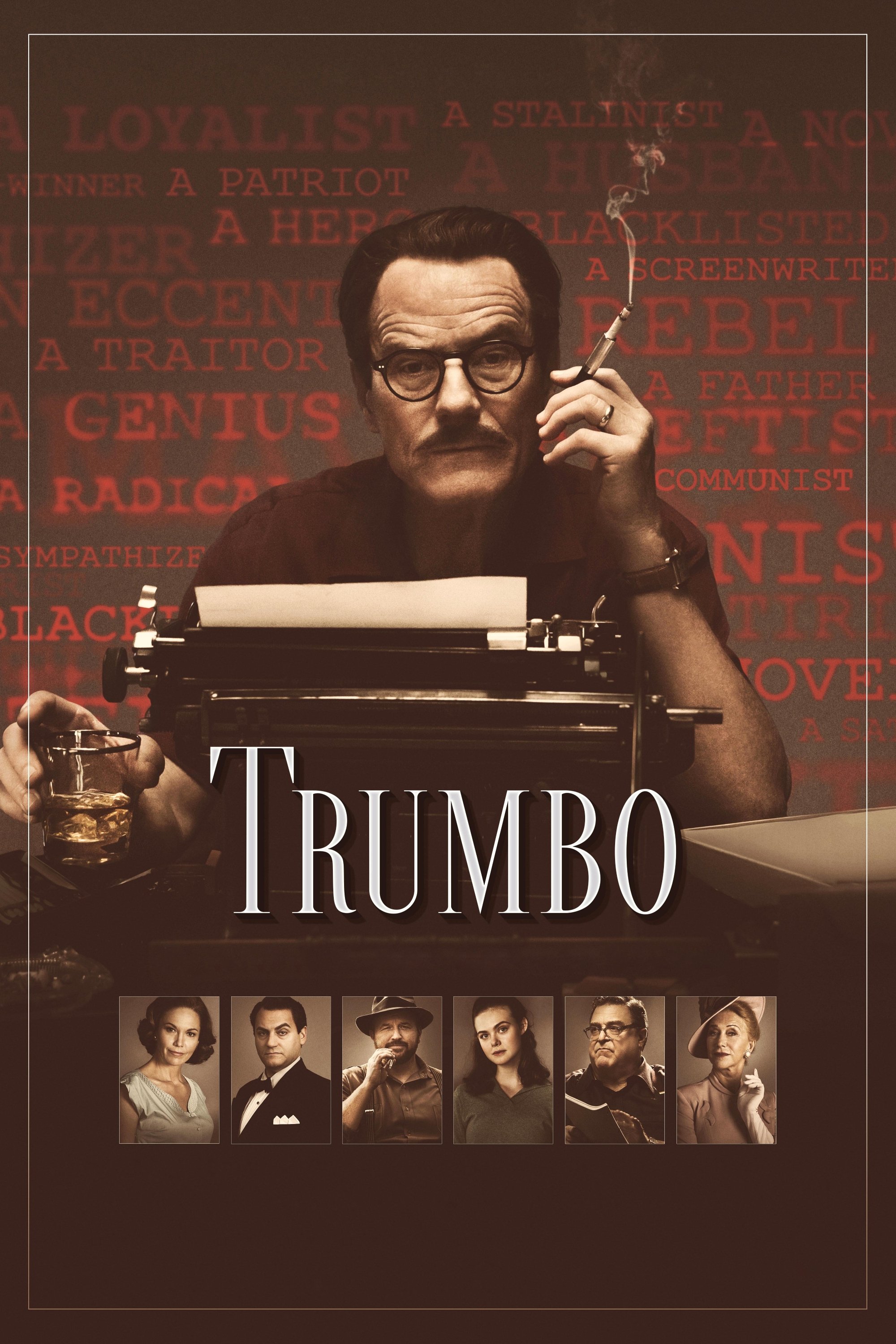
Trumbo
In Hollywood’s golden age, a successful screenwriter faces professional exile during a controversial political crackdown. Refusing to remain silent, he continues creating stories under difficult circumstances, challenging the limits of artistic freedom and perseverance.
Trumbo — Plot Summary
Hollywood Elite
Late 1940s Hollywood. Dalton Trumbo is a successful screenwriter whose exceptional talent places him among the entertainment industry's elite. He commands high fees and works on prestigious projects, enjoying the financial rewards and social status that come with being a top Hollywood writer.
However, Trumbo's membership in the Communist Party of the USA creates powerful enemies. Staunchly anti-Soviet figures in the entertainment industry, including influential columnist Hedda Hopper and actor John Wayne, view Trumbo and other communist party members with contempt. During the early Cold War period, communist affiliation is seen as equivalent to supporting America's enemy, and these anti-communist figures wield their influence to punish those with leftist political associations.
HUAC Investigation
Trumbo is one of ten screenwriters subpoenaed to testify before the House Committee on Un-American Activities (HUAC). The congressional committee is investigating alleged Communist propaganda infiltrating Hollywood films. The committee demands that witnesses name other communists working in the entertainment industry, effectively asking people to inform on their colleagues and friends.
The ten screenwriters—who become known as the "Hollywood Ten"—refuse to answer questions directly about their political affiliations or to name others. They invoke their constitutional rights, confident that the Supreme Court's liberal majority will eventually overturn any contempt of Congress convictions resulting from their refusal to cooperate with the committee.
Trumbo's friend, actor Edward G. Robinson, supports the Hollywood Ten's cause. To raise money for their legal defense fund, Robinson makes a personal sacrifice by selling Vincent van Gogh's 1887 painting "Portrait of Père Tanguy" from his art collection—a valuable and personally meaningful work.
The Hollywood Ten's legal strategy collapses when two Supreme Court justices—Wiley Rutledge and Frank Murphy—die unexpectedly. These deaths shift the Court's ideological balance, ruining Trumbo's plan to appeal the contempt convictions. Without the expected liberal majority, the convictions stand.
Prison
In 1950, Trumbo is sentenced to serve eleven months in the Federal Correctional Institution in Ashland, Kentucky, for contempt of Congress. The imprisonment marks his transformation from respected Hollywood elite to convicted criminal, fundamentally altering his life and career prospects.
Blacklist
As Trumbo serves his sentence, the Hollywood Blacklist expands dramatically. The Blacklist is an informal agreement among studio executives, producers, and industry leaders to deny employment to anyone suspected of communist sympathies or who refuses to cooperate with HUAC investigations. The Blacklist grows to exclude hundreds of writers, directors, actors, and other entertainment professionals from working in their chosen field.
Friends and colleagues who previously supported Trumbo and the Hollywood Ten now abandon them to protect their own careers. Edward G. Robinson, despite his earlier financial support, publicly disavows his communist friends. Producer Buddy Ross similarly distances himself. These betrayals demonstrate that professional survival in Hollywood requires denouncing former allies and principles.
Trumbo is released from prison but remains blacklisted. No studio will hire him under his own name. His finances become increasingly strained without his previous high income. Family life suffers under the financial pressure and the social stigma of his conviction and blacklisting.
Pseudonymous Work
Unable to work under his own name, Trumbo develops a strategy for surviving the Blacklist. He writes the screenplay for "Roman Holiday" but gives it to his friend Ian McLellan Hunter to submit under Hunter's name. Hunter takes credit for the screenplay, receives payment that he shares with Trumbo, and eventually wins the Academy Award for Best Story—an Oscar that rightfully belongs to Trumbo but which he cannot claim without exposing his continued work in the industry.
Trumbo sells his idyllic lakeside home—a symbol of his previous success—and moves his family to a more modest house in the city. He begins working as a pseudonymous screenwriter for King Brothers Productions, a low-budget film company willing to use blacklisted talent if they work under false names. To increase his output and income, Trumbo also farms out B-movie screenplay assignments to other blacklisted writers, creating a underground network of hidden talent working under assumed names.
Trumbo's financial desperation forces him to transform his home into a screenplay factory. He puts his wife Cleo and their teenage children to work as his support staff—typing scripts, managing correspondence, and handling logistics. The arrangement adds to domestic conflict as family time disappears under the pressure of producing numerous scripts to replace his lost high-paying work.
King Brothers produces "The Brave One," an original story written by Trumbo under a pseudonym. The film receives an Academy Award, but again Trumbo cannot publicly claim the Oscar without revealing his continued work and ending his ability to earn income under false names.
Deaths and Intimidation
Arlen Hird, one of Trumbo's blacklisted friends, dies from cancer. Hird dies destitute, having been unable to work in his profession for years due to the Blacklist. His death illustrates the human cost of the Blacklist beyond lost careers—some blacklisted individuals died in poverty, their talents wasted and their families destroyed.
Hedda Hopper and her allies attempt to intimidate the head of King Brothers into firing Trumbo, even though he works under pseudonyms. However, the intimidation attempt fails completely—King Brothers continues employing Trumbo because his screenplays are profitable regardless of his political past.
Industry insiders begin suspecting that Trumbo is ghostwriting screenplays despite his blacklisted status. However, Trumbo is careful never to confirm these suspicions, maintaining plausible deniability that allows him to continue working.
Breaking the Blacklist
By 1960, Trumbo's reputation as a talented screenwriter—even hidden behind pseudonyms—leads to opportunities that will break the Blacklist's power. Actor Kirk Douglas recruits Trumbo to write the screenplay for "Spartacus," an epic film about a slave rebellion in ancient Rome. Separately, director Otto Preminger recruits Trumbo to write the screenplay for "Exodus," a film about the founding of Israel.
Both Douglas and Preminger make the courageous decision to publicly credit Trumbo as the screenwriter using his real name, directly defying the Blacklist. Hedda Hopper makes futile efforts to intimidate Kirk Douglas into dropping Trumbo from the project, but Douglas refuses to back down.
The public crediting of a blacklisted writer on two major Hollywood productions shatters the informal agreement that had sustained the Blacklist. By early 1961, the Blacklist's effectiveness has been broken to the point where newly inaugurated President John F. Kennedy publicly endorses "Spartacus" by attending a screening. The presidential endorsement provides political cover for studios and filmmakers to begin hiring blacklisted talent again.
Trumbo and other blacklisted writers are able to begin rebuilding their careers under their own names after more than a decade of exile from open participation in Hollywood.
Reflection
Ten years after the Blacklist's collapse, Trumbo—finally receiving proper recognition from Hollywood—gives a speech reflecting on the Blacklist era. He speaks about how the Blacklist victimized everyone involved: those who stood by their principles lost their jobs, careers, and in some cases their lives, suffering poverty and early death; those who compromised their principles to keep working lost their integrity and lived with the guilt of betraying friends and colleagues.
Trumbo's reflection suggests that the Blacklist created only victims—there were no winners, only people who lost different things. Some lost their livelihoods, while others lost their moral standing, but everyone involved in the Blacklist era was diminished by it.
Trumbo — Ending Explained
The ending validates Trumbo's decade-long resistance to the Blacklist while acknowledging that fighting injustice carries enormous personal costs that "winning" does not fully compensate. Trumbo's ability to rebuild his career demonstrates that principled resistance can eventually succeed, but his speech recognizing all participants as victims suggests that the damage inflicted during the Blacklist years—financial ruin, broken relationships, early deaths, betrayed friendships—cannot be undone by later vindication.
President Kennedy's endorsement of "Spartacus" represents institutional validation that what was once considered dangerous subversion is now recognized as acceptable political expression, demonstrating how quickly political persecution can be forgotten by those who did not suffer it. The presidential attendance frames the Blacklist's end not as acknowledging injustice but as simply moving past an unfortunate period, avoiding accountability for those who implemented and benefited from it.
The film's conclusion that the Blacklist created only victims complicates simplistic hero-villain narratives by recognizing that those who informed or betrayed colleagues often did so under enormous pressure, though this recognition does not excuse their choices. Trumbo's nuanced view suggests that while individuals must take responsibility for compromising principles, the system that forced such choices deserves primary condemnation.
Trumbo receiving recognition "ten years later" emphasizes how long actual rehabilitation took even after the Blacklist officially ended—being allowed to work again is not the same as recovering lost decade, repaying destroyed finances, or healing broken families. The time gap between the Blacklist's collapse and proper recognition illustrates that injustice's effects persist long after formal discrimination ends.
The ending ultimately argues that political persecution damages entire communities rather than just targeted individuals, and that defending constitutional principles requires willingness to sacrifice career and security with no guarantee of eventual vindication. Trumbo's story demonstrates both the possibility and cost of principled resistance to institutional injustice.
Trumbo — FAQ
Who were the Hollywood Ten?
The Hollywood Ten were screenwriters and directors subpoenaed by the House Committee on Un-American Activities in 1947 who refused to answer questions about their political affiliations or name others as communists. Besides Dalton Trumbo, they included Alvah Bessie, Herbert Biberman, Lester Cole, Edward Dmytryk, Ring Lardner Jr., John Howard Lawson, Albert Maltz, Samuel Ornitz, and Adrian Scott. All were convicted of contempt of Congress, served prison sentences, and were blacklisted from Hollywood.
Did Trumbo really win Academy Awards he couldn't claim?
Yes. Trumbo wrote "Roman Holiday" (1953) under Ian McLellan Hunter's name, with Hunter winning the Oscar for Best Story. Trumbo also wrote "The Brave One" (1956) under the pseudonym "Robert Rich," which won the Oscar for Best Story with no one claiming the award. The Academy officially credited both Oscars to Trumbo posthumously—"Roman Holiday" in 1993 and "The Brave One" in 1975.
How many people were actually blacklisted?
Estimates vary, but approximately 300-500 entertainment industry professionals were formally blacklisted, unable to work under their own names. However, the chilling effect was much broader—many more people informed on colleagues, compromised their principles, or left the industry voluntarily to avoid persecution. The Blacklist effectively controlled Hollywood hiring from roughly 1947 to 1960.
What happened to Hedda Hopper?
Hedda Hopper continued her gossip column and her anti-communist activism throughout the 1950s and 1960s, never facing professional consequences for her role in the Blacklist. She died in 1966, remaining a powerful Hollywood figure until her death. Unlike the blacklisted writers, Hopper faced no accountability for using her platform to destroy careers and families.