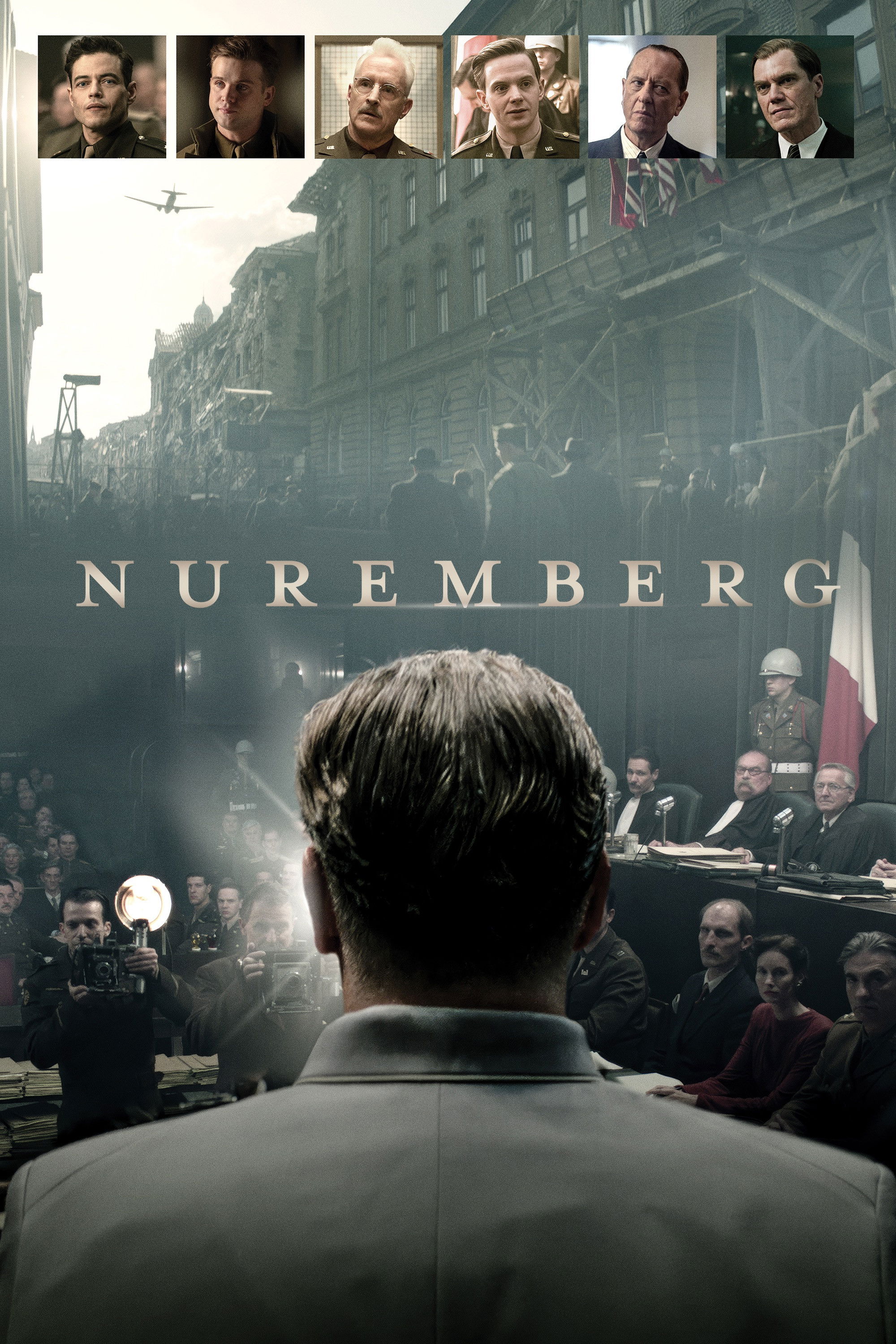
Nuremberg
2025A U.S. Army psychiatrist evaluates Nazi leaders including Hermann Göring at the Nuremberg trials, developing a dangerous rapport with prisoners while prosecutors establish unprecedented international war crimes precedent, culminating in executions, suicide, and lasting trauma that shapes his fate.



Nuremberg Plot Summary
Surrender and Ambition
May 8, 1945. One day after Nazi Germany’s surrender to the Allied forces, Reichsmarshall Hermann Göring, Adolf Hitler’s former second-in-command, surrenders to U.S. forces in Austria along with his family. Göring represents the highest-ranking Nazi official captured alive, making his arrest a significant moment for the victorious Allies.
At the same time, Associate Justice Robert Jackson receives news of Göring’s arrest. The information prompts an important discussion with his secretary, Elsie Douglas, about establishing an international tribunal to charge surviving Nazi leadership with war crimes. Douglas takes a conservative position, noting that such action has no legally-established international precedent. No court has ever prosecuted leaders of a sovereign nation for crimes committed during wartime. However, Jackson views this lack of precedent not as an obstacle but as an opportunity to establish one, creating a foundation for international justice.
Initially, the United States government shows reluctance to support Jackson’s ambitious plans. Many officials favor summary executions—simply shooting the Nazi leaders and avoiding complicated legal proceedings. Jackson persists in advocating for a proper trial, ultimately winning crucial support from Pope Pius XII by implying his knowledge of the Pope’s controversial relationship with the Nazi regime during the war years.
Psychiatric Evaluation
Elsewhere in Europe, U.S. Army psychiatrist Lieutenant Colonel Douglas Kelley receives orders to report to Bad Mondorf, Luxembourg. His assignment is evaluating the mental health of twenty-two Nazi leaders currently held under Allied custody, including Göring. These prisoners have been selected for prosecution at the forthcoming trial.
Kelley reports to the facility’s warden, Colonel Burton Andrus, and begins his psychiatric evaluations with assistance from interpreter Sergeant Howard Triest. Initial meetings with Göring proceed civilly. Kelley finds Göring intelligent and articulate, though highly narcissistic. Other prisoners respond with less civility—Robert Ley and Julius Streicher react to Kelley with open contempt.
Kelley recognizes the professional opportunity his unique access to these historical figures represents. He plans to use his detailed notes from psychiatric sessions to write a tell-all book after the trial, anticipating significant personal profit from publishing insider accounts of the Nazi leadership’s psychology.
The Tribunal Begins
In due course, Jackson and British barrister Sir David Maxwell Fyfe are appointed as prosecuting counsels for the newly-established International Military Tribunal in Nuremberg, Germany. The tribunal formally charges the detained Nazi officials with crimes against peace, war crimes, crimes against humanity, and conspiracy—sweeping charges that encompass the entirety of Nazi aggression and atrocities.
During the lead-up to trial, Kelley and Göring develop an unexpectedly warm relationship. Göring assists Kelley in examining former Deputy Führer Rudolf Hess, whose mental state presents particular challenges. In exchange, Kelley arranges for Göring to write letters to his wife Emmy and daughter Edda. Kelley develops rapport with Göring’s family as well, acting as a courier delivering messages between the imprisoned Reichsmarshall and his loved ones.
Privately, Jackson approaches Kelley with a request that crosses ethical boundaries. He asks the psychiatrist to report the prisoners’ legal defense strategies, allowing prosecutors to shape their case accordingly. Kelley agrees, compromising his professional neutrality.
Before the trial officially commences, Robert Ley commits suicide in his cell by strangling himself. The death prompts Andrus to summon psychologist Gustave Gilbert to provide a second psychiatric opinion, creating professional tension with Kelley.
Trial and Revelation
At the trial’s opening, Jackson delivers a powerful statement highlighting the necessity of accountability for unprecedented crimes. Göring, accustomed to commanding attention, is silenced by the tribunal and ordered simply to enter his plea. He and the other prisoners all plead not guilty.
During trial adjournments, Kelley learns that Göring’s family has been arrested in connection with reported art thefts—valuable paintings and cultural treasures Göring stole throughout occupied Europe. Kelley requests that Andrus intervene on their behalf. Göring later learns of this development from Gilbert rather than from Kelley directly.
When the trial reconvenes, the prosecution presents filmed evidence from Nazi concentration camps. The footage displays the regime’s systematic atrocities—mass graves, emaciated survivors, gas chambers, and crematoria. The evidence is undeniable and devastating.
An upset Kelley confronts Göring, who had previously denied any knowledge of such actions during their psychiatric sessions. Göring maintains his claimed unawareness and resorts to denying the atrocities’ full extent or attempting to compare them with alleged crimes committed by Allied forces. His deflections and moral equivalencies dismay Kelley, who had developed personal regard for Göring despite knowing intellectually what the Nazi regime represented.
Betrayal and Redemption
Dismayed by Göring’s denials, Kelley gets drunk and unwittingly reveals details of his private psychiatric discussions with Göring to Lila, a journalist with The Boston Globe. She publishes the information, creating a scandal. Psychiatrist-patient confidentiality, even for war criminals, has been violated publicly.
Andrus, infuriated by this breach, relieves Kelley of his duties and orders him out of Nuremberg. Before Kelley departs, Andrus reveals that he successfully intervened to secure the release of Emmy and Edda Göring from arrest.
As Kelley prepares to leave, Triest reveals personal information he had kept private throughout their work together. He is a German-born Jew whose younger sister escaped to Switzerland but whose parents were executed by the Nazis in 1942. Triest warns Kelley that the Nazi regime’s cruelty went unchallenged for so long because of general impassivity toward evil—people looked away or convinced themselves it wasn’t happening.
Triest’s revelation and warning compel Kelley to reconsider his departure. Instead of leaving in disgrace, he chooses to stay and submits all his private psychiatric notes on Göring to Jackson and Fyfe. He predicts that Göring plans to use the trial as a platform to defend the Nazi regime’s conduct rather than accept accountability.
Cross-Examination
Kelley’s predictions prove accurate. During Jackson’s cross-examination, Göring skillfully evades questions and controls the narrative. He declares that his decree regarding the Final Solution was actually intended as a complete solution focused on emigrating Germany’s Jews rather than exterminating them—a brazen rewriting of documented genocide.
Jackson’s visible anger toward Göring’s lies earns him a stern rebuke from the tribunal judges, who demand professional decorum. The setback prompts Fyfe to take over the cross-examination.
Fyfe employs different tactics, exploiting Göring’s narcissism and vanity. He goads Göring into overtly admitting his continued loyalty to Hitler and the Nazi regime, finally cornering him into statements that undermine his defense. At the trial’s conclusion, the tribunal sentences Göring to death by hanging.
Final Acts
Kelley pays Göring a final visit before departing Nuremberg. During this last meeting, Kelley comes to terms with Göring’s true nature—recognizing that the intelligent, charismatic man he interviewed was also a mass murderer and architect of genocide.
On October 15, 1946, the night before his scheduled execution, Göring commits suicide by ingesting cyanide he had somehow concealed throughout his imprisonment. The suicide enrages Andrus, whose security measures failed to prevent it.
The remaining executions proceed as scheduled. Julius Streicher suffers a nervous breakdown before his hanging. Triest, who had yearned to reveal his Jewish heritage to Streicher before the execution, finds himself instead compelled to gently assist the terrified man to the gallows. The execution proceeds poorly—Streicher must be weighed down on the noose to die, creating a gruesome spectacle.
Aftermath
Kelley, traumatized by his experiences at Nuremberg, returns to the United States and publishes his tell-all book, “22 Cells in Nuremberg.” However, he struggles to promote the work effectively. He descends into alcoholism and spends the rest of his life warning about the possibility of a future regime parallel to the Nazis—warnings largely ignored by a society eager to move past wartime trauma.
In 1958, twelve years after Göring’s suicide, Kelley commits suicide himself by ingesting cyanide, mirroring the method used by the man he had studied so closely.
Triest manages to reunite with his sister who escaped to Switzerland, finding some measure of peace after witnessing justice delivered at Nuremberg. Jackson’s prosecutorial efforts at the trial laid the foundation for all future international prosecution of war crimes, establishing precedents still used in tribunals today.