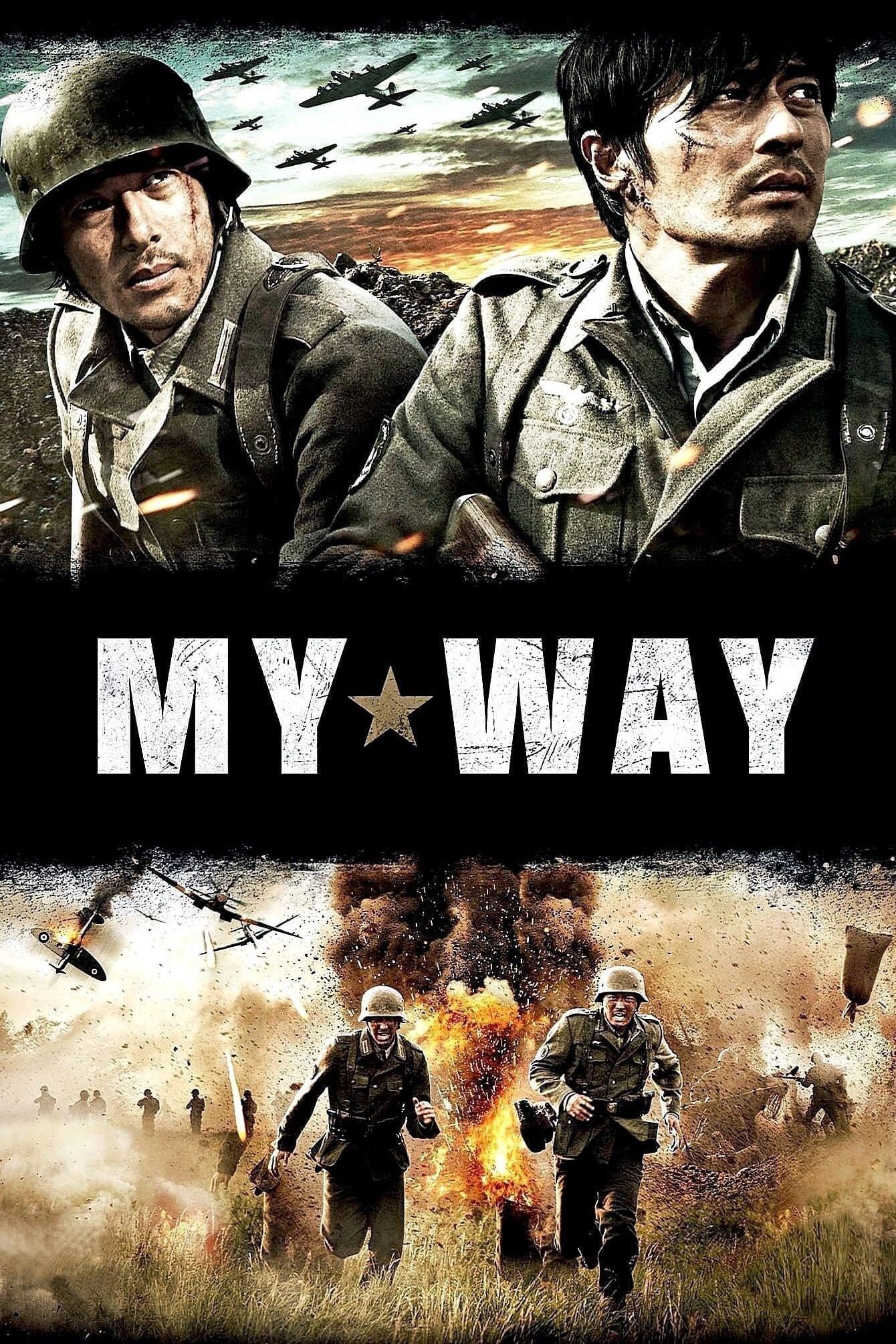
My Way (Original Title 마이 웨이)
2011Two runners, one Korean and one Japanese, are swept from colonial rivalry through forced conscription in multiple armies across three continents during World War II, experiencing the Eastern Front, Soviet captivity, and Normandy before a final act of sacrifice transforms their relationship.



My Way Plot Summary
Colonial Childhood
Gyeong-seong, 1928. Korea exists under Japanese colonial occupation, its people subjected to cultural suppression and economic exploitation. Kim Jun-shik works alongside his father and sister Eun-soo on the farm owned by the Hasegawa family, Japanese settlers who have claimed Korean land as their own. Despite the colonial hierarchy that places Koreans beneath Japanese, young Jun-shik develops a friendship with Tatsuo Hasegawa, the landowner’s grandson. Both boys share a passion for running.
As they grow into teenagers, Jun-shik and Tatsuo become fierce competitors, racing each other through the countryside and pushing one another to greater speeds. Their rivalry exists in a complicated space between genuine friendship and the imposed racial hierarchy of occupation.
Two events shatter this fragile equilibrium. First, Tatsuo’s grandfather is killed in a bombing carried out by a Korean freedom fighter, hardening Japanese attitudes toward Koreans and fueling Tatsuo’s growing nationalism. Second, Korean marathon runner Sohn Kee-chung wins a race against Japanese competitors, demonstrating Korean athletic superiority and further inflaming already-tense Korean-Japanese relations. For colonized Koreans, Sohn’s victory represents defiance and national pride. For Japanese colonizers, it represents humiliation requiring correction.
The Stolen Victory
May 1938 arrives, ten years after the boys’ first races. Jun-shik now works as a rickshaw runner, using his athletic abilities for survival rather than sport. Japanese authorities have banned Koreans from participating in official sports events, attempting to prevent any repeat of Sohn Kee-chung’s embarrassing victory. Tatsuo has evolved into a fierce Japanese nationalist who has publicly sworn that no Korean will ever again defeat Japanese competitors in running.
Despite his nationalism, Tatsuo faces a personal decision. He has been accepted to a prestigious medical college in Berlin, Nazi Germany—an opportunity representing significant professional advancement. However, Tatsuo chooses to remain in Korea to compete in the All Japan Trials marathon race, prioritizing his vow to defeat Koreans over his medical career.
Sohn Kee-chung secretly supports Jun-shik’s entry into the race despite the ban on Korean participation. Jun-shik wins the marathon convincingly, crossing the finish line ahead of all Japanese competitors including Tatsuo. However, race officials disqualify Jun-shik on allegations of cheating—fabricated charges designed to deny a Korean victory. They award the medal to Tatsuo instead.
Korean spectators, witnessing this blatant injustice, riot in protest. Japanese authorities respond with collective punishment, forcibly drafting those who participated in the riot into the Imperial Japanese Army. Jun-shik and his friend Lee Jong-dae, who harbors romantic feelings for Jun-shik’s sister Eun-soo, are among those conscripted.
Nomonhan
July 1939 brings the conscripted Koreans to Nomonhan on the Mongolian border, where Japan fights Soviet forces. The Koreans serve in a unit commanded by Takakura, an officer who treats Korean soldiers more fairly than most Japanese commanders. Among the prisoners captured in the region is Shirai, a Chinese sniper who has been targeting Japanese forces to avenge her family’s deaths.
Tatsuo arrives at Nomonhan as a colonel, having risen rapidly through military ranks. He assumes command and immediately demonstrates his nationalist cruelty by forcing Takakura to commit seppuku for showing leniency toward Korean soldiers. Tatsuo’s command style emphasizes fanatical loyalty and willingness to die for the Emperor.
When Jun-shik refuses to join a suicide squad—a mission with no expectation of survival—Tatsuo imprisons him alongside Shirai. Jun-shik escapes with Shirai, Jong-dae, and two other Korean soldiers. While fleeing, they reach the Khalkhin Gol river and observe a massive Red Army advance preparing to attack Japanese positions.
Despite everything Tatsuo and the Japanese military have done to him, Jun-shik runs back to warn the Japanese forces of the impending assault. Shirai sacrifices herself, shooting down a Soviet I-16 Ishak fighter aircraft before being killed. Jun-shik delivers his warning, but Tatsuo refuses to order a retreat, condemning his soldiers to face overwhelming Soviet forces.
The battle is completely one-sided. Soviet armor and artillery devastate Japanese positions. A tank shell explodes near both Tatsuo and Jun-shik, knocking them unconscious and leaving them vulnerable to capture.
Soviet Captivity
By February 1940, Jun-shik and Tatsuo are imprisoned together in a Soviet prisoner-of-war camp at Kungur, southeast of Perm in the Ural Mountains. The camp houses both Koreans and Japanese, creating strange dynamics as former colonial subjects and colonizers share captivity under Soviet guards.
Jong-dae, operating under the adopted name “Anton,” has become a pro-Soviet work-unit leader. He assists fellow Korean prisoners while abusing the Japanese inmates, reversing the power dynamic he suffered under Japanese rule. The camp authorities organize a sanctioned fight to the death between Jun-shik and Tatsuo. Jun-shik dominates the fight, humiliating Tatsuo, but refuses to kill him. Both are punished for this defiance.
A work accident triggers a riot among prisoners. As punishment, Soviet authorities sentence Tatsuo and Jun-shik to execution by firing squad. However, Germany’s declaration of war against the Soviet Union interrupts the executions. The Soviets desperately need soldiers and begin mass conscription of prisoners of war. Jong-dae volunteers both Jun-shik and Tatsuo for the Red Army, saving their lives through forced military service.
December 1941 brings their penal unit to Dedovsk, where they engage advancing Wehrmacht forces. The battle kills many prisoners, including Jong-dae. Jun-shik convinces Tatsuo to scavenge German uniforms from corpses and trek over the mountains into German-held territory, hoping to escape the Eastern Front entirely.
During their journey, Jun-shik realizes Tatsuo has been seriously wounded. He searches an abandoned town for medicine, but German soldiers discover them. Unable to understand Korean or Japanese, the Germans assume Jun-shik and Tatsuo are Soviet soldiers and capture them.
Normandy
By 1944, circumstances have forced Tatsuo into service with the Wehrmacht. He has been transferred to a unit manning defensive positions along the Atlantic Wall in Normandy, Occupied France. While on duty, Tatsuo notices someone running on the beach. He catches up to the runner and discovers it is Jun-shik, whom he has not seen since their capture in 1941.
The reunion is extraordinary—two men who began as colonial subject and colonizer, became military enemies, then Soviet prisoners, have now been conscripted into the German military and stationed at the same location. They make plans to desert by reaching Cherbourg and boarding a ship that will carry them away from the European theater of war, ultimately allowing them to return home to Korea.
However, the Normandy landings commence before they can escape. Allied forces launch the massive D-Day invasion, and a German officer locks Jun-shik and Tatsuo into a machine gun pillbox, forcing them to defend the position. They break out of the pillbox as United States Army forces scale the cliffsides.
Jun-shik and Tatsuo attempt to flee inland, running from the battle. Naval artillery shells rain down on German positions. Shrapnel from one explosion strikes Jun-shik in the chest, mortally wounding him. He collapses as American paratroopers land nearby.
Jun-shik realizes the approaching American soldiers might kill Tatsuo simply for being Japanese. In his final moments, Jun-shik forcibly exchanges identification tags with Tatsuo, giving him his own Korean identity. He tells Tatsuo, “You are now Jun-shik,” before dying in his arms as the paratroopers surround them.
The Olympian
After the war ends, Tatsuo participates in the 1948 Summer Olympics in London. He competes in the athletics events not under his own name but as “Jun-shik Kim,” honoring his friend’s sacrifice and carrying his identity forward. By assuming Jun-shik’s name, Tatsuo allows a Korean to achieve the Olympic glory that colonial occupation had denied.
In a flashback to their first childhood encounter in Gyeong-seong, Tatsuo reflects on meeting Jun-shik. He confesses in internal monologue that when he first met Jun-shik, he was secretly happy to have found someone who could be his running mate—not a rival defined by colonial hierarchy, but a true companion in their shared passion for running.