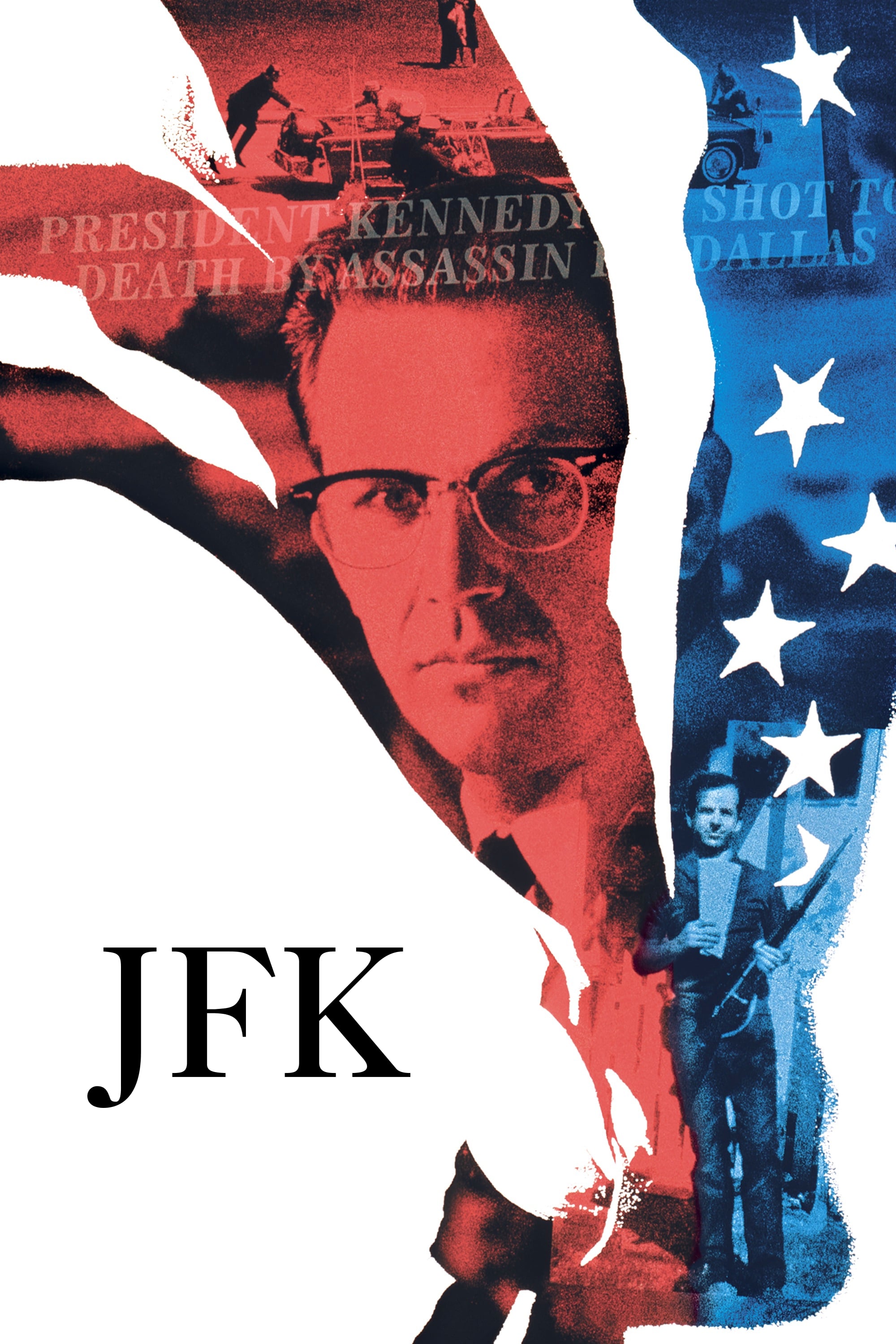
JFK
New Orleans District Attorney reopens investigation into President Kennedy's assassination after finding inconsistencies in official reports, uncovering alleged conspiracy involving CIA, military-industrial complex, and government officials while facing witness deaths, FBI infiltration, and personal costs before prosecuting prominent businessman in controversial trial.
JFK — Plot Summary
Warning and Assassination
In 1961, outgoing President Dwight D. Eisenhower delivers his farewell address to the nation, warning about the dangerous build-up of the military-industrial complex—an alliance between defense contractors, military leadership, and government officials whose interests align around perpetual warfare and massive defense spending. Eisenhower's warning suggests this concentration of power threatens democratic governance.
John F. Kennedy succeeds Eisenhower as president. His brief time in office is marked by major Cold War crises: the failed Bay of Pigs Invasion attempting to overthrow Fidel Castro's Cuban government, and the Cuban Missile Crisis that brings the world to the brink of nuclear war. Kennedy's presidency ends abruptly on November 22, 1963, when he is assassinated while riding in a motorcade through Dealey Plaza in Dallas, Texas.
Ex-Marine Lee Harvey Oswald, who previously attempted to defect to the Soviet Union, is arrested for murdering Dallas police officer J.D. Tippit. Authorities quickly arraign him for both Tippit's murder and President Kennedy's assassination. However, before Oswald can stand trial, nightclub owner Jack Ruby shoots and kills him on live television while police transfer him between facilities.
Initial Investigation
New Orleans District Attorney Jim Garrison and his team investigate potential New Orleans connections to the assassination. Their inquiry focuses on David Ferrie, a private pilot and political activist with possible links to Oswald. However, the federal government publicly rebukes Garrison's investigation, effectively pressuring him to abandon the case. Garrison closes his investigation under this external pressure.
In 1966, Garrison reopens the investigation after reading the Warren Commission Report—the official government account of the assassination. Garrison identifies what he believes are multiple critical inaccuracies and inconsistencies in the report. The single-bullet theory particularly troubles him: the official claim that one bullet passed through Kennedy's neck, then struck Texas Governor John Connally multiple times, causing seven separate wounds while remaining virtually intact.
Building the Case
Garrison and his staff interrogate people who had connections with Oswald and Ferrie. One significant witness is Willie O'Keefe, a male prostitute currently serving five years in prison for solicitation. O'Keefe testifies that he witnessed Ferrie discussing Kennedy's assassination with a man identified as "Clay Bertrand." O'Keefe also claims he briefly met Oswald during this period.
Based on their investigation, Garrison and his team develop a theory that Oswald never actually defected to the Soviet Union in any genuine sense. Instead, they theorize he was a double agent working for the CIA who was later betrayed and framed for Kennedy's murder by the very organization that employed him.
Witness Testimony
In 1967, Garrison's team interviews numerous witnesses whose accounts differ substantially from the official narrative. Jean Hill, a schoolteacher who was present at Dealey Plaza, testifies she witnessed a gunman shooting from the "grassy knoll"—a small hill adjacent to the motorcade route. Hill claims Secret Service agents threatened her into stating that only three shots came from the Texas School Book Depository, the building from which Oswald allegedly fired. She further alleges that the Warren Commission altered her testimony to fit their predetermined conclusions.
Garrison's staff conducts their own ballistics experiments, test-firing an empty Carcano rifle identical to the one Oswald supposedly used. They fire from the sixth-floor window of the Book Depository, attempting to replicate the shots. Based on these tests, they conclude that Oswald was too poor a marksman to have made the shots attributed to him within the brief timeframe available, and that multiple shooters must have been involved.
Garrison comes to believe that "Clay Bertrand," the man O'Keefe identified as conspiring with Ferrie, is actually Clay Shaw, a prominent New Orleans businessman. Garrison interviews Shaw, who denies ever meeting Ferrie, O'Keefe, or Oswald. Shaw's denials do not satisfy Garrison's suspicions.
Obstacles and Deaths
The investigation faces mounting obstacles. Key witnesses become frightened and refuse to provide testimony. Others die under suspicious circumstances. Jack Ruby dies in prison, officially from cancer but under conditions that raise questions. David Ferrie dies shortly before he is scheduled to testify. Before his death, Ferrie tells Garrison that a conspiracy to kill Kennedy definitely existed.
The Mysterious "X"
Garrison meets with a high-level government figure in Washington D.C. who identifies himself only as "X" to protect his identity. X provides an insider's perspective on the assassination, claiming Kennedy's security in Dallas was deliberately compromised. He suggests a coup d'état involving the highest levels of American government.
X implicates numerous powerful entities: the CIA, organized crime syndicates, the military-industrial complex Eisenhower warned about, the Secret Service, the FBI, and even Vice President Lyndon B. Johnson. According to X, some were direct co-conspirators while others had motives to cover up the truth.
X explains Kennedy's murder as motivated by his policy positions. Kennedy planned to withdraw American forces from Vietnam, ending the profitable war. He intended to halt further aggressive actions against Cuba, abandoning efforts to overthrow Castro. Most significantly, Kennedy planned to dismantle the CIA after the Bay of Pigs disaster. These positions threatened powerful interests that depended on Cold War tensions and military intervention.
X encourages Garrison to continue his investigation and prosecute Clay Shaw, believing this may be the only opportunity to expose the conspiracy through official legal proceedings.
Personal Costs
Garrison indicts Shaw for conspiring to murder President Kennedy. However, the investigation exacts heavy personal costs. Garrison's marriage deteriorates as his wife Liz complains he spends more time on the case than with their family. After someone makes a sinister phone call threatening their daughter, Liz accuses Garrison of selfishness and suggests his prosecution of Shaw is motivated by homophobia rather than justice.
Some of Garrison's staff begin doubting his motives and disagreeing with his investigative methods. Several key team members abandon the investigation entirely. One departing staffer, Bill Broussard, is later revealed to have been an FBI informant throughout the investigation, reporting Garrison's activities to federal authorities. Broussard even participates peripherally in what appears to be an attempt to kidnap, murder, or intimidate Garrison.
The media criticizes Garrison harshly, characterizing him as wasting taxpayer money pursuing baseless conspiracy theories. The public narrative portrays him as obsessed and irrational. Garrison suspects connections between Kennedy's assassination and the subsequent murders of Martin Luther King Jr. and Robert F. Kennedy, but these suspicions further damage his credibility in mainstream discourse.
Trial and Verdict
Shaw's trial takes place in 1969, six years after Kennedy's death. Garrison presents the court with his case against the single-bullet theory. He proposes an alternative scenario involving three assassins firing six shots from multiple locations. According to Garrison's theory, these conspirators framed Oswald for both Kennedy's and Tippit's murders. The ultimate purpose was installing Lyndon Johnson as president so he could escalate American involvement in Vietnam, thereby enriching defense contractors and the military-industrial complex.
Despite Garrison's presentation, the jury acquits Shaw after deliberating for less than one hour. The quick acquittal suggests either that Garrison's evidence was insufficient, that the jury found his conspiracy theory implausible, or that powerful forces influenced the outcome.
Aftermath
While Garrison's prosecution fails to secure a conviction, the experience transforms his family relationships. His wife and children develop respect for his determination and moral courage in pursuing what he believed was truth despite enormous opposition. The investigation's failure in court is balanced by personal redemption—Garrison repairs his relationship with his family, who recognize his integrity even if others do not.