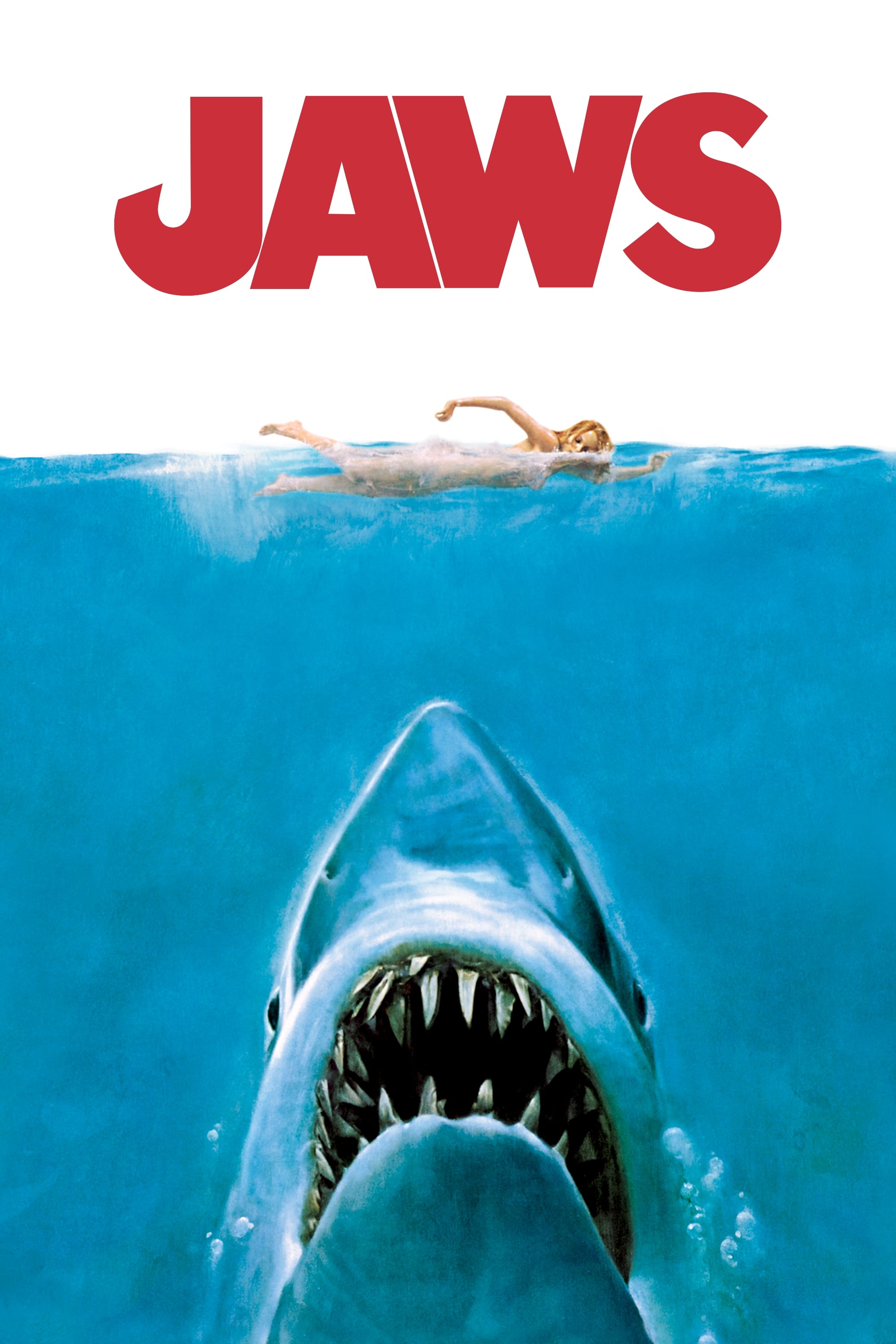
Jaws (1975)
A great white shark terrorizes a New England beach town during peak summer season, forcing the police chief, marine biologist, and obsessed shark hunter to pursue the massive predator after multiple fatal attacks despite political pressure to keep beaches open for tourism.
Jaws Film Synopsis
A great white shark terrorizes a New England beach town during peak summer season, forcing the police chief, marine biologist, and obsessed shark hunter to pursue the massive predator after multiple fatal attacks despite political pressure to keep beaches open for tourism.



The First Victim
Amity Island sits off the New England coast, a small beach community that depends entirely on summer tourism for its economic survival. During a late-night beach party, a young woman decides to go for a swim in the ocean. She wades into the dark water alone while her friends remain on shore, too intoxicated or preoccupied to join her. The cool waves feel refreshing as she swims further from the beach, enjoying the solitude and the sensation of floating in the darkness.
Without warning, something beneath the surface seizes her. An unseen force with tremendous power pulls her underwater violently. She thrashes and screams, fighting desperately against whatever has grabbed her, but the attacks continue with mechanical efficiency. She is pulled under repeatedly, her cries for help growing weaker each time she surfaces. Finally, she disappears beneath the waves entirely, leaving only disturbed water and silence.
Morning sunlight reveals what remains of the young woman washed up on the beach. Her body has been partially consumed, the damage extensive and horrifying. The discovery sends shockwaves through the small community. Martin Brody, Amity Island’s police chief, arrives at the scene to investigate. After examining the remains, the town’s coroner delivers his professional conclusion: the woman was killed by a shark attack. The severity of the injuries and the pattern of the wounds leave little room for alternative explanations.
Political Pressures
Brody’s immediate response is to order the beaches closed until the threat can be neutralized. As police chief, he has both the authority and the responsibility to protect the town’s residents and visitors from known dangers. However, his decision brings him into direct conflict with Mayor Larry Vaughn, whose priorities differ significantly from the police chief’s.
Vaughn meets with Brody privately and persuades him to reconsider the beach closure. The mayor presents the economic reality facing Amity Island: the town’s entire financial survival depends on summer tourism revenue. If the beaches close during peak season, local businesses will suffer catastrophic losses. Hotels will lose bookings, restaurants will lose customers, and shops will lose sales. The economic devastation could destroy the community that depends on these few crucial months to sustain itself year-round.
Brody finds himself caught between public safety and economic necessity. The situation becomes more complicated when the coroner, who initially confirmed the shark attack, suddenly revises his assessment. Under apparent pressure from the mayor and other town officials, the medical examiner now agrees with Vaughn’s alternative theory: the woman’s death was a boating accident, not a shark attack. The injuries, he suggests, could have been caused by a boat propeller or other maritime incident.
Despite his own professional judgment and instincts, Brody reluctantly accepts this revised conclusion. He agrees to keep the beaches open, convincing himself that perhaps the coroner’s new assessment is correct, that his initial fears were overreactions.
The Kintner Boy
Brody’s doubts prove tragically justified when young Alex Kintner is killed at a crowded beach in broad daylight. Families and children fill the sand and surf on a beautiful summer day when the attack occurs. Alex is playing on an inflatable raft in shallow water, surrounded by other swimmers, when the shark strikes. The water erupts in violence as the predator seizes the boy. Witnesses scream and rush for shore as the ocean turns red. Alex’s mother watches helplessly from the beach as her son is pulled underwater and killed.
This second death makes denial impossible. The town can no longer pretend the threat does not exist or attribute the attacks to boating accidents. Public panic spreads rapidly as news of the beach attack circulates. The town places a three-thousand-dollar bounty on the shark, hoping to incentivize its quick capture. This bounty triggers an amateur shark-hunting frenzy as local fishermen and opportunistic outsiders flood Amity’s waters with boats, lines, and weapons, all seeking the reward money.
Among those attracted by the bounty is Quint, an eccentric local fisherman with a reputation for shark hunting. Quint is a weathered, intense man who lives on the margins of Amity society, respected for his skills but avoided for his abrasive personality. He approaches the town council with his own offer: he will hunt and kill the shark for ten thousand dollars, significantly more than the posted bounty. His price reflects both his confidence in his abilities and his assessment of the danger involved.
Meanwhile, Matt Hooper arrives on Amity Island. Hooper is a young oceanographer whose expertise in marine biology and shark behavior has been requested by local authorities. He examines what remains of the first victim’s body, applying scientific analysis to the wounds and damage. His professional assessment confirms what Brody initially believed: the woman was killed by a shark, and an unusually large specimen at that. The size and power required to inflict such injuries suggest a predator far more dangerous than the typical sharks found in these waters.
False Security
Local fishermen eventually succeed in catching a tiger shark, a large and impressive specimen that seems plausible as the killer. Mayor Vaughn eagerly seizes upon this capture as evidence that the threat has been eliminated. He declares the beaches safe once again, announcing to the press and public that the dangerous shark has been caught and killed. The town can now return to normal operations, and tourists can feel confident swimming in Amity’s waters.
Hooper examines the captured tiger shark with scientific skepticism. He requests permission to dissect the animal and examine its stomach contents, looking for evidence that would confirm this shark was responsible for the human deaths. Vaughn and other town officials object to this proposal, arguing that the shark’s capture is sufficient proof and that dissection is unnecessary. However, Hooper persists, and permission is eventually granted.
The dissection reveals what Hooper suspected: the tiger shark’s stomach contains no human remains whatsoever. The absence of evidence is itself damning evidence—this shark, while dangerous, is not the one that killed the young woman and Alex Kintner. Hooper presents his findings to Brody and the mayor, concluding that the actual killer shark remains at large and continues to pose a threat to anyone entering the water.
Vaughn refuses to accept this conclusion or take action based on it. He insists the beaches will remain open and dismisses Hooper’s scientific analysis as inconclusive speculation. Political and economic pressures continue to outweigh safety concerns in the mayor’s decision-making process.
Night Investigation
Frustrated by the official refusal to acknowledge the ongoing danger, Hooper and Brody conduct their own investigation during the night. They take Hooper’s boat out into Amity’s coastal waters, searching for evidence of the shark’s continued presence. Their nocturnal patrol brings them to the half-sunken wreckage of a small fishing vessel belonging to Ben Gardner, a local fisherman who has been reported missing.
Hooper dons scuba gear and submerges to examine the damaged boat more closely. He swims around the hull, looking for clues about what caused the vessel to sink. His flashlight beam reveals significant damage to the boat’s structure, including what appears to be a large shark tooth embedded deeply in the wooden hull. The tooth’s size confirms Hooper’s worst fears about the predator they are dealing with.
As Hooper reaches to extract the tooth for evidence, he notices something floating in the water nearby. His flashlight illuminates Ben Gardner’s severed head, the dead fisherman’s face frozen in a final expression of terror. Hooper recoils in shock, dropping the tooth as he scrambles away from the gruesome discovery. The evidence is lost, sinking into the murky water below.
When Hooper and Brody report their findings to Mayor Vaughn the next day, the mayor remains unmoved. He refuses to close the beaches or take any action that might discourage tourism. Instead, he authorizes only modest increases to safety precautions—additional lifeguards, closer monitoring of swimmers, and posted warnings about marine life. These measures create an appearance of response without actually addressing the fundamental danger.
Fourth of July Disaster
The Fourth of July weekend arrives, bringing massive crowds of tourists to Amity Island. The beaches are packed with families, the town’s businesses are thriving, and Mayor Vaughn’s economic gamble appears to be paying off. The increased safety measures seem sufficient to reassure visitors, and the water is filled with swimmers enjoying the holiday.
The shark enters a nearby lagoon, a protected area where families often gather because of the calm, shallow water. A man on a small boat becomes the predator’s next victim, killed in full view of horrified witnesses. The attack triggers immediate panic as swimmers rush for shore, parents screaming for their children, chaos spreading across the beach.
Martin Brody’s young son Michael is among the swimmers in the lagoon. The shark’s attack occurs near enough to Michael that the boy witnesses the violence and carnage directly. Although Michael escapes physical harm, the psychological trauma is severe. He is pulled from the water in shock, unresponsive and catatonic. An ambulance rushes him to the hospital where doctors work to stabilize his condition.
The attack finally breaks through the mayor’s denial and political calculations. Faced with the hospitalization of the police chief’s son and undeniable evidence of ongoing danger, Vaughn experiences genuine remorse. His decisions, driven by economic concerns and political pressure, have resulted in multiple preventable deaths. Brody confronts the mayor, and Vaughn, consumed by guilt, agrees to hire Quint at his asking price. The shark must be hunted and killed, regardless of cost.
Setting Out
Quint, Hooper, and Brody prepare for the hunt aboard Quint’s vessel, the Orca. The boat is functional rather than comfortable, equipped with the tools and weapons necessary for hunting large marine predators. The three men represent vastly different backgrounds and expertise: Quint’s practical experience and obsessive determination, Hooper’s scientific knowledge and modern equipment, and Brody’s inexperience but desperate motivation to protect his family and community.
Tension exists between Quint and Hooper from the beginning. Quint dismisses Hooper’s scientific credentials and fancy equipment, viewing him as a pampered academic who lacks real-world experience with dangerous sharks. Hooper, in turn, finds Quint’s methods crude and his attitude insufferable. The two men clash over tactics and approach, their conflict adding stress to an already dangerous mission.
Brody struggles with his own fear of the ocean. Unlike his companions, who are comfortable on the water, Brody experiences genuine anxiety about being at sea. His discomfort manifests as he watches the shoreline recede and realizes how far from safety they are traveling. Despite this fear, he remains committed to the mission, driven by guilt over the deaths that occurred on his watch and his son’s near-miss with the predator.
First Encounter
Brody establishes a chum line, dumping bloody fish parts into the water to create a scent trail that will attract the shark. He works mechanically, scooping the foul-smelling mixture and spreading it across the ocean surface. As he tosses another scoop, the massive shark suddenly surfaces directly behind the boat, rising from the depths without warning.
The three men get their first clear look at the predator they are hunting. The shark is enormous, far larger than any of them anticipated. Quint, drawing on decades of experience hunting and killing sharks, estimates the creature at twenty-five feet in length and weighing approximately three tons. The size exceeds anything Hooper has encountered in his academic research, and Brody realizes with horror that this monster has been swimming in the same waters where his children play.
Quint immediately springs into action, grabbing one of his harpoons attached to a flotation barrel. The barrel system is designed to prevent the shark from diving too deep and to track its movements on the surface. Quint’s throw is perfect, embedding the harpoon deeply into the shark’s flesh. The barrel deploys as intended, but instead of surfacing and allowing itself to be tracked, the shark simply pulls the barrel underwater and disappears into the depths. The three men watch the water where the barrel vanished, realizing that their quarry possesses both size and strength beyond their expectations.
Night at Sea
As darkness falls, the Orca rocks gently in the calm ocean. The tension of the day’s encounter fades somewhat as Quint and Hooper share drinks and begin exchanging stories. The alcohol loosens their antagonism toward each other, replacing it with a mutual recognition of shared experiences in dangerous situations. They compare scars, each injury carrying its own story of close calls and narrow escapes.
Hooper notices that one of Quint’s scars is in the shape of a removed tattoo. He asks about it, and Quint’s demeanor changes. The older man begins to speak about his experiences during World War II, specifically about the sinking of the USS Indianapolis. Quint was aboard the cruiser when it was torpedoed and sank rapidly, leaving hundreds of sailors floating in open ocean awaiting rescue.
The survivors clung to wreckage and life rafts, waiting for help that took days to arrive. During that time, sharks attacked the helpless sailors, drawn by blood from injuries and the splashing of men too exhausted to defend themselves. Quint describes watching his shipmates pulled underwater one by one, the ocean turning red with their blood. The trauma of that experience has haunted him for decades and fuels his obsessive hatred of sharks. His hunt for the Amity predator is not merely professional—it is deeply personal.
Their conversation is interrupted when the shark returns, ramming the Orca’s hull with tremendous force. The impact damages the boat’s power system, knocking out electrical systems and threatening to disable the vessel entirely. The three men work through the night, repairing the damaged engine and attempting to restore functionality. By morning, they have managed temporary repairs that allow the Orca to operate, though the boat is no longer fully reliable.
The Chase
Brody attempts to radio the Coast Guard for assistance or backup, recognizing that they are outmatched and in danger. Quint, however, is obsessed with killing the shark himself, without outside help or interference. He views the hunt as personal and refuses to share the achievement with anyone else. When Brody reaches for the radio, Quint physically intervenes, smashing the communications equipment and making it impossible to call for help. The three men are now committed to completing the hunt alone, cut off from any possibility of rescue or support.
The shark reappears, and Quint launches another harpoon, successfully attaching a second barrel to the creature. This time, instead of allowing the shark to pull the barrel underwater, Quint ties the attached line to the stern cleats on the Orca, intending to use the boat’s weight and power to prevent the shark from diving. The tactic backfires catastrophically.
Rather than being restrained, the shark simply drags the entire boat backward through the water. The Orca is pulled stern-first at increasing speed, water pouring over the back deck and flooding into the engine compartment. The boat begins to take on dangerous amounts of water as the shark continues pulling relentlessly. Quint realizes they are in danger of being pulled under entirely and moves to sever the line, which would save the boat but allow the shark to escape. Before he can cut through the rope, the cleats tear completely free from the Orca’s structure, unable to withstand the immense strain. The barrels remain attached to the shark, but the boat is no longer tethered to the predator.
To Brody’s relief, Quint announces they will head for shore, planning to draw the shark into shallower waters where its size will become a disadvantage. The Orca turns toward land and accelerates, racing for the coast. However, the damage sustained during the backward drag has compromised the engine’s integrity. The motor runs roughly, producing concerning sounds and smoke. As they approach shallower waters, the engine fails completely, dying with a final sputter and leaving the Orca dead in the water.
Final Desperation
Water continues to pour into the damaged Orca, and the three men recognize that the boat is sinking. They need to kill the shark quickly before their vessel goes down completely. Hooper proposes a desperate plan: he will enter a shark-proof cage and descend to where the predator is circling. Once close enough, he will use a hypodermic spear loaded with strychnine to inject the shark with a lethal dose of poison. The plan is risky, but their options have narrowed to desperate measures.
Hooper suits up in scuba gear and climbs into the reinforced cage. The cage is lowered into the water, submerging Hooper into the shark’s domain. He carries the hypodermic spear, waiting for the predator to approach close enough for him to strike. The shark circles the cage warily at first, then attacks with sudden violence.
The massive predator slams into the cage repeatedly, its jaws biting at the reinforced bars. The force of the impacts shakes Hooper violently inside the cage, and during one particularly brutal strike, he drops the hypodermic spear. The weapon sinks away into the darker water below, lost. Hooper is now trapped in a disintegrating cage with an enraged shark and no means of defending himself.
The shark continues its assault, bending and breaking the cage’s bars. Hooper realizes the structure will not hold and makes a split-second decision to escape. As the shark tears at the upper portion of the cage, Hooper swims downward and out through the bottom, descending to the ocean floor and hiding in the rocks and shadows below. The shark, focused on destroying the cage, does not immediately pursue him. Hooper remains hidden on the bottom, hoping the predator will lose interest.
The Final Attack
On the surface, Quint and Brody watch helplessly as the destroyed cage is pulled back up, empty. They cannot know if Hooper escaped or was killed. Before they can process this loss, the shark’s attention turns to the Orca itself. The massive predator propels itself partially out of the water and crashes onto the boat’s stern, its weight causing the already damaged vessel to tilt dangerously.
Quint loses his footing as the deck tilts beneath him. He slides down the sloping surface toward the shark’s open jaws. He claws desperately at the deck, trying to find purchase, but his hands slip on the wet wood. The shark’s teeth close around Quint’s body, and the old hunter is pulled into the predator’s mouth. His screams are cut short as the shark devours him, dragging his body underwater and ending his decades-long quest for vengeance against the species that haunted him since the Indianapolis.
Brody is now alone on the sinking Orca with a monster that has just killed his companion. The police chief scrambles up the tilting deck toward higher ground as water pours into the vessel. He grabs one of the scuba tanks that had been stored on board and, in a moment of desperate inspiration, forces the metal cylinder into the shark’s mouth as it lunges at him again. The shark bites down on the tank but does not immediately attack further, seemingly confused by the metal object.
Brody climbs higher, reaching the crow’s nest at the top of the Orca’s mast. The boat is nearly vertical now, sinking rapidly. He grabs a rifle and aims carefully at the scuba tank protruding from the shark’s mouth. The first shot misses. The second shot misses. The shark circles, preparing for another attack. Brody forces himself to calm down, to aim properly despite his terror and the chaos around him.
His third shot strikes the scuba tank directly. The compressed air inside the tank explodes with tremendous force, detonating like a bomb inside the shark’s mouth. The explosion tears the predator apart from within, killing it instantly. Blood and tissue erupt across the water’s surface as the shark’s destroyed body sinks into the depths.
Return to Shore
The ocean grows quiet. Hooper surfaces from his hiding place on the bottom, having survived the encounter. He swims to the wreckage of the Orca where Brody clings to the mast. The boat is beyond saving, already slipping beneath the waves. The two survivors find the floating barrels that were attached to the shark, now drifting free. They grab onto the barrels and begin the long, exhausting paddle back toward Amity Island’s shore.
As they kick their way through the water, using the barrels for flotation, neither man speaks. Quint is dead, the Orca is destroyed, and they have barely survived an encounter that cost them nearly everything. But the shark is dead, and the waters around Amity Island are safe once again.