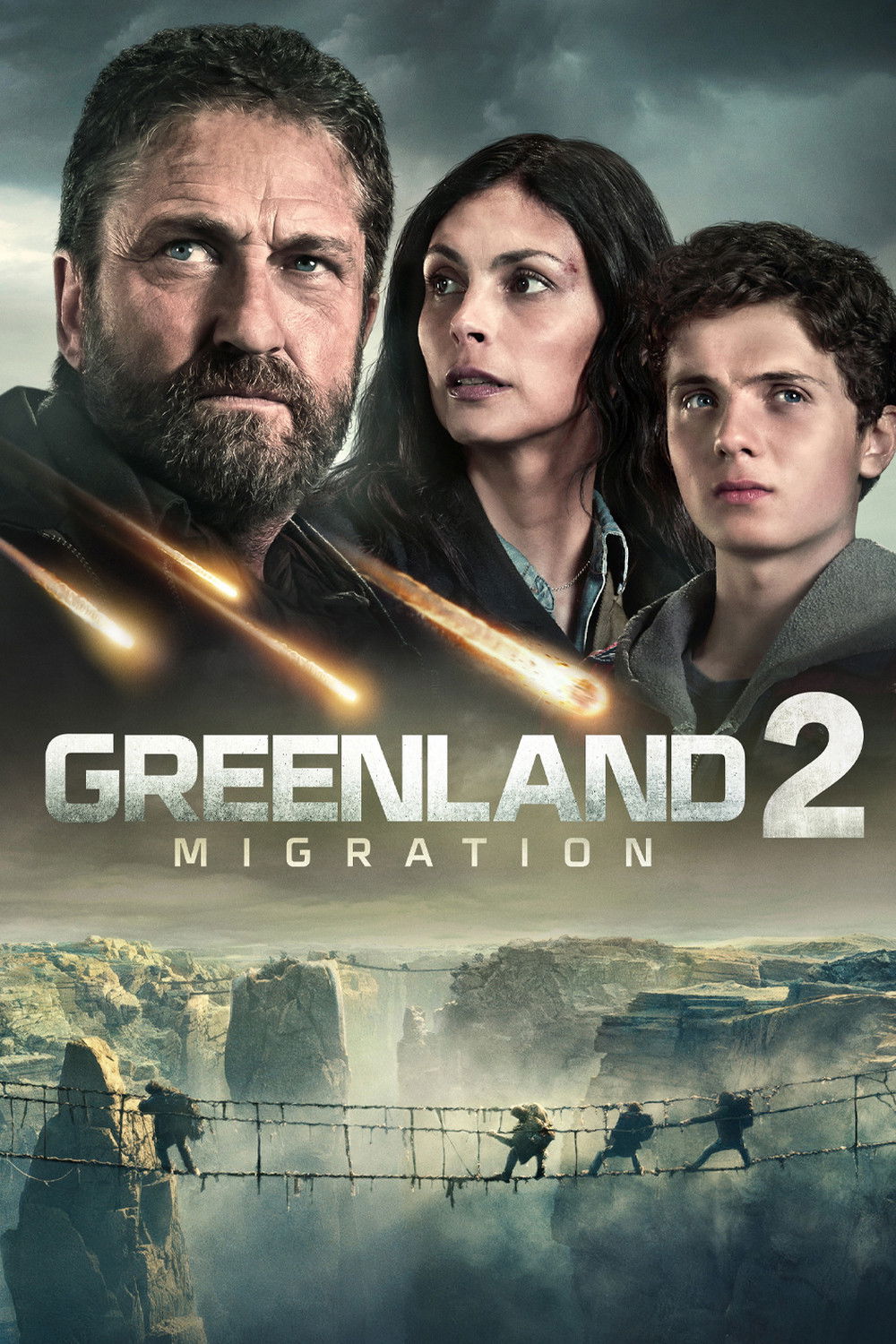
Greenland
Structural engineer and estranged family race toward military evacuation as extinction-level comet approaches Earth in two days, separated when diabetic son disqualified from official shelters, reunite and reach Greenland bunker complex just before nine-mile-wide fragment impacts destroying civilization, emerge nine months later as atmosphere clears for rebuilding.
Greenland — Plot Summary
The Comet's Arrival
Atlanta, Georgia. Structural engineer John Garrity lives separated from his wife Allison, though they are attempting to reconcile. They have a young son, Nathan, who has diabetes requiring regular insulin treatments. The family plans to watch the near-earth passing of a recently discovered interstellar comet nicknamed "Clarke" together with neighbors at their home, treating it as a spectacular celestial event to observe.
While John is at the supermarket, he receives an automated message from the Department of Homeland Security announcing that he and his family have been selected for emergency sheltering. The message is vague but official, confusing John about what emergency it refers to.
John returns home just as a comet fragment is shown entering Earth's atmosphere on live television. The fragment was previously expected to land harmlessly in the ocean near Bermuda. Instead, it strikes Tampa, Florida directly. The impact is catastrophic—the fragment vaporizes the entire city along with most of the state, killing millions instantly.
John immediately receives a phone call with specific instructions: take his family to Robins Air Force Base for an evacuation flight. The authorities reveal that Clarke is not passing near Earth but is on a direct collision course. The comet will impact Earth in approximately two days, causing an extinction-level event that will end human civilization and most life on the planet.
John, Allison, and Nathan quickly pack essential belongings and drive toward the air force base, joining millions of other people desperately trying to reach safety.
Separation
The roads to Robins Air Force Base are clogged with heavy traffic as panicked civilians flee or attempt to reach evacuation sites. The Garritys abandon their car and continue on foot, carrying their belongings.
In the rush and chaos, Nathan's insulin supply is accidentally left behind in the abandoned car. As they reach the base entrance, John realizes the insulin is missing. He goes back to retrieve it, leaving Allison and Nathan to proceed through security.
While John is away, military personnel discover Nathan's medical condition during screening. Nathan's diabetes—which requires ongoing medication and medical care—disqualifies him from the emergency sheltering program. The evacuation is designed for healthy individuals who can survive long-term in bunkers without extensive medical support. Allison, refusing to leave without her son, stays behind with Nathan rather than boarding the evacuation flight.
John returns to the base with the insulin and is directed to board an evacuation plane. He boards, but quickly realizes that Allison and Nathan are not on the flight. Understanding they have been left behind, John makes a split-second decision and jumps off the plane before it takes off.
As John exits the secured base area, a panicked mob of people who have been denied entry breaks through the perimeter fence. In the chaos, gunfire erupts and ignites spilled jet fuel, destroying several evacuation planes and killing numerous people. The base descends into violence and disaster.
Desperate Journeys
Returning to where they left their car, John finds a note from Allison saying she and Nathan are going to her father Dale's home in Lexington, Kentucky. John must now find a way to reach them as the world falls apart around him.
After obtaining medical supplies for Nathan, Allison and Nathan accept a ride from a seemingly kind couple, Ralph and Judy Vento. However, Ralph's kindness is a deception. He kidnaps Nathan, planning to use the boy and his family's emergency evacuation wristbands to board a flight by pretending Nathan is his son. The wristbands are the key to accessing the evacuation system, making them extremely valuable.
John hitchhikes a ride on a truck full of people heading toward Canada. He plans to get off in Lexington to find Allison and Nathan. A passenger named Colin tells John that the group is headed to Osgoode, Ontario, where private planes are flying people to Greenland—believed to be the actual military evacuation site rather than the compromised air force bases in the United States.
During the journey, another passenger attempts to steal John's evacuation wristband by force. The struggle causes the truck to crash violently. Colin dies in the crash, along with others. John is forced to kill the man who attacked him in self-defense, taking a life to protect his chance of survival.
Reunion
At another air force base, Ralph and Judy Vento attempt to board an evacuation flight by posing as Nathan's parents, using the boy's wristband. However, Nathan—frightened and knowing they are not his parents—reveals the truth to security personnel. The Ventos are immediately arrested for attempted fraud and kidnapping.
Allison and Nathan are reunited shortly afterward at a nearby FEMA emergency camp in Knoxville, Tennessee. They are together again but still separated from John with no clear way to reach the evacuation sites.
Final Sprint
The following morning, John learns via emergency broadcasts that Clarke's largest fragment—the one that will cause the extinction event—will hit Earth in approximately 24 hours. Time is running out for all of humanity.
John steals a car and drives to Dale's house in Lexington. He arrives to find that Allison and Nathan have also made it there safely. The reunited family learns from emergency broadcasts about a complex of underground bunkers near Thule Air Base in Greenland. This confirms Colin's information: Greenland is where evacuees are being sent to survive the impact in massive underground shelters.
Dale, Allison's father, chooses to stay behind at his home rather than attempting the dangerous journey. He is elderly and prefers to spend his final hours in the place he has lived his entire life. Dale bids farewell to his daughter and grandson, giving the family his truck for the journey north.
John, Allison, and Nathan drive Dale's truck toward Osgoode, Ontario, racing against the clock. While making steady progress northward, they hear over the radio that Clarke's largest fragment has been measured at 9 miles (14 kilometers) wide. The broadcast announces that this fragment will strike Western Europe imminently and will obliterate the entire continent.
The family arrives at the Osgoode airport just in time to board the last private flight heading to Greenland. The plane is overloaded with desperate refugees, but they manage to get aboard.
As the plane approaches Greenland, a comet fragment strikes nearby. The shockwave from the impact causes the plane to crash-land violently on the frozen terrain. The Garritys and other passengers survive the crash with injuries.
The survivors flag down a military truck that is racing toward the bunker complex. They pile into the vehicle and drive desperately toward the entrance as the sky fills with fire from incoming fragments.
The truck reaches the bunker complex just as the largest fragment—the 9-mile-wide city-killer—enters the atmosphere and begins its final descent toward Earth. John, Allison, Nathan, and the other survivors rush into the bunker entrance. Massive blast doors seal behind them as the fragment impacts, devastating the surface and destroying civilization worldwide.
Aftermath
Nine months pass underground. The bunker's occupants have survived in the massive shelter complex, waiting for the Earth's surface to become habitable again.
The bunker makes radio contact with other survivors around the world, confirming that pockets of humanity survived in various underground shelters, caves, and protected locations. The human species has not been entirely extinguished.
The Garritys and other bunker occupants carefully exit the shelter to assess the surface conditions. Reports come in via radio that Earth's atmosphere is finally clearing after nine months of dust, ash, and debris blocking out the sun. The nuclear winter effect is ending.
The survivors emerge into a devastated but survivable world. With the atmosphere clearing, plants can begin growing again, and the long process of rebuilding human civilization can begin. The Garritys stand together as a family, having survived the extinction event, facing the enormous challenge of helping bring Earth back from the brink of total destruction.
Greenland — Ending Explained
The ending validates the family's desperate struggle to stay together by showing that their reunion before entering the bunker gave them the emotional foundation to survive nine months underground, suggesting that psychological survival required intact family bonds as much as physical shelter. Their journey's dangers and separations made their final togetherness meaningful rather than coincidental.
The nine-month timeframe parallels human gestation, symbolically positioning the survivors as being "reborn" into a new world where old civilization has been destroyed and humanity must start over. The clearing atmosphere represents literal and metaphorical new beginning where survivors can build society differently than before.
Nathan's diabetes—initially disqualifying him from official evacuation—ultimately became irrelevant to survival once the family reached Greenland outside the official system, demonstrating that bureaucratic survival criteria were arbitrary rather than truly predictive of who could survive underground. The film critiques systems that exclude people based on medical conditions when crisis survival depends more on determination and family support.
The bunker's contact with other survivors worldwide prevents the ending from being purely American-centric, acknowledging that humanity's survival depended on international cooperation and that people in various countries found ways to survive despite their governments' failures. The global communication network suggests that rebuilding will be collaborative rather than nationalistic.
The film's conclusion that survivors have "the chance to bring Earth back onto its feet" presents optimistic vision of post-apocalyptic rebuilding without addressing the likely reality: billions dead, ecosystems destroyed, infrastructure gone, and survivors facing starvation, disease, and violence over scarce resources. The ending prioritizes hope over realism about civilization's collapse.
Greenland — FAQ
Is the comet scenario scientifically accurate?
The film's depiction of a comet impact causing extinction-level event is scientifically plausible—a 9-mile-wide impactor would indeed cause global devastation similar to the asteroid that killed the dinosaurs 66 million years ago. However, some elements are compressed for drama: actual comet detection would likely occur years in advance rather than days, and the fragmentation pattern is simplified. The survival timeline of nine months underground is realistic for nuclear winter duration.
Could the evacuation actually work this way?
No. The film's evacuation system—selecting families via automated messages with little advance notice—is implausible. Real disaster planning for extinction-level events would involve years of preparation, pre-designated shelter assignments, and systematic population selection rather than last-minute notifications. The chaotic implementation depicted reflects how actual crisis response often fails rather than how evacuation would be officially planned.
Why was Nathan initially disqualified for having diabetes?
The film suggests that evacuation planners prioritized people who wouldn't require ongoing medical care or medications that might be unavailable during years-long underground survival. This utilitarian approach assumes limited medical resources in bunkers and selects for healthy individuals most likely to survive and reproduce. The criteria reflects harsh survival calculation rather than humanitarian values.
What happened to the rest of the world's population?
The film implies that billions died from the initial impacts, subsequent atmospheric effects (nuclear winter, crop failures, starvation), and societal collapse. Only people who reached underground shelters or naturally protected locations survived. The radio contact with other survivors suggests perhaps tens of millions survived globally out of an initial population of 7-8 billion, though exact numbers are never specified.