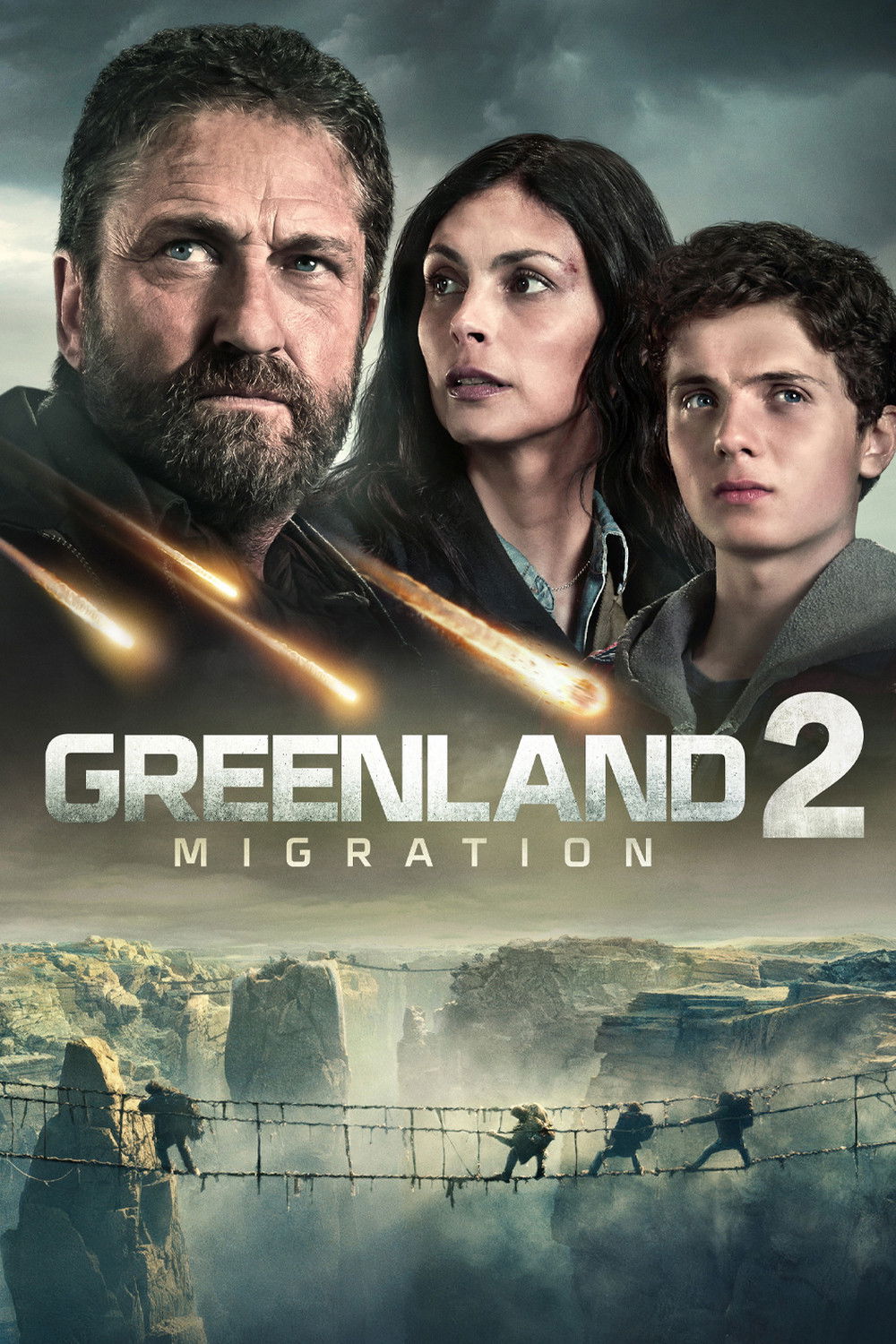
Greenland 2: Migration
Five years after extinction-level comet destroyed civilization, family evacuates collapsing Greenland bunker after tsunami kills most survivors, crosses devastated Europe toward rumored fertile impact crater while father dying from radiation sickness, reaches sanctuary but father succumbs to wounds after protecting family to safety.
Greenland 2: Migration — Plot Summary
Five Years Later
Five years after the Clarke interstellar comet destroyed most of Earth and human civilization, the planet's environment remains chaotic and unstable. Sudden electromagnetic storms can form without warning, lingering radioactive fallout contaminates many areas, and earthquakes continue as the planet's crust adjusts from the catastrophic impact. Earth has become a hostile, unpredictable environment where survival remains uncertain.
The Garrity family—John, Allison, and their now-teenage son Nathan—have survived since the disaster by living in an underground bunker near Thule Air Base in Greenland. The bunker community has developed its own structure: Allison has become a leader making decisions for the group, John works as a scout and engineer maintaining the community's infrastructure, and Nathan has grown into a teenager who aspires to become a scout like his father.
Without warning, severe earthquakes strike the bunker complex. The tremors cause catastrophic structural collapse throughout the facility. An emergency evacuation is ordered as the bunker becomes uninhabitable and dangerous.
During the chaotic evacuation, a massive tsunami—triggered by underwater seismic activity or coastal collapse—hits the area. Most of the bunker survivors are killed by the rushing water. The facility is completely destroyed, eliminating the shelter that had protected hundreds of people for five years.
Escape and Separation
The Garritys manage to escape the destruction along with Dr. Amina, a survivor who has medical knowledge, and a handful of other refugees. They board a lifeboat and barely make it across the Atlantic Ocean to Liverpool, England. The journey is perilous, with the survivors exposed to the elements and uncertain whether they will reach land alive.
Upon arriving in Liverpool, the last Greenland survivors—already depleted in number—are separated during a violent gun battle. Desperate locals are trying to force their way into another rescue bunker in the area, creating chaos and violence. The Garritys become separated from some of their companions during the fighting.
The family eventually reunites and makes their way to London, where they recuperate from their ordeal and gather supplies for the next leg of their journey. They learn from survivor network communications that humanity has begun attempting to rebuild civilization in a specific location: the massive impact crater left by Clarke's largest fragment.
This crater, located in what was formerly the Gulf of Lion and the Mediterranean Sea, has reportedly become habitable. Rumors circulating through survivor networks claim that the crater area is heavily defended by organized military forces, that the land surrounding it is being farmed successfully, and that the tectonic instability and radiation problems that plague the rest of Earth have somehow ended in this region.
The Garritys decide to travel toward France and ultimately to the crater, hoping to find safety and a stable community where they can finally stop running.
Deterioration and Loss
During their preparations, the family learns devastating news: John is dying from radiation sickness. His years of work as a scout—traveling outside the bunker's protection to gather supplies and assess conditions—have exposed him to lethal doses of radiation. His condition is terminal, and he has limited time remaining.
The group, including Dr. Amina, sets out toward Dover to cross what remains of the English Channel. En route, they are attacked by bandits—desperate survivors who prey on travelers for their supplies and resources. During the attack, Dr. Amina is shot and killed, leaving the family without medical expertise and losing another companion.
The family reaches the English Channel and discovers it has been dramatically altered by the comet's impact. What was once a body of water separating England from France is now a dry, windswept wasteland. Climate and geological changes have drained the channel, creating a desolate landscape they must cross on foot.
In Calais, France, the Garritys encounter a French family that has survived in the ruins. The French family provides shelter and rest for the exhausted travelers. Before the Garritys depart, the French family makes a desperate request: take their daughter Camille with them to the crater region. They want their child to have a chance at life in the reportedly safe and fertile area, even if it means never seeing her again.
The Garritys agree to bring Camille with them, accepting responsibility for the girl's safety and future.
The Crater
As the expanded group approaches the crater region, they encounter the front lines of a raging military battle. Organized forces are defending the fertile crater area against outsiders attempting to enter—suggesting that the crater has become a highly valuable and contested territory where entry is strictly controlled.
The Garritys are recognized as legitimate refugees or have documentation/connections that allow them to be escorted behind the defensive lines rather than being turned away or killed as infiltrators.
While being transported deeper into the crater region, bandits ambush their military escort. A firefight erupts. During the battle, John is shot while defending Allison, Nathan, Camille, and the other survivors. Despite his wound, John survives the immediate attack and the group continues toward their destination.
The family finally reaches the crater itself. The rumors prove to be true: the impact site has become a region of fertile farmland with fresh lakes and clear skies completely free of the ash and electromagnetic energy storms that plague the rest of the planet. The massive destruction caused by the comet fragment's impact has somehow created conditions that allow this specific area to heal and become habitable while the rest of Earth remains hostile.
The survivors rest in a safe valley within the crater region, finally reaching the sanctuary they have been seeking for weeks of desperate travel.
However, John's gunshot wound and his underlying radiation sickness have taken their toll. Within sight of the goal he fought to reach—the safe new life for his family—John succumbs to his injuries and dies. He passes away satisfied, knowing that he successfully protected Allison and Nathan and brought them to safety. His final moments are peaceful, seeing that his family has reached a place where they can survive and rebuild their lives.
Greenland 2: Migration — Ending Explained
The ending validates John's sacrifice and his five years of exposure to radiation as a scout by showing he succeeded in protecting his family long enough to reach safety, though at the cost of his own life. His death within sight of the crater represents the common survivor's tragedy: enduring years of hardship only to die just before reaching sanctuary, making his sacrifice bittersweet rather than triumphant.
The crater's transformation into fertile land while the rest of Earth remains hostile suggests that catastrophic destruction can paradoxically create renewal, with the impact site becoming Eden-like through mechanisms the film doesn't explain scientifically. This narrative choice prioritizes symbolic rebirth over realistic portrayal of impact crater geology, which would typically remain toxic and barren for centuries.
Camille's inclusion in the family represents the expansion of survival units beyond blood relations to encompass adoptive kinship born from shared trauma, continuing the first film's theme that family is defined by who you protect rather than genetic connection. Her French parents' sacrifice mirrors John's—giving up everything to ensure the next generation reaches safety.
The military defense of the crater acknowledges that habitable land post-apocalypse becomes the most valuable resource, requiring armed protection against desperate refugees. The film suggests that even in rebuilding, humanity will replicate pre-disaster patterns of militarized borders and violent exclusion, with the crater becoming a fortress rather than welcoming sanctuary for all survivors.
Nathan's loss of his father just as they reach safety positions him as the next generation who must build the new world without the guidance of those who remember the old one. His teenage status suggests he'll reach adulthood in the crater, making him part of the first generation raised entirely in post-comet civilization.
Greenland 2: Migration — FAQ
Why did the Greenland bunker fail after five years?
The film attributes the bunker's collapse to ongoing seismic activity from the comet impact—earthquakes continuing to destabilize the region five years later. The tsunami that kills most survivors suggests the bunker was built in a geologically vulnerable location that couldn't withstand long-term tectonic shifts, raising questions about why such a critical facility was placed in a high-risk zone.
How is the crater habitable when impact sites should be toxic?
The film doesn't explain the scientific mechanism that makes the crater fertile and radiation-free while the rest of Earth remains hostile. Realistically, a 9-mile-wide impactor would create a crater remaining uninhabitable for centuries due to heat, radiation, toxic debris, and geological instability. The film prioritizes symbolic rebirth narrative over scientific accuracy.
Why has the English Channel drained?
The film suggests that geological and climate changes from the comet impact have altered sea levels or terrain so dramatically that the English Channel has become a dry wasteland. This could result from tectonic uplift, massive sea-level drops from ocean evaporation during nuclear winter, or redirection of ocean currents, though specific mechanisms aren't explained.
What happened to the other bunkers mentioned in the first film?
The film implies most other survival bunkers have either been destroyed by ongoing environmental catastrophes (earthquakes, tsunamis, storms) or are heavily contested by desperate survivors trying to force entry. The Liverpool gun battle suggests that functioning bunkers have become fortresses violently defended against refugees, making them inaccessible to most survivors.