Defiance
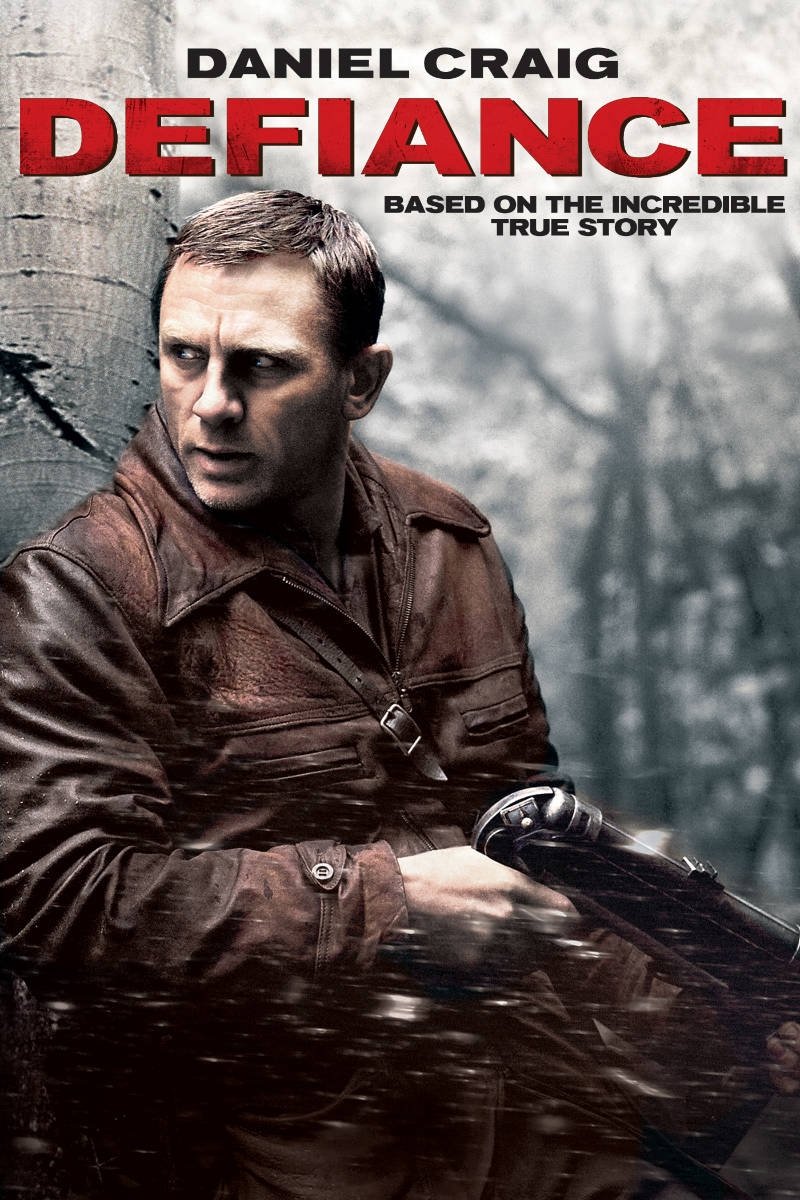
Jewish brothers fleeing Nazi extermination establish a forest refuge that grows into a community of 1,200 survivors, conducting raids for supplies while navigating internal conflicts, Soviet partisan alliances, and a climactic German assault during their two-year resistance in occupied Belarus.



Defiance Plot Summary
Extermination and Escape
August and September 1941 mark the early weeks following Nazi Germany’s invasion of the Soviet Union. Behind the rapidly advancing German military forces, Einsatzgruppen death squads sweep across the occupied western regions of the USSR. Their systematic mission is exterminating the Jewish population through mass shootings and other methods. Many Jews are forced into German-enforced ghettos, but some manage to escape into the countryside.
Among the survivors are the Bielski brothers: Tuvia, Zus, Asael, and the youngest, Aron. Their parents are murdered by local Schutzmannschaft—auxiliary police collaborators recruited from the local population—acting under orders from German occupiers. The brothers flee to the Naliboki forest, a vast wilderness that offers concealment from German patrols.
In the forest, they encounter other Jewish escapees already hiding among the trees. The Bielskis take these survivors under their protection, establishing themselves as defenders. Tuvia tracks down and kills the Schutzmannschaft chief personally responsible for ordering their parents’ execution, exacting revenge for his family.
The brothers soon encounter more Jewish refugees fleeing the ghettos and massacres. Among these survivors, Zus learns devastating news: his wife and child have been killed, joining the countless victims of the German extermination campaign.
Building Community
Over the following year, the number of Jewish refugees seeking protection with the Bielskis grows substantially. What begins as a small band of survivors evolves into a forest community requiring organization and rules. Tuvia, as the eldest brother, establishes guidelines for their camp. Everyone must contribute work to the collective survival. He also forbids pregnancies, recognizing that infants and pregnant women would be liabilities in their precarious situation.
The group conducts raids on local farms to acquire food and essential supplies. They also stage attacks against German forces and their collaborators, functioning as irregular fighters while protecting refugees. Whenever German patrols discover their location, the camp relocates deeper into the forest, maintaining mobility as their primary defense.
However, mounting casualties force Tuvia to reconsider their tactical approach. As the eldest brother and camp leader, he prioritizes minimizing Jewish deaths above all other considerations. Zus, younger and more aggressive, advocates for bolder, more militant operations against the Germans despite increased risk to their people.
Division and Alliance
As winter approaches, the disagreement between Tuvia and Zus intensifies until it reaches a breaking point. Zus departs the camp, taking several followers who share his more militant philosophy. They join a local company of Soviet partisans, integrating into the organized resistance movement.
Despite this division, the brothers negotiate an arrangement between the two groups. The Soviet partisans agree to provide protection for the Jewish forest camp in exchange for supplies the refugees can provide through their raids. The alliance is pragmatic rather than ideological.
Zus confronts antisemitism within the Soviet partisan ranks after one of his Jewish fighters is assaulted for using a Russian latrine. The incident reveals that even among those fighting Nazi Germany, prejudice against Jews persists.
Asael, the third brother remaining with Tuvia’s group, marries Chaya in a forest ceremony, creating moments of normalcy and hope amid the constant danger.
Winter Crisis
Tuvia’s group endures a brutal winter characterized by sickness, starvation, and growing discontent among the refugees. The harsh conditions strain their cohesion and test Tuvia’s leadership. He is forced to sacrifice his horse—a valuable asset for mobility and labor—to feed his starving people.
Arkady, a known refugee and bully within the camp, assaults Asael and declares himself the new leader in an attempted mutiny. Tuvia shoots and kills Arkady, reasserting his authority and demonstrating he will use deadly force to maintain order.
Later, Tuvia discovers that one of the women in camp has been hiding her pregnancy, violating his explicit rule. He considers expelling her from the camp, recognizing that her deception undermines his authority. However, Lilka, another camp member, convinces him to show mercy by revealing the woman was raped by Nazis. The pregnancy was not a choice but a consequence of violence. Tuvia relents, allowing the woman to remain.
German Assault
The camp captures a German soldier during one of their operations. Through interrogation, they learn that German forces are planning a major assault on their forest location, scheduled for Passover. The angry refugees, frustrated by months of fear and deprivation, beat the captured soldier to death.
The Soviet partisans, learning of the impending German attack, decide to retreat eastward to avoid confrontation. Zus refuses to comply with the partisan commander’s order, unwilling to abandon the Jewish camp to face the German assault alone.
Tuvia’s group prepares to evacuate the day before Passover. As they begin their retreat, Luftwaffe Stuka dive bombers attack, dropping bombs on the forest camp and causing casualties. Asael leads a delaying force that stays behind to slow the advancing German infantry, allowing the main group time to escape. The defense is brief—only Asael and one other defender survive to rejoin the fleeing refugees.
The escaping group reaches the forest’s edge and confronts a seemingly impassable marsh. They have no choice but to attempt crossing through the water and mud. Shimon Haretz becomes the only casualty during the treacherous crossing, dying in the marsh.
Final Stand
Upon emerging from the marsh, the exhausted refugees are immediately attacked by a German platoon supported by a Panzer III tank. Outgunned and exhausted, the Jewish fighters face annihilation. The tank’s armor makes it impervious to their small arms, and the German infantry prepares to finish them.
Just as the situation becomes hopeless, the Germans are assaulted from behind. Zus and his fighters have deserted the Soviet partisans and returned to rejoin the Jewish group. Their surprise attack from the rear disrupts the German assault, saving the refugees from destruction and reuniting the Bielski brothers.
Legacy
The Bielski partisans continued living in the Naliboki forest for two more years after this battle. Their community grew to 1,200 Jews—men, women, and children who survived the Holocaust in the forest. They built infrastructure including a hospital, a nursery for children, and a school, creating a functioning society in the wilderness.
Asael joined the Red Army after the forest community dissolved and was killed in action six months later. Zus, Tuvia, and Aron survived the war and emigrated to the United States, settling in New York City where they established a small trucking business.
The Bielski brothers never sought public recognition for their actions during the war. The descendants of the 1,200 people they saved now number tens of thousands.