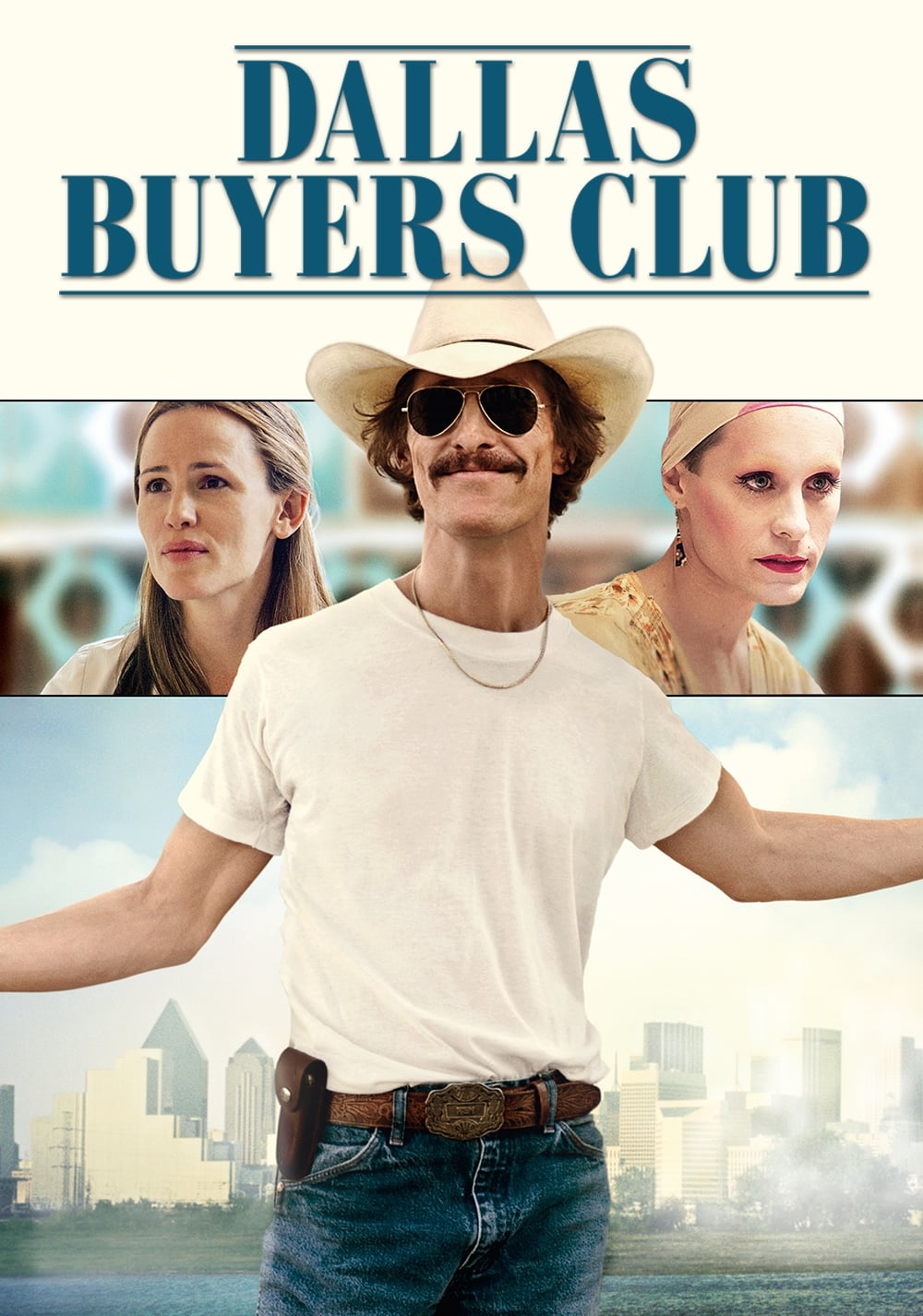
Dallas Buyer Club
In the 1980s, a determined Texas electrician refuses to accept the limits of conventional treatment after a shocking diagnosis. He embarks on an unconventional mission to access alternative medications, challenging authorities and helping others along the way.
Dallas Buyer Club — Plot Summary
Dallas, Texas, 1985. Ron Woodroof is a promiscuous electrician and rodeo cowboy living a hard-partying lifestyle characterized by heavy drinking, cocaine use, and casual sex. He is diagnosed with HIV/AIDS and given a devastating prognosis: approximately 30 days to live.
Initially, Woodroof refuses to accept the diagnosis, dismissing it as impossible. However, he is forced to confront reality when he remembers having unprotected sex with a prostitute who was an intravenous drug user—a high-risk encounter that could have transmitted the virus.
Woodroof's family and friends ostracize him after learning of his diagnosis. In the mid-1980s, AIDS was widely misunderstood and heavily stigmatized as a "gay disease." Despite Woodroof's heterosexuality and his history with women, people mistakenly assume he contracted AIDS through homosexual sex. The social stigma is devastating: Woodroof is fired from his job and evicted from his home.
AZT Trial
Woodroof's doctor, Eve Saks, informs him about an antiretroviral drug called zidovudine, commonly known as AZT. This is the only drug that has been approved for testing in human clinical trials by the FDA for AIDS treatment. Dr. Saks explains that the trial follows standard double-blind protocol: half the patients receive AZT while the other half receive a placebo. This methodology is considered necessary to scientifically determine whether the drug actually works.
Desperate for any potential treatment, Woodroof bribes a hospital worker to obtain AZT for him outside the clinical trial. However, Woodroof's continued cocaine and alcohol abuse, combined with AZT, causes his health to deteriorate rather than improve.
While recuperating in the hospital, Woodroof meets Rayon, a drug-addicted, HIV-positive transgender woman. Woodroof is initially hostile toward Rayon, displaying the homophobia and transphobia common in his social circles.
Mexican Alternative
As his health continues to worsen on AZT, Woodroof drives across the border to a makeshift hospital in Mexico seeking more of the drug. The facility is run by Dr. Vass, an American physician whose medical license was revoked in the United States because his work treating people with AIDS violated U.S. regulations.
Dr. Vass delivers shocking information: he warns Woodroof that AZT is "poisonous" rather than therapeutic. Instead of prescribing AZT, Dr. Vass provides Woodroof with a cocktail of alternative drugs and nutritional supplements. The regimen centers on ddC (another antiretroviral) and peptide T (a protein). Neither drug has been approved for use in the United States by the FDA, making them illegal to import or sell domestically.
Three months later, Woodroof finds his health has improved dramatically on Dr. Vass's alternative treatment protocol. The improvement is stark compared to his deterioration on AZT. Woodroof realizes he has discovered both a personal lifeline and a potential business opportunity: he could import these unapproved drugs and sell them to other HIV-positive patients who are dying while waiting for FDA approval of effective treatments.
Woodroof begins smuggling drugs across the border by disguising himself as a priest with cancer, claiming the medications are for personal use only. This disguise and justification allows him to transport drugs that would otherwise be seized as contraband.
The Buyers Club
Back in Dallas, Dr. Saks begins noticing the adverse effects that AZT is having on her patients in the clinical trial. However, when she raises concerns, her supervisor Dr. Sevard tells her the trials cannot be discontinued despite evidence of harm. The institutional momentum behind AZT is too strong to stop based on emerging safety concerns.
Woodroof begins selling his imported drugs on the streets of Dallas, at gay nightclubs, and at discotheque bars—locations where HIV-positive individuals congregate. He reluctantly forms a partnership with Rayon, recognizing that she can bring in more customers from the LGBT community who initially distrust the straight, homophobic cowboy.
To circumvent laws that make it illegal to sell unapproved drugs, Woodroof and Rayon establish the Dallas Buyers Club. Rather than directly selling drugs, they charge $400 per month for club membership and give the drugs away to members as membership benefits. This legal structure attempts to avoid prosecution for drug sales.
The Dallas Buyers Club becomes extremely popular as word spreads about alternative treatments that appear more effective and less toxic than AZT. Through his partnership with Rayon and his interactions with dying club members, Woodroof gradually begins to respect Rayon as a friend. His homophobia and transphobia diminish as he recognizes their shared humanity and struggle against both disease and institutional indifference.
FDA Conflict
Woodroof is hospitalized for a heart attack caused by an overdose of interferon, a drug he recently acquired from Japan and added to his product line. During his hospitalization, Dr. Sevard learns about the Dallas Buyers Club and its distribution of alternative, unapproved drugs. Sevard is furious that the buyers club is interfering with his AZT clinical trial by providing patients with alternative options that reduce enrollment and compliance.
The FDA confiscates Woodroof's supply of interferon and threatens to arrest him for importing and distributing unapproved drugs. Dr. Saks privately agrees that buyers clubs provide genuine benefits for HIV patients who have few options, but she feels powerless to change the system from within the medical establishment.
The FDA's process for researching, testing, and approving drugs is widely criticized as flawed and inadequate for addressing the AIDS crisis. At this time, the United States and the FDA are particularly conservative by international standards regarding anti-AIDS drugs. The FDA treats imported drugs as contraband even when they are legal and widely used in other countries, prioritizing regulatory authority over patients' access to potentially life-saving treatments.
Dr. Saks and Woodroof develop a friendship based on their shared frustration with the institutional barriers preventing effective AIDS treatment.
Regulatory Crackdown
The FDA obtains a warrant to raid the Dallas Buyers Club. However, because of the club's membership structure, the FDA can do nothing beyond imposing a fine—they cannot arrest Woodroof for drug sales since he is technically giving drugs away to members rather than selling them directly.
In 1987, the FDA changes its regulations to make any unapproved drug illegal, closing the loophole that the buyers club had exploited. The new regulations threaten to shut down the club entirely.
With the club financially struggling under regulatory pressure and legal costs, Rayon takes desperate action. She begs her estranged father for money to keep the club operating. When he refuses, Rayon tells Woodroof that she has sold her life insurance policy to raise funds for the club.
Woodroof travels to Mexico to obtain more peptide T—the protein that has become central to their treatment protocol. Upon his return to Dallas, he discovers that Rayon has died in the hospital during his absence. Woodroof is extremely upset by her death, having come to deeply care for the woman he initially despised.
Dr. Saks faces professional consequences for her support of the buyers club. When the hospital administration discovers she has been sending patients to the buyers club, they ask her to resign. Dr. Saks refuses to resign and insists they will have to fire her instead, forcing the hospital to take official action rather than allowing them to quietly remove her.
Transformation and Legal Battle
After Rayon's death, Woodroof undergoes a profound personal transformation. He begins showing much more compassion toward LGBT members of the club, recognizing them as individuals rather than stereotypes. Making money becomes less of a concern; his priority shifts to ensuring club members can access the drugs they need, even as peptide T becomes increasingly difficult to acquire due to regulatory restrictions.
In late 1987, Woodroof files a lawsuit against the FDA. He seeks the legal right to take peptide T, which has been scientifically confirmed as nontoxic but remains unapproved by the FDA. The case represents a broader challenge to the FDA's authority to prevent dying patients from accessing drugs that are safe even if not yet proven effective through lengthy clinical trials.
The judge hearing the case is sympathetic toward Woodroof and his arguments. He publicly admonishes the FDA for its rigid approach to AIDS drugs. However, the judge acknowledges he lacks the legal power to override FDA regulations or force the agency to approve specific drugs.
As a compromise, the FDA eventually allows Woodroof to take peptide T for personal use only, though the drug remains unapproved for general prescription or distribution.
Legacy
Ron Woodroof dies of AIDS-related complications in 1992—seven years longer than his doctors initially predicted when they gave him 30 days to live in 1985. His survival demonstrates both the inadequacy of early AIDS treatments like high-dose AZT and the potential benefits of alternative drug cocktails that he and Dr. Vass pioneered.
Dallas Buyer Club — Ending Explained
The ending validates Woodroof's rebellion against FDA restrictions by demonstrating he lived seven years beyond his 30-day prognosis, suggesting that alternative drugs and patient autonomy extended his life in ways the approved medical establishment could not. His survival serves as powerful anecdotal evidence that the FDA's conservative approval process was killing patients by denying access to potentially beneficial drugs during a health crisis.
Rayon's death before the film's conclusion emphasizes that not everyone survived long enough to benefit from the buyers club or to see the eventual development of effective AIDS treatments in the 1990s, reminding viewers that Woodroof's success story exists alongside thousands of failures. Her death also demonstrates that access to alternative drugs was not a miracle cure but simply gave patients better odds than AZT alone provided.
Woodroof's transformation from homophobic cowboy to compassionate advocate for the LGBT community represents the film's moral arc, suggesting that proximity to suffering and shared struggle against institutional indifference can overcome prejudice. His journey from viewing Rayon with contempt to mourning her death and fighting for LGBT club members illustrates how the AIDS crisis forced unlikely alliances and changed attitudes among people who might otherwise never have questioned their bigotry.
The judge's sympathy combined with legal powerlessness reflects the institutional barriers AIDS activists faced—even sympathetic officials lacked authority to override regulatory frameworks designed for normal circumstances rather than health emergencies. The FDA's eventual allowance of peptide T for Woodroof's personal use demonstrates that bureaucracies can make individual exceptions while maintaining institutional resistance to systemic change.
The film's conclusion that Woodroof died in 1992 rather than 1985 frames the buyers club as a success by the metric of extended life, though the ending also implicitly acknowledges that without the eventual development of protease inhibitors and highly active antiretroviral therapy in the mid-1990s, even alternative treatments only delayed rather than prevented AIDS deaths. Woodroof lived long enough to benefit from his activism but not long enough to see truly effective AIDS treatment.
Dallas Buyer Club — FAQ
Was Ron Woodroof a real person?
Yes. Ron Woodroof was a real Dallas electrician who was diagnosed with AIDS in 1986 (the film changes this to 1985), established the Dallas Buyers Club to distribute alternative AIDS treatments, and died in 1992. However, the film significantly dramatizes and fictionalizes many aspects of his story, including creating the composite character Rayon (Woodroof's actual business partner was not transgender) and simplifying complex medical and legal battles into streamlined narrative.
Was AZT actually "poisonous" as Dr. Vass claimed?
This remains controversial. Early AZT trials used very high doses that did cause severe side effects, leading to legitimate concerns about toxicity. However, later studies with lower doses showed AZT could extend life when used properly. The film presents a simplified version of complex debates about AZT dosing, timing, and combination with other drugs, portraying AZT more negatively than current medical consensus supports.
Did the FDA really treat imported AIDS drugs as contraband?
Yes. During the 1980s, the FDA prohibited importation of unapproved drugs even if they were legally prescribed in other countries, making AIDS patients who traveled abroad for treatment risk having medications seized at customs. This policy was widely criticized during the AIDS crisis and eventually led to regulatory reforms allowing personal importation of small quantities of unapproved drugs for serious illnesses.
What happened to the Dallas Buyers Club after Woodroof's death?
The Dallas Buyers Club continued operating briefly after Woodroof's death but eventually closed as FDA policies evolved to allow faster approval of AIDS drugs and as protease inhibitors became available in the mid-1990s, transforming AIDS from a death sentence into a manageable chronic condition for those with access to treatment.