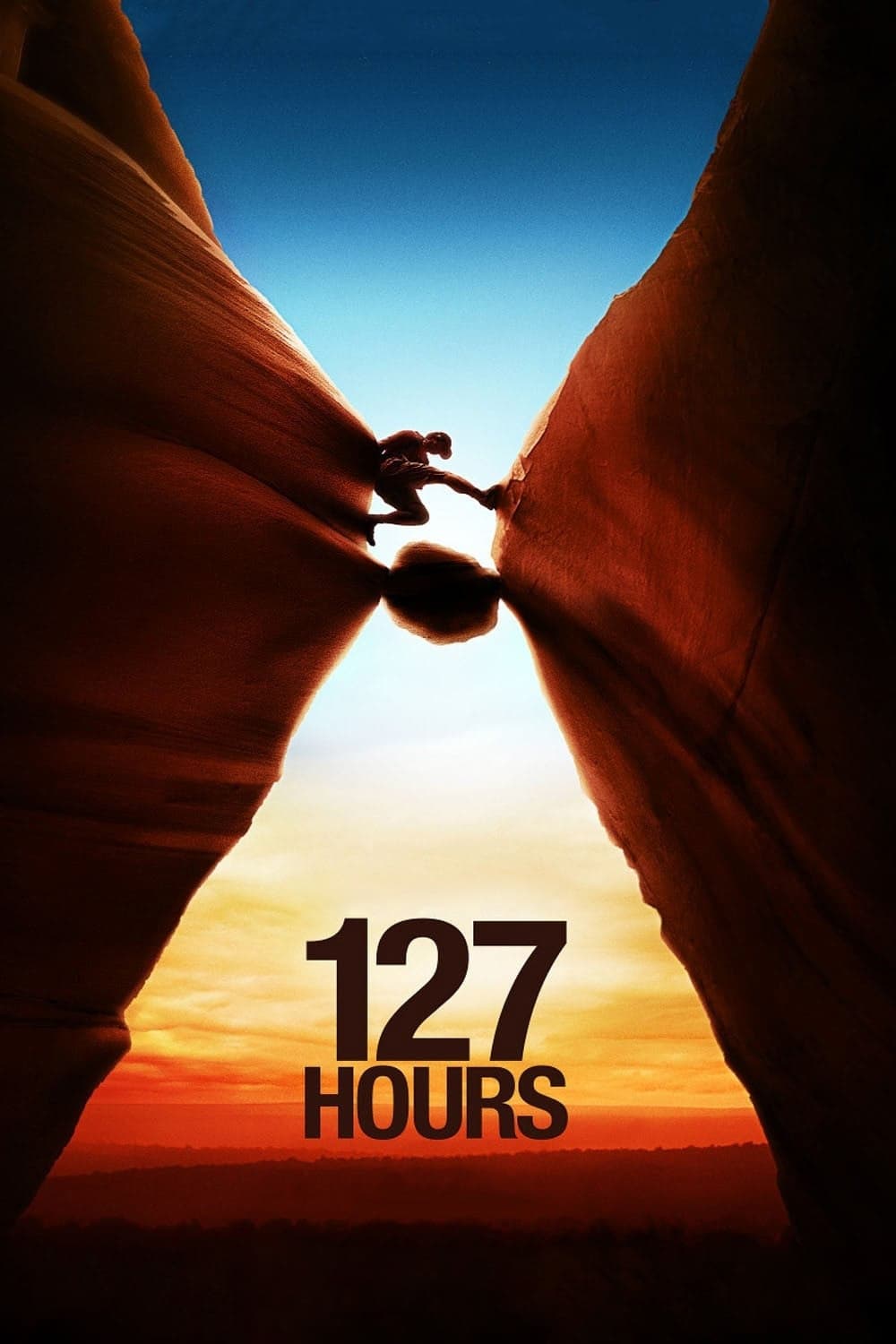
127 Hours
An adventurous outdoorsman embarks on a solo canyon expedition that suddenly turns into a life-changing fight for survival. Isolated in the wilderness, he must rely on ingenuity, endurance, and determination while confronting the limits of human resilience.
127 Hours — Plot Summary
Setting Out Alone
April 26, 2003. Aron Ralston, an avid mountaineer and experienced outdoorsman, prepares for a solo hiking trip to Utah's Canyonlands National Park. He packs his equipment, including climbing gear, a camcorder, a multi-tool, a cheap pocket knife, and a small amount of water and food. However, Aron makes a critical decision: he does not tell anyone where he is going or how long he plans to be gone. This violation of basic hiking safety protocol will have nearly fatal consequences.
While hiking through the canyons, Aron encounters two women, Kristi and Megan, who are lost and trying to find their way. Aron befriends them and offers to guide them. He shows them an underground pool hidden within the canyon system—a beautiful natural formation accessible through narrow passages. The three hikers swim and have fun exploring the pool together.
That afternoon, as they prepare to part ways, Kristi and Megan invite Aron to a party being held the following night. Aron expresses half-hearted interest, giving a noncommittal response. The women head home, and Aron says goodbye, continuing deeper into the canyon system alone.
The Accident
Aron proceeds through a slot canyon in Bluejohn Canyon—an extremely narrow passage carved through rock by erosion over millennia. While climbing through the confined space, he hangs from an 800-pound boulder wedged between the canyon walls. As Aron shifts his weight, the boulder comes loose. Both Aron and the massive rock fall together down into the narrow slot.
The boulder pins Aron's right arm against the canyon wall, trapping him completely. He attempts to move the boulder using his free hand and his body weight, but the 800-pound rock does not budge even slightly. The boulder has him trapped in a position where he cannot generate enough leverage or force to shift it.
Aron quickly realizes the severity of his situation. He is alone in a remote slot canyon that few people visit. He did not tell anyone where he was going. No one knows to look for him. He is trapped with limited water and food, and the boulder crushing his arm shows no sign of being movable through his available strength.
First Days
Aron begins recording a video diary using his camcorder. The recordings serve multiple purposes: maintaining his morale by giving him someone to "talk" to, documenting what happened in case his body is eventually found, and creating messages for his family if he dies.
He attempts to chip away parts of the boulder using his pocket knife, hoping to create enough space to pull his arm free. The work is extraordinarily slow—the boulder is solid rock, and his cheap knife makes minimal progress despite hours of scraping and chipping.
At one point during his efforts, the knife slips from his hand and falls. Given his trapped position, Aron cannot simply bend down to retrieve it. He is forced to use his bare feet to manipulate the knife—using his toes to grip it and his other foot to maneuver it, along with a small branch he can reach, to eventually recover the blade. The incident demonstrates how his trapped position makes even simple tasks nearly impossible.
Over the next five days, Aron carefully rations his small supply of food and his 300ml of water—barely more than one cup. He struggles to keep warm during the cold desert nights, as the narrow slot canyon provides no protection from temperature drops. When his water supply runs out completely, Aron is forced to drink his own urine to avoid dehydration, despite the knowledge that this provides only temporary relief and further concentrates toxins in his system.
Aron attempts to create a pulley system using his climbing rope, hoping mechanical advantage will allow him to lift or shift the boulder. He works for hours setting up the system, but when he applies force, the boulder still does not move. The attempt fails completely.
Deterioration
Throughout the days of entrapment, Aron's physical and mental condition deteriorates. He becomes increasingly desperate and depressed. His body weakens from dehydration, starvation, and the trauma of his crushed arm. He begins experiencing hallucinations—vivid visions that blur the line between memory, imagination, and hope.
He hallucinates about escape scenarios where he is free from the canyon. He relives memories of relationships and past experiences, including time with his family and with his former girlfriend, Rana. He also imagines attending the party that Kristi and Megan invited him to, visualizing himself having fun with them instead of being trapped.
During one particularly significant hallucination, Aron realizes and acknowledges his critical mistake: he did not tell anyone where he was going or for how long. This realization comes too late to change his situation, but it represents acceptance that his current predicament resulted from his own poor judgment rather than unforeseeable bad luck.
Vision and Decision
On the sixth day of entrapment, Aron has a vision that transforms his will to survive. He sees his future son—a young boy reaching up toward him. The vision is extraordinarily vivid and emotionally powerful. Whether the vision represents hallucination, premonition, or desperate hope is ambiguous, but it spurs Aron's determination to survive at any cost.
Aron realizes that his only chance of survival requires amputating his own arm. He has been trapped for nearly six days. No rescue is coming because no one knows where to look for him. His water and urine are gone, meaning dehydration will kill him within hours or perhaps a day. The arm trapped under the boulder has likely suffered irreversible damage from crushing injury and lack of circulation. His only option is self-amputation.
Amputation
Aron prepares systematically for the amputation. He fashions a tourniquet from insulation material taken from his CamelBak hydration pack. He uses a carabiner—a metal climbing clip—to tighten the tourniquet around his upper arm, cutting off blood flow to prevent him from bleeding to death during and after the amputation.
Using his knowledge of physics and torque, Aron positions his body to apply force against his trapped forearm. He breaks the radius and ulna bones in his arm by bending them against the boulder edge. The bones snap, creating the opportunity to cut through the remaining soft tissue without needing to saw through bone using his inadequate knife.
Aron uses the multi-tool—a folding knife with various blades and tools—to slowly amputate his arm. He cuts through skin, muscle, tendons, and nerves over an agonizing period. The multi-tool's dull blade makes the process slow and extraordinarily painful. Throughout the amputation, Aron maintains focus on survival, knowing that hesitation or losing consciousness could still result in death.
After successfully severing his arm, Aron wraps the stump to prevent exsanguination—death from blood loss. He takes a photograph of the boulder that trapped him for nearly 127 hours, documenting what caused his ordeal.
Escape
Free from the boulder but severely injured and weakened, Aron must still escape the canyon. He rappels down a 65-foot rockface using his climbing rope, managing the technical descent with only one arm while in shock and weakened from days without food or water.
After descending, Aron discovers rainwater that has collected in natural rock depressions. Despite the water being stagnant and likely containing bacteria, Aron drinks it desperately, prioritizing immediate hydration over concerns about waterborne illness. He continues hiking toward where he hopes to find help.
Aron spots a family—parents and children—on a recreational hike in the desert. He calls out for help. The family, shocked by his appearance and condition, immediately gives him water and uses their communication device to alert authorities about his location and condition.
A Utah Highway Patrol rescue helicopter arrives and airlifts Aron to a hospital. Medical professionals treat his dehydration, his amputated arm, and other injuries sustained during his six-day ordeal.
Aftermath
Years after the incident, Aron recovers and continues living an active life. He gets married and has a son—fulfilling the vision that motivated him to survive during his darkest moment in the canyon. The vision that seemed like desperate hallucination proved to be, in some sense, accurate.
Aron continues climbing and mountaineering, refusing to let the loss of his arm end his passion for outdoor adventure. However, he fundamentally changes one critical habit: he always leaves a detailed note telling his family exactly where he has gone and when he expects to return. He never again makes the mistake that nearly killed him.
127 Hours — Ending Explained
The ending validates Aron's vision of his future son as either premonition or self-fulfilling prophecy—whether the vision revealed an actual future or created the motivation that made that future possible remains ambiguous, but Aron does eventually have the son he saw during his darkest moment. The vision's accuracy suggests that survival instinct can manifest as hallucinated hope that becomes real through the determination it inspires.
Aron's decision to continue climbing after losing his arm demonstrates that the ordeal, while traumatic, did not destroy his identity or force him to abandon what he loves. The amputation took his arm but not his spirit or passion. His continued mountaineering represents refusing to let trauma define or limit him, choosing instead to adapt and persist.
The contrast between Aron never telling anyone his plans before the accident and always leaving detailed notes afterward illustrates learning through catastrophic experience. The lesson that basic safety protocols matter was learned at the cost of his arm and nearly his life. His changed behavior represents integrating this lesson permanently rather than treating his survival as luck that allows him to continue risky behavior unchanged.
The film's ending emphasizes that survival required not just physical endurance but also psychological resilience and willingness to inflict extraordinary pain on himself. The amputation scene demonstrates that self-preservation instinct can overcome even the most intense physical and psychological barriers when death is the alternative. Aron's survival resulted from his choice to endure unbearable pain rather than accept death.
The family Aron builds after the ordeal represents recovery and normalcy after trauma. He does not remain defined solely by being "the man who cut off his arm" but instead becomes a husband and father who also happens to have experienced and survived extraordinary circumstances. The ending suggests that trauma, even when it permanently changes someone physically, need not prevent building a fulfilling life.
127 Hours — FAQ
Is 127 Hours based on a true story?
Yes. The film depicts the actual ordeal of Aron Ralston, who was trapped by a boulder in Bluejohn Canyon, Utah, from April 26 to May 1, 2003. Ralston wrote a memoir titled "Between a Rock and a Hard Place" detailing his experience. The film accurately portrays the major events, though some elements are dramatized or condensed for cinematic purposes.
Did Aron really see a vision of his future son?
According to Ralston's own account, he did experience a powerful vision of a future son during his ordeal, which motivated his decision to amputate his arm and survive. He later married and had a son, making the vision seemingly prophetic. Whether the vision represented genuine premonition, subconscious desire manifesting as hallucination, or retrospective meaning-making remains subject to interpretation.
What happened to Aron's severed arm?
Rangers recovered Aron's arm from under the boulder after his rescue. The arm was cremated and the ashes were given to Ralston. He later scattered the ashes at the site where the accident occurred. The boulder itself remains in Bluejohn Canyon where it fell, essentially serving as a monument to Ralston's ordeal.
How long did the actual amputation take?
Ralston has stated that the entire amputation process took approximately one hour, though the film compresses this timeline for dramatic purposes. The process included breaking the bones, cutting through soft tissue, and wrapping the wound—all while in extreme pain, in shock, and severely dehydrated after nearly six days without food or water.