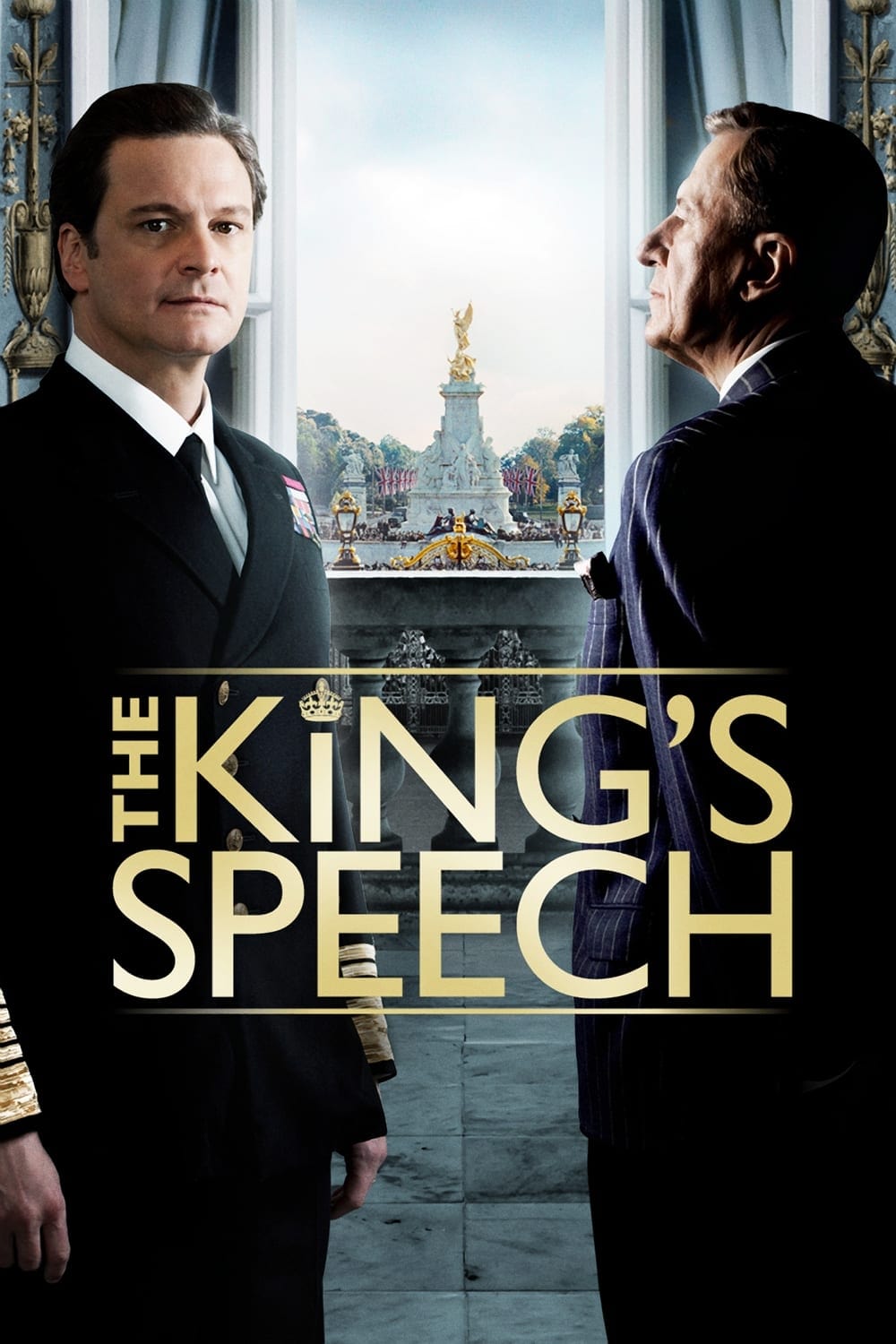
The King’s Speech
A reluctant royal battles crippling self-doubt and a severe speech impediment as war looms over Britain. With the help of an unconventional therapist, he must find the courage and voice to inspire a nation in its darkest hour.
The King’s Speech — Plot Summary
The Stammer
At the official closing ceremony of the British Empire Exhibition at Wembley Stadium, Prince Albert—known as "Bertie" to his family—Duke of York and second son of King George V, steps forward to address the massive crowd. As he begins speaking into the microphone, he struggles with a severe stammer, unable to get words out smoothly. The agonizing public speech is humiliating for both Bertie and the listening audience.
Bertie has been searching desperately for treatment to overcome his speech impediment, but every therapy and specialist he has tried has proven discouraging and ineffective.
His wife, Elizabeth, Duchess of York, refuses to give up. She persuades a reluctant Bertie to see Lionel Logue, an Australian-born speech therapist who works with people suffering from speech defects. Bertie is skeptical but agrees to try one session.
The First Session
The initial appointment does not go well from Bertie's perspective. Lionel's unconventional methods and informal manner—he insists on calling the Duke "Bertie" rather than using proper royal titles—irritate the prince, who is accustomed to deference and formal protocol.
However, Lionel has a plan. He asks Bertie to recite Hamlet's famous "To be, or not to be" soliloquy while listening to classical music playing loudly through headphones. This prevents Bertie from hearing his own voice as he speaks. Bertie finds the exercise frustrating and believes it accomplished nothing.
As Bertie prepares to leave, convinced the session was a failure, Lionel gives him an acetate recording he made of Bertie's reading as a souvenir. Bertie takes it dismissively, certain it will only demonstrate his inability to speak properly.
The Wireless Age
After King George V broadcasts his 1934 Royal Christmas Message over the radio—a relatively new technology reaching millions of homes—he explains something crucial to Bertie: the wireless will play an increasingly significant role in the modern monarchy. Radio allows the royal family to enter directly into the homes of ordinary people, making public speaking ability essential for future kings.
George V is particularly concerned because Bertie's older brother, Edward (called David by the family), the heir to the throne, is neglecting his royal responsibilities. This makes it necessary for Bertie to be trained in public speaking and radio broadcasts as a potential backup.
When Bertie attempts to practice reading the Christmas message himself, the effort is a complete failure—his stammer makes the text nearly impossible to deliver.
That night, discouraged and desperate, Bertie plays the recording Lionel gave him. He is absolutely astonished to discover that the recording reveals almost no stutter at all. When he couldn't hear himself speak, when the music blocked his self-consciousness, his words flowed smoothly.
This revelation convinces Bertie to return to Lionel. He begins daily treatment sessions designed to address both the physical mechanics of his speech and the psychological roots underlying his stammer.
The Constitutional Crisis
King George V dies in 1936. His eldest son David ascends to the throne as King Edward VIII, becoming the new monarch.
However, a massive constitutional crisis quickly develops. Edward has fallen in love with Wallis Simpson, an American socialite who has been divorced twice. Edward wants to marry her, but this creates an impossible situation: as King, Edward serves as Supreme Governor of the Church of England, which forbids remarriage after divorce when former spouses are still living. Both of Wallis Simpson's ex-husbands are alive, meaning the Church cannot sanction the marriage even if her second divorce is finalized.
During an unscheduled therapy session with Lionel, Bertie expresses deep frustration. While his speech has improved significantly in most situations, he still stammers severely when talking to his brother David. During this conversation, Bertie simultaneously reveals the full extent of Edward VIII's reckless obsession with Simpson and the constitutional disaster unfolding.
When Lionel suggests that Bertie himself could make a good king, Bertie reacts with fury. He accuses Lionel of treason for even suggesting such a thing and angrily storms out, ending their professional relationship.
The Abdication
The crisis comes to its inevitable conclusion: King Edward VIII decides to abdicate the throne in order to marry Wallis Simpson, choosing personal happiness over royal duty.
This decision forces the crown onto Bertie, who never wanted or expected to be king. Urged by Prime Minister Stanley Baldwin, Bertie reluctantly accepts that he must ascend the throne as King George VI.
Recognizing that he will need Lionel's help more than ever, Bertie and his wife Elizabeth visit Lionel's modest home before the coronation ceremony. Mrs. Logue is shocked to discover that her husband's mysterious client is actually the future King of England—Lionel had kept Bertie's identity confidential throughout their sessions.
The Coronation
As preparations begin for the coronation ceremony at Westminster Abbey, Bertie and Lionel's unconventional relationship comes under scrutiny from the King's official advisors.
The Archbishop of Canterbury, Cosmo Gordon Lang, raises serious objections. He points out that George VI never consulted his advisors about choosing Lionel as his speech therapist, and more importantly, that Lionel completely lacks any formal medical qualifications or credentials.
Lionel explains to an outraged Bertie that when he began working with speech defects, there were no formal qualifications or training programs available. His expertise came from practical experience helping Australian soldiers returning from the Great War who suffered from shell-shock and associated speech disorders.
Bertie remains unconvinced and angry—until Lionel deliberately provokes him. Lionel shows disrespect for King Edward's Chair (the coronation throne) and the Stone of Scone (an ancient symbol of Scottish monarchy). Bertie explodes in protest, defending the sacred symbols of his kingship.
Then Bertie realizes what just happened: he expressed himself clearly, forcefully, and without any impediment whatsoever. When he stopped worrying about stammering and focused on what he wanted to say, the words flowed naturally.
This breakthrough allows Bertie to rehearse properly with Lionel's guidance and successfully complete the elaborate coronation ceremony.
The War Speech
As King George VI, Bertie faces his greatest challenge in 1939 when Britain declares war on Nazi Germany. He must broadcast to the British people and the entire Empire—millions of listeners—at this moment of supreme national crisis.
Lionel is summoned to Buckingham Palace to prepare the King for this crucial speech. Understanding the immense challenge before George VI, Archbishop Lang, First Sea Lord Winston Churchill, and Prime Minister Neville Chamberlain all gather to provide support and witness the broadcast.
Bertie and Logue are left alone in the broadcasting room. As the microphone goes live, Bertie begins his speech with Logue standing nearby, conducting him like an orchestra conductor—using hand gestures and facial expressions to guide the King's breathing, pacing, and delivery.
Bertie struggles at first, but gradually, with Logue's supportive presence, he begins speaking more freely and confidently. The speech succeeds—the King addresses his nation clearly and powerfully during its darkest hour.
After the broadcast, Logue mentions with gentle humor that Bertie still struggles somewhat with pronouncing the letter "w." Bertie replies with a smile: "I had to throw in a few so they'd know it was me."
Friendship Endures
The Royal Family steps onto the palace balcony to acknowledge the cheering crowd gathered below. The people of Britain have heard their King speak, and they trust him to lead them through the coming war.
A closing title card explains what happened afterward: Lionel Logue was made a Commander of the Royal Victorian Order in recognition of his services to the Crown. He remained present at King George VI's side for all his wartime speeches, providing support and guidance throughout the conflict.
The two men maintained their close friendship until King George VI's death from lung cancer in 1952, their bond transcending the vast difference in their social stations.
The King’s Speech — Ending Explained
The ending's focus on the successful war declaration speech demonstrates that Bertie's journey was preparation for this singular crucial moment when Britain needed a king who could inspire confidence through clear communication during existential crisis. His personal triumph over stammering becomes national triumph over self-doubt entering World War II.
Logue's presence during the broadcast despite his lack of formal credentials validates practical expertise and personal connection over institutional authority, with the King choosing the therapist who actually helped him rather than credentialed experts who failed. Their friendship transcending class barriers represents the democratic spirit Britain would need to survive the war.
Bertie's joke about deliberately including stammers "so they'd know it was me" reframes his impediment from shameful weakness into distinctive characteristic, demonstrating self-acceptance rather than elimination of difference. His ability to laugh about his continuing struggles shows growth from humiliated prince to confident king comfortable with imperfection.
The revelation that Logue attended all wartime speeches positions their relationship as essential to Britain's war effort rather than personal medical matter, elevating speech therapy to strategic national importance. George VI's clear communication became weapon against Nazi propaganda portraying democracies as weak and divided.
The film ending with George VI's 1952 death rather than wartime conclusion emphasizes that their friendship mattered more than the specific achievement of one speech, positioning human connection as more significant than overcoming disability. Logue's loyalty until the King's death validates that their bond was genuine rather than merely professional.
The King’s Speech — FAQ
Is The King's Speech based on a true story?
Yes, the film depicts the real relationship between King George VI (1895-1952) and Australian speech therapist Lionel Logue (1880-1953). The basic historical facts—George VI's stammer, his unexpected ascension after Edward VIII's abdication, his crucial wartime broadcasts, and his long friendship with Logue—are all accurate. However, specific conversations and some dramatic elements are fictionalized or compressed for narrative purposes.
Did King George VI really have such a severe stammer?
Yes, George VI struggled with a debilitating stammer throughout his life, which caused him great anxiety about public speaking. Contemporary recordings confirm his speech impediment, though it varied in severity depending on stress levels and context. The stammer likely resulted from being forced to write with his right hand despite being naturally left-handed, combined with psychological factors from his strict upbringing.
Did Lionel Logue really lack formal qualifications?
Yes, Logue had no medical degree or formal speech therapy credentials because such qualifications didn't exist when he began his career. He developed his methods working with Australian soldiers suffering from shell-shock and speech disorders after World War I. Despite lacking credentials, his practical expertise proved more effective than formally trained doctors who had previously treated the King.
How important were King George VI's wartime speeches?
George VI's radio broadcasts during World War II were crucial for British morale, providing reassurance and inspiring confidence during the darkest moments of the war. His ability to overcome his stammer to communicate clearly with his subjects became symbolic of Britain's determination to overcome seemingly impossible challenges. His speeches helped unite the nation during the Blitz and throughout the conflict.