Book of Eli
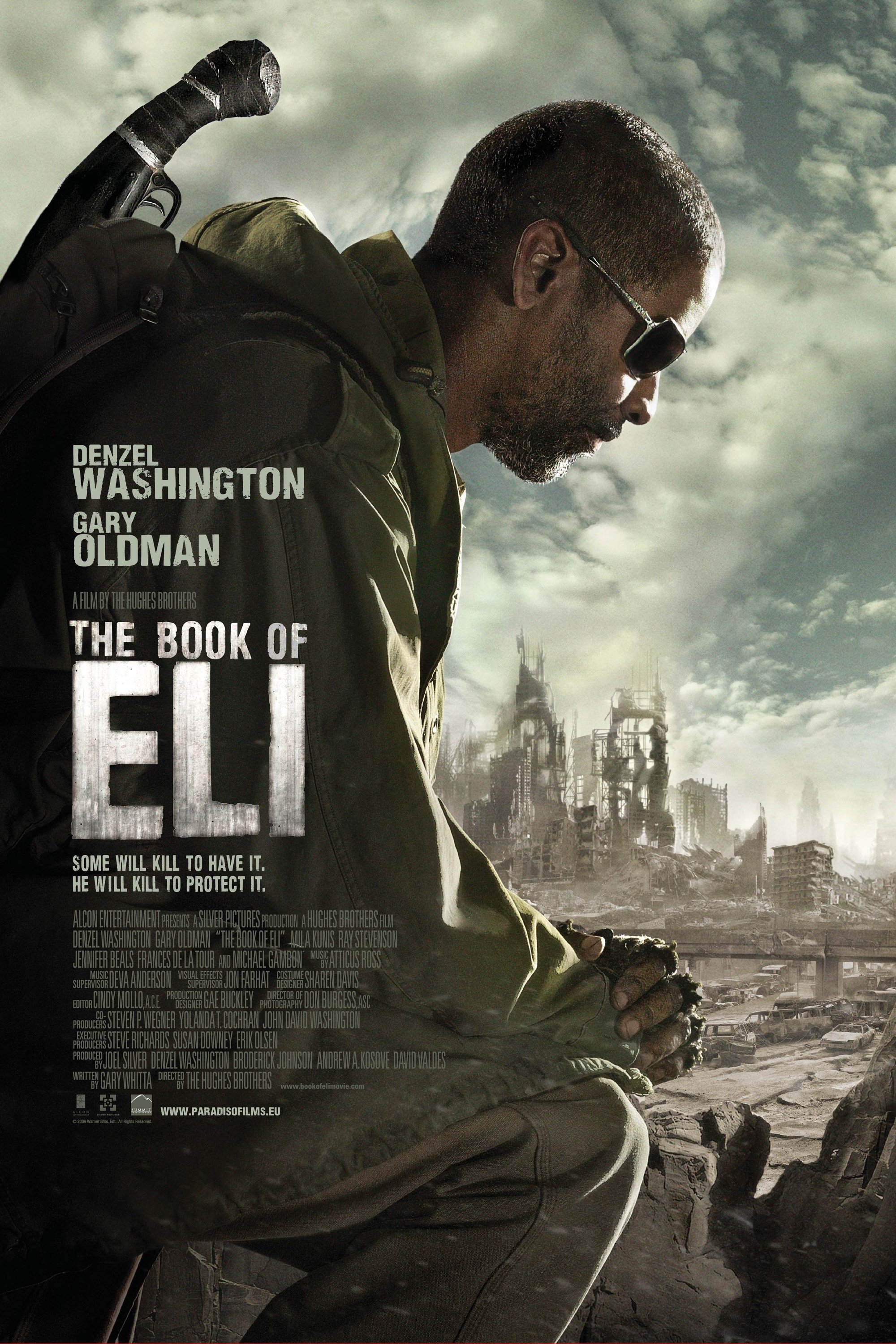
Blind wanderer carrying last remaining Bible across post-apocalyptic wasteland arrives in settlement ruled by warlord seeking sacred text to control population through religious authority, forcing traveler to protect scripture while completing thirty-year mission to deliver book to sanctuary preserving human knowledge after nuclear holocaust destroyed civilization and all religious texts were systematically burned.
Book of Eli — Plot Summary
The Wanderer
Thirty years after a catastrophic nuclear holocaust has devastated civilization, the world has been transformed into a desolate wasteland. The once-mighty United States is now a barren landscape of ruins, ash, and scattered survivors struggling to exist in the harsh post-apocalyptic environment.
Through this wasteland walks Eli, a solitary traveler moving steadily westward on foot. He carries few possessions: a machete, a canteen, a backpack containing his meager supplies, and most importantly, a worn leather-bound book that he guards carefully. Eli survives through a combination of hunting, scavenging, and uncanny combat skills that have kept him alive through countless dangers.
Searching for water in the unforgiving landscape, Eli arrives at a ramshackle settlement—one of the few towns that has emerged in the post-war world. This town is ruled by an authoritarian warlord named Carnegie, a literate and intelligent man who understands that knowledge is power in this ignorant, violent age.
Carnegie has built his power on controlling resources and information, but he is obsessed with obtaining one specific object: a certain book that he believes will give him absolute control over the people. He has sent his henchmen throughout the wasteland searching for this book for years, but they have been unable to locate a single copy.
The Town
Eli enters the town and barters with a merchant known as the Engineer, trading salvaged goods to recharge the battery of his portable music player—one of his few connections to the world before the war, allowing him to listen to preserved music from a lost civilization.
Later, while at the town's bar, Eli is confronted by a gang of bikers who attempt to rob or intimidate him. What follows is a brutal, one-sided fight. Eli demonstrates extraordinary combat abilities, swiftly and efficiently killing all of the attackers with his machete. His fighting style is precise and economical, suggesting years of experience surviving in this dangerous world.
Carnegie witnesses the aftermath of the fight and is deeply impressed by Eli's skills. In a world where strength is survival, a fighter like Eli would be an invaluable asset. Carnegie approaches Eli and invites him to join his employment, offering protection, resources, and a position of authority in the town.
However, Eli politely but firmly declines. He has no interest in staying in the town or working for Carnegie—he has a mission that requires him to keep moving west.
Carnegie, recognizing that Eli is literate like himself—a rare trait in this post-apocalyptic world where most survivors are uneducated and illiterate—decides that Eli is too valuable to let leave. He orders his men to detain Eli and forces him to stay the night under armed guard, hoping to persuade him to reconsider.
Solara
That evening, Carnegie sends two people to Eli's quarters. First, his blind mistress Claudia brings Eli food and water, treating him with quiet kindness. Then Carnegie sends Claudia's daughter, Solara, a young woman who has lived her entire life in this harsh town.
Carnegie orders Solara to seduce Eli, using her as a tool to manipulate the stranger. However, Eli, recognizing the situation for what it is and maintaining his principles, gently rebuffs Solara's advances.
During their conversation, Solara notices that Eli possesses a book—a genuine, pre-war printed book, something rare and precious in this world where most written materials were destroyed. Eli, seeing that Solara is curious and sincere rather than threatening, offers to share his food with her.
Before eating, Eli does something Solara has never witnessed before: he says grace, reciting a prayer of gratitude for the meal. This simple act profoundly affects Solara, who has grown up in a world devoid of spirituality or ritual. She listens carefully to the words of the prayer, memorizing them.
The next morning, Carnegie overhears Solara repeating the prayer to her mother, Claudia. In that moment, Carnegie realizes the truth: Eli possesses the book that Carnegie has been desperately seeking for years—a Bible, perhaps the last remaining copy in existence.
The Bible
Carnegie's obsession with finding a Bible is rooted in his understanding of power. He knows that in the pre-war world, the Bible was one of the most powerful texts in human civilization, used to inspire, control, and mobilize populations. In this new world of ignorance and desperation, Carnegie believes that possessing the Bible will allow him to establish himself not just as a warlord, but as a religious authority, giving him absolute control over people's hearts and minds.
The morning after Solara's prayer, Eli attempts to sneak away from the town, hoping to slip past Carnegie's guards and continue his journey west. However, Carnegie and his armed henchmen confront him in the street, blocking his escape.
Carnegie demands that Eli hand over the Bible. When Eli refuses, explaining that the book is not his to give and that he has a sacred mission to complete, Carnegie orders his men to kill Eli and take the book by force.
What follows is an extraordinary battle in the middle of the town's main street. Eli fights with his machete against multiple armed gunmen, moving with impossible precision and timing. Bullets seem to miss him by inches, while his blade finds its targets with lethal accuracy. When the fight ends, many of Carnegie's henchmen lie dead in the street, while Eli remains completely untouched—not a single bullet has struck him.
However, the battle is not without casualties. Carnegie himself has been shot in the leg during the crossfire, suffering a serious wound that will later prove significant.
Eli manages to escape the town during the chaos. Solara, who has been moved by Eli's grace and kindness—the first genuine goodness she has experienced in her brutal life—catches up to him and offers to help. She leads him to the town's hidden water supply, a precious secret she reveals as a gesture of trust and friendship.
Solara asks to accompany Eli on his journey west, wanting to escape Carnegie's tyrannical town and see something beyond the only world she has known. However, Eli, perhaps believing the journey is too dangerous for her or that his mission must be completed alone, traps Solara inside the water facility and continues west without her.
The Journey West
Solara manages to escape from where Eli trapped her and sets out after him across the wasteland. However, she is soon ambushed by two bandits who attempt to rape her—a common danger in this lawless world where violence and exploitation are everyday occurrences.
Before the assault can be completed, Eli reappears. He has been watching over Solara from a distance, ensuring her safety despite his attempt to leave her behind. Eli kills both bandits, saving Solara from the attack.
Recognizing that Solara will follow him regardless of his wishes, and perhaps moved by her determination and the connection they've formed, Eli allows her to accompany him as they continue traveling westward together.
As they walk through the wasteland, Eli explains his mission to Solara, sharing the truth about the book he carries and his purpose. Eli reveals that he possesses the last remaining copy of the Bible in existence. After the nuclear war that devastated civilization, all other copies of the Bible were systematically and intentionally destroyed.
Eli explains that the war was blamed on religious conflict, and in the aftermath, survivors destroyed all religious texts in a misguided attempt to prevent future wars. However, Eli believes this was a terrible mistake that left humanity spiritually empty.
Thirty years ago, Eli heard a voice in his head—which he interprets as the voice of God—directing him to a specific location where he found the last Bible. The voice instructed him to travel west to a place of safety where the book would be protected and preserved. The voice promised that Eli would be protected and guided throughout his journey, kept safe from harm as he completed this sacred mission.
This revelation provides context for Eli's seemingly impossible survival skills and the miraculous way bullets failed to strike him during the street battle with Carnegie's men.
The Cannibals
As Eli and Solara continue west, they come across an isolated house in the middle of the wasteland—a rare sight in this desolate landscape. Desperate for shelter and supplies, they approach the dwelling.
The house is occupied by an elderly couple who introduce themselves as George and Martha. The couple appears friendly and welcoming, offering hospitality to the weary travelers. However, as Eli and Solara enter the house, they fall into a trap—literally, as part of the floor gives way beneath them.
Though they manage to avoid serious injury and allay George and Martha's suspicions that they discovered the trap intentionally, Eli's instincts tell him something is wrong. As he observes details about the house—trembling hands, suspicious behavior, certain items that shouldn't be present—Eli realizes the horrifying truth: George and Martha are cannibals who lure travelers to their home to kill and eat them.
Eli and Solara attempt to leave immediately, making excuses to depart before George and Martha can spring their deadly trap. However, just as they're preparing to flee, Carnegie and his armed men arrive at the house, having tracked Eli across the wasteland.
A violent shootout erupts. In the chaos, both George and Martha are killed, their cannibalistic enterprise ended by the gunfire. However, Eli and Solara are captured by Carnegie's superior numbers.
The Sacrifice
Carnegie, wounded and desperate after days of pursuing Eli across the wasteland, threatens to kill Solara unless Eli surrenders the Bible. Faced with the choice between protecting the sacred book and saving the innocent young woman who has become his companion, Eli makes his decision.
He hands over the Bible to Carnegie, surrendering the book he has protected for thirty years to save Solara's life.
Carnegie, finally possessing the prize he has sought for so long, shoots Eli at close range and leaves him for dead. The warlord departs with his caravan, carrying the Bible back to his town where he plans to use its power to solidify his control over the population.
However, Solara, who Carnegie underestimates, manages to escape from her captors. She finds a hand grenade among the weapons scattered around the battle site and uses it to destroy one of Carnegie's trucks, creating chaos in his caravan. In the confusion, Solara steals another vehicle and drives back to where Eli was left.
Against all odds, Eli is still alive, though severely wounded from the gunshot. Solara finds him and helps him into the vehicle. With Carnegie's remaining truck running low on fuel, he is forced to return to his town rather than continue pursuing them, allowing Eli and Solara to escape.
Alcatraz
Solara drives Eli west, following the direction he indicates despite his critical injuries. They drive until they reach the ruins of what was once San Francisco, arriving at the remnants of the Golden Gate Bridge spanning the bay.
Unable to drive further, they abandon the vehicle and find a small boat. Eli and Solara row across the water to Alcatraz Island, the former maximum-security prison that sits isolated in the middle of San Francisco Bay.
On Alcatraz, they discover an unexpected sanctuary: a community of scholars and preservationists who have dedicated themselves to protecting and preserving what remains of human literature, art, and music from before the nuclear holocaust. The sanctuary represents hope for rebuilding civilization based on the wisdom and culture of the past.
Eli tells the guards that he has a copy of the Bible—the book they have been hoping to find for their collection. The guards, recognizing the immense significance of this claim, immediately bring Eli inside the sanctuary's main facility to meet with Lombardi, the leader of the preservation community.
The Revelation
Back in Carnegie's town, the warlord finally examines his prize in private, opening the Bible he sacrificed so much to obtain. However, when he looks at the pages, he makes a devastating discovery: the entire Bible is printed in Braille, the raised-dot writing system designed for blind readers.
This revelation transforms everything. Eli, the warrior who fought with impossible precision, who survived countless dangers and gunfights without injury, who seemed guided by divine protection—Eli has been blind the entire time.
His extraordinary combat abilities, his survival through situations where sight seemed necessary, his journey across the wasteland—all of it was accomplished without vision, guided by faith and the voice he believed was God directing his path.
Carnegie, unable to read Braille, possesses a Bible he cannot use. His ambitions to control the population through scripture are destroyed by this cruel irony.
Carnegie confronts Claudia, his blind mistress, demanding that she read the Braille Bible for him. However, Claudia—who has suffered under Carnegie's control and witnessed his cruelty—pretends not to know how to read Braille, denying Carnegie access to the knowledge he sought.
She also delivers devastating news: Carnegie's leg wound from the street battle weeks ago has become badly infected. Without proper medical treatment and antibiotics (which don't exist in this world), the infection is spreading. Furthermore, the loss of so many of his enforcers during the pursuit of Eli has weakened Carnegie's control over the town, and the population has begun to run amok, challenging his authority.
Carnegie's empire is crumbling, his wound is killing him, and the Bible he sacrificed everything to obtain is useless in his hands.
Dictation
At the Alcatraz sanctuary, Eli is taken to a private room with Lombardi. There, Eli reveals the full truth: he cannot read the Braille Bible to them because although he has been carrying it for thirty years, he has the entire text memorized.
Eli begins dictating the Bible from memory, reciting the New King James Version word for word. For hours or days, Eli speaks while scribes record every word, preserving the text that had been lost to the world.
The effort of completing this final task takes the last of Eli's strength. After reciting the complete Bible from memory—an extraordinary feat representing thirty years of study and memorization—Eli dies, his sacred mission finally fulfilled.
However, his sacrifice was not in vain. The sanctuary's printing press begins producing new copies of the Bible, making the text available to humanity once again. Lombardi himself places one of the newly printed Bibles on a bookshelf in the sanctuary's library, positioning it between the Hebrew Bible (the Tanakh/Old Testament) and the Quran, symbolically reuniting the three Abrahamic faiths' sacred texts.
Solara's Choice
The scholars of Alcatraz offer Solara sanctuary on the island, a safe place where she could live in peace, surrounded by preserved knowledge and culture, protected from the wasteland's dangers.
However, Solara makes a different choice. She decides to return home to the town, to her mother Claudia, and to face whatever remains of Carnegie's regime.
Before departing, Solara takes up Eli's machete and his other possessions—the tools that kept him alive through thirty years of wandering. The film's final images show Solara walking back into the wasteland alone, armed and determined.
The implication is clear: Solara intends to kill Carnegie, to free her mother and the town from his tyrannical rule. She has become Eli's spiritual successor, a warrior carrying forward his mission of protection and justice, armed with both his weapons and the lessons he taught her about faith, grace, and doing what is right.
Eli's journey may have ended, but his impact continues through Solara, who will carry his legacy forward into whatever future awaits the wasteland.
Book of Eli — Ending Explained
The ending's revelation that Eli was blind throughout his entire journey recontextualizes every action scene and survival moment as divinely guided rather than dependent on physical sight, validating Eli's faith that God was protecting him. His blindness transforms what appeared to be exceptional skill into miraculous preservation.
Carnegie's discovery that the Bible is in Braille creating a useless prize demonstrates that spiritual texts cannot be weaponized by those seeking power rather than understanding, with the physical possession of scripture meaningless without genuine faith or ability to comprehend its message. His fatal infection from the street battle represents divine justice for attempting to abuse sacred knowledge.
Eli dictating the entire Bible from memory before dying positions his thirty-year journey as preparation for this final act of preservation, with the memorization ensuring the text's survival even if the physical book was destroyed. His death immediately after completing dictation suggests his purpose was fulfilled and divine protection was no longer necessary.
The Bible being shelved between the Hebrew Bible and Quran symbolizes reuniting divided Abrahamic faiths whose conflicts contributed to the nuclear war, suggesting humanity's spiritual healing requires recognizing shared foundations rather than emphasizing differences. The preservation of multiple religious texts implies balanced spiritual renewal rather than dominance of one tradition.
Solara choosing to return to the wasteland rather than accepting sanctuary demonstrates that Eli's teachings inspired active resistance to tyranny rather than passive withdrawal, with her taking up his weapons representing the passing of responsibility to protect the innocent. Her presumed mission to kill Carnegie completes the justice Eli began.
Book of Eli — FAQ
Is The Book of Eli based on a book?
No, The Book of Eli is an original screenplay written by Gary Whitta. However, it draws thematic inspiration from post-apocalyptic literature, Western films, and the biblical concept of prophetic missions. The film's structure deliberately echoes both the wandering prophet archetype from religious texts and the lone gunslinger from Western genre conventions.
How could Eli fight so effectively while blind?
The film suggests divine protection and guidance allowed Eli to survive situations where sight would normally be necessary, positioning his abilities as miraculous rather than simply learned skill. His fighting effectiveness, ability to navigate terrain, and survival of numerous gunfights without injury are presented as evidence of supernatural intervention rather than exceptional training.
Why were all Bibles destroyed after the war?
The film establishes that religious conflict was blamed for causing the nuclear war, leading survivors to systematically destroy all religious texts—particularly the Bible—in a misguided attempt to prevent future wars. This represents humanity rejecting spirituality entirely rather than addressing how religious texts were misused to justify violence.
What happened to Carnegie?
While Carnegie's ultimate fate is not explicitly shown, the film strongly implies he died from the infected leg wound suffered during his street battle with Eli. Claudia's statement that the infection has spread, combined with the lack of antibiotics in the post-apocalyptic world, suggests Carnegie succumbed to sepsis. The loss of his enforcers and the town's rebellion would have prevented him from securing medical help.