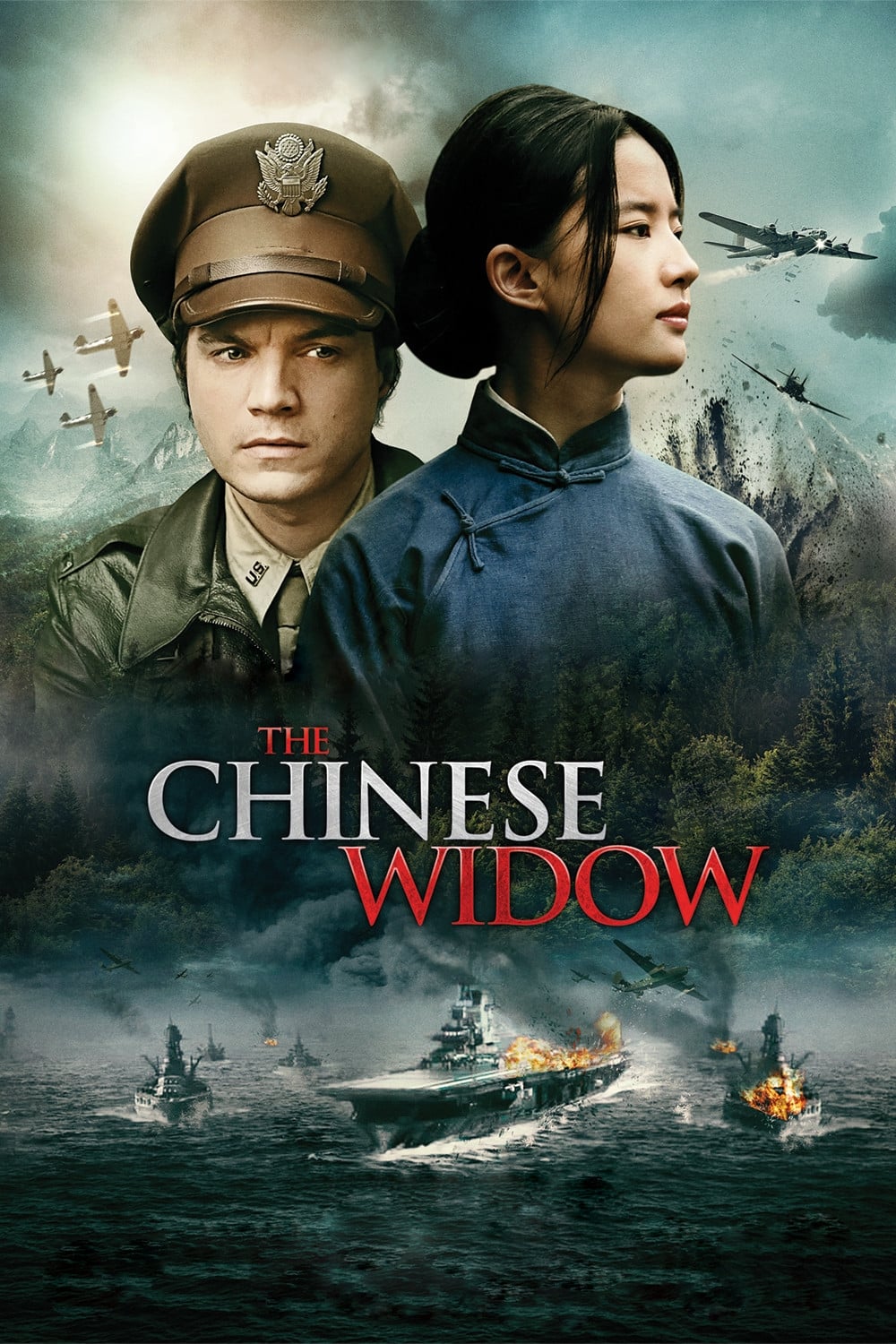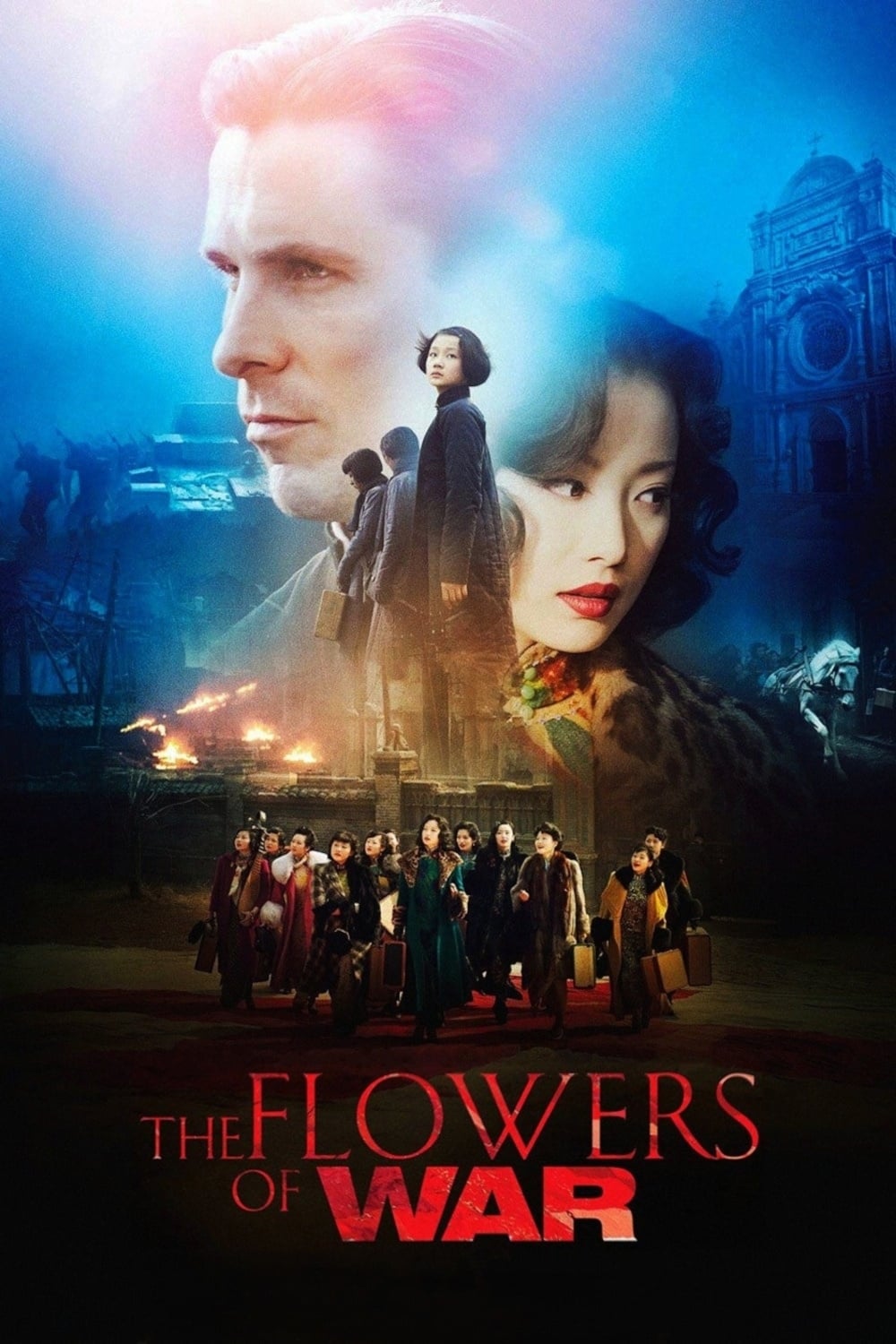
The Flowers of War
During a brutal wartime siege in China, a group of unlikely protectors gather inside a church as chaos unfolds outside. As danger closes in, courage, sacrifice, and unexpected alliances shape a powerful story set against one of history’s darkest conflicts.
The Flowers of War — Plot Summary
The Fall of Nanjing
December 1937. Japan invades China during the Second Sino-Japanese War. The Imperial Japanese Army launches a brutal assault on China's capital city, Nanjing. The Chinese defenses collapse under the overwhelming Japanese military force.
As the Japanese army overruns Nanjing, they begin carrying out what will become known as the Nanjing Massacre—one of the most horrific atrocities of World War II. Japanese soldiers systematically murder civilians, commit mass rapes, and engage in widespread destruction throughout the city.
Amid the chaos, desperate Chinese schoolgirls flee through the burning streets seeking sanctuary. They take refuge in their convent, a Western-run Roman Catholic church compound that they hope will be protected by its neutral religious status and foreign affiliation.
John Miller, an American mortician, has been hired to perform a burial service for the church's recently deceased head priest. Miller is a flawed, cynical man—an alcoholic opportunist more interested in being paid than in the unfolding humanitarian disaster around him. At the church, he meets George, an orphan boy who was raised and educated by the dead priest, who taught him fluent English.
Shortly after Miller's arrival, a group of flamboyant prostitutes from Nanjing's brothel district arrives at the cathedral seeking refuge. Fleeing the Japanese soldiers who are systematically raping women throughout the city, the prostitutes hide in the church's cellar, hoping to avoid detection.
To maintain the church's protected status and keep everyone safe, Miller begins pretending to be a priest despite having no religious training or calling. His immediate goal is to repair the convent's damaged truck so they can escape the occupied city.
The Assault
The fragile peace at the church is shattered when rogue Japanese forces assault the compound. A lone Chinese Major who has been protecting the area launches a desperate, dying counterattack against the Japanese soldiers. His heroic sacrifice beats back the assault temporarily, but he is mortally wounded in the process.
Following this incident, Japanese Colonel Hasegawa visits the church. Hasegawa presents himself as a cultured, educated officer—in stark contrast to the brutal soldiers committing atrocities throughout the city. He promises to protect the convent by stationing guards outside the gate to prevent further attacks by undisciplined troops.
However, Hasegawa's protection comes with conditions. He requests that the schoolgirls sing a chorale performance for him, ostensibly as a gesture of goodwill and cultural appreciation. The girls comply, performing for the Colonel.
Several days later, Hasegawa returns with an official invitation: the schoolgirls are to sing at the Japanese Army's victory celebration. Miller, understanding the true nature of what such an "invitation" means for young women in Japanese custody, immediately declines on their behalf.
Hasegawa coldly informs Miller that this is not a request but an order. The schoolgirls will be picked up by Japanese soldiers the following day, regardless of anyone's objections.
Before leaving, the Japanese soldiers conduct a head count of the schoolgirls to ensure the correct number will be delivered. During the count, one of the prostitutes who has strayed from the cellar is accidentally included among the schoolgirls. The soldiers erroneously record a total of thirteen girls.
The Decision
Shu Juan, the de facto leader among the schoolgirls, understands the horrific fate awaiting them if they go to the Japanese celebration. Rather than endure rape and likely murder at the hands of Japanese soldiers, Shu Juan convinces the other schoolgirls that they should maintain their honor and dignity by committing suicide together.
The girls climb to the church tower, preparing to jump to their deaths.
At the last moment, Yu Mo, the de facto leader among the prostitutes, stops them. Yu Mo and the other prostitutes have overheard the girls' desperate plan. Despite being looked down upon by society and treated with disdain by the "respectable" schoolgirls, the prostitutes make an extraordinary decision: they will protect the innocent schoolgirls by taking their place at the Japanese celebration.
However, there is a mathematical problem: there are only twelve prostitutes, but the Japanese soldiers counted thirteen girls. The group needs one more person to complete the substitution without arousing suspicion.
George, the orphan boy who was raised by the dead priest, volunteers to be the thirteenth person. Despite understanding the almost certain death sentence this represents, the young boy chooses to sacrifice himself alongside the women.
The Transformation
Miller initially opposes this self-sacrificial plan, recognizing that he is essentially allowing these women and a child to walk to their deaths. However, he ultimately relents, understanding that there are no good options and that this choice at least saves the schoolgirls.
Using his professional skills as a mortician, Miller assists in the elaborate disguise. He carefully adjusts the prostitutes' makeup to make them appear younger and more innocent. He cuts their hair to match the schoolgirls' styles. He helps them dress in the school uniforms and practice the mannerisms and speech patterns of sheltered convent students.
The prostitutes also prepare for potential resistance or revenge. They create improvised weapons by breaking church windows and fashioning the sharp glass shards into hidden knives. They conceal these blades in their clothing, planning to fight or at least take some of their attackers with them rather than going passively to their fates.
The Sacrifice
The next day, Japanese soldiers arrive at the church to collect the "thirteen schoolgirls" for the victory celebration. The disguised prostitutes and George, now transformed into convincing schoolgirl doubles, are led away by the unsuspecting Japanese soldiers.
These "13 Flowers of Nanjing"—twelve prostitutes and one orphan boy—walk calmly toward what they know will likely be their martyrdom, sacrificing themselves so that thirteen innocent schoolgirls might live.
After the substitutes depart with the Japanese soldiers, Miller reveals the truck he has been secretly repairing. He hides the actual schoolgirls on the vehicle.
Mr. Meng, the father of Shu Juan (one of the schoolgirls), is a Chinese collaborator who has been working with the Japanese occupation forces. He provides Miller with a single-person travel permit—a document allowing one person to leave the city through Japanese checkpoints.
Shortly after providing this assistance, Mr. Meng is killed by the Japanese forces he had been collaborating with, demonstrating the ultimate futility and danger of cooperation with the occupiers.
Using the permit, Miller drives the truck loaded with hidden schoolgirls out of Nanjing. In the film's final scene, the truck is shown traveling on a deserted highway heading west, away from the Japanese-occupied territory and toward safety.
Unknown Fate
The film ends without revealing the fate of the thirteen prostitutes and George who sacrificed themselves. Their destiny remains deliberately unknown—whether they fought back with their hidden knives, whether they were killed immediately or suffered prolonged torture, whether any of them survived.
The ambiguity serves to honor their sacrifice while acknowledging the countless victims of the Nanjing Massacre whose fates were similarly never recorded or known. The "13 Flowers" become symbols of the estimated 20,000-80,000 women who were raped during the massacre, and the hundreds of thousands of civilians who were murdered.
The film concludes with the schoolgirls escaping to uncertain safety while those who saved them likely perished, their sacrifice ensuring that at least some innocent lives were preserved during one of history's darkest chapters.
The Flowers of War — Ending Explained
The ending's ambiguity about the prostitutes' and George's fate honors their sacrifice while acknowledging that countless Nanjing Massacre victims disappeared without trace, with their stories lost to history just as the film leaves the thirteen's ultimate destiny unresolved. The deliberate lack of closure positions them as representatives of all unknown victims rather than individuals whose suffering requires detailed depiction.
The prostitutes' decision to save the schoolgirls despite being socially despised demonstrates that moral worth and capacity for selfless heroism exist independent of social status or occupation, with the film positioning sex workers as more virtuous than the collaborating father and more courageous than the cynical American. Their transformation from scorned outcasts to martyred saviors critiques class and gender hierarchies.
Miller's evolution from opportunistic alcoholic mortician to protective guardian represents redemption through witnessing others' sacrifice, with the prostitutes' courage shaming him into moral action where his own self-interest had failed. His use of mortician skills—typically associated with death—to enable the disguises that save lives provides symbolic transformation of his profession from servicing death to facilitating survival.
George's volunteering as the thirteenth despite being a child demonstrates that the massacre created moral circumstances where children were forced into adult sacrificial choices, with innocence destroyed not just through victimization but through the necessity of becoming willing martyrs. His participation represents the war's corruption of childhood itself.
The schoolgirls' survival while the "unrespectable" women died creates uncomfortable moral complexity where virtue and survival become separated, challenging narratives that good people are rewarded while the morally compromised suffer. The film refuses easy justice by having the "pure" live while the "fallen" die, instead presenting sacrifice as transcending such categories.
The Flowers of War — FAQ
Is Flowers of War based on a true story?
The film is based on Yan Geling's 2006 novel "The 13 Women of Nanjing," which is a work of historical fiction set during the very real Nanjing Massacre (December 1937-January 1938). While the specific characters and their story are fictional, the historical context—the Japanese army's systematic murder of an estimated 200,000-300,000 Chinese civilians and mass rape of women—is extensively documented by historical records, survivor testimonies, and international observers.
What was the Nanjing Massacre?
The Nanjing Massacre (also called the Rape of Nanjing) occurred when Japanese forces captured China's capital in December 1937. Over approximately six weeks, Japanese soldiers engaged in systematic mass murder, rape, looting, and arson. Conservative estimates place civilian deaths at 200,000, with some historians citing figures over 300,000. An estimated 20,000-80,000 women and girls were raped. The atrocity remains a source of tension in Sino-Japanese relations, with some Japanese nationalist groups denying or minimizing what occurred.
Why do the prostitutes sacrifice themselves for the schoolgirls?
The film presents multiple motivations: maternal instinct to protect children, desire to prove their moral worth despite social condemnation, recognition that they've already lost innocence the girls still possess, and perhaps belief that their lives matter less than virginal students'. The prostitutes' sacrifice redeems their social status by demonstrating that heroism and virtue exist independent of sexual history or occupation.
What happened to foreigners like Miller during the massacre?
Western missionaries, businesspeople, and diplomats who remained in Nanjing during the massacre established the Nanjing Safety Zone, using their foreign status to create protected areas for Chinese refugees. While some Japanese soldiers ignored these protections, the presence of Westerners did save thousands of lives. John Miller's character represents these foreign witnesses, though he is fictional and more morally compromised than many of the actual historical figures.