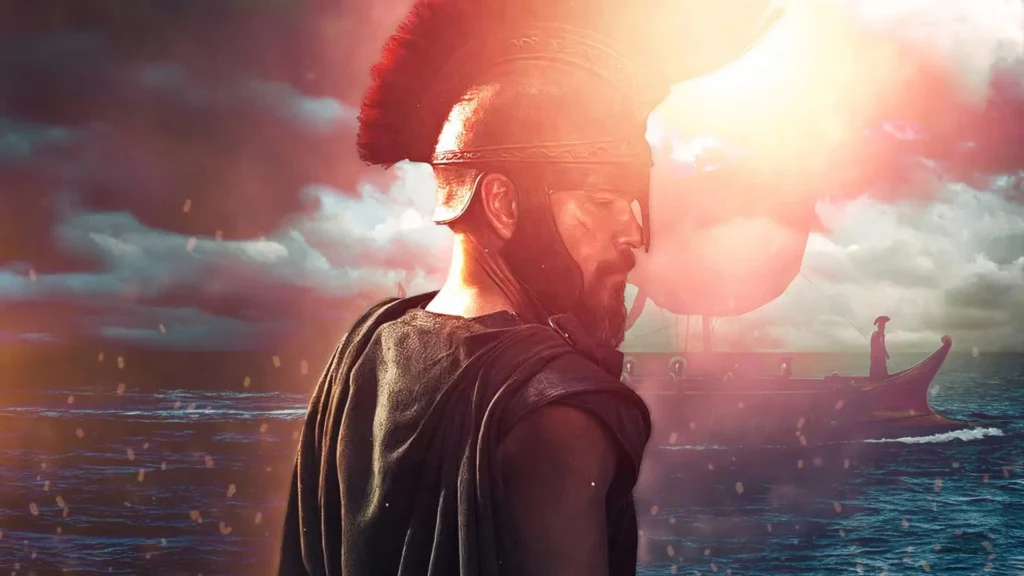
Christopher Nolan’s The Odyssey is scheduled for theatrical release on July 17, 2026, distributed by Universal Pictures. The film adapts Homer’s Odyssey — the ancient Greek epic poem composed around the 8th century BCE — and follows Odysseus, King of Ithaca, on his decade-long journey home after the Trojan War. With a reported production budget of $250 million, it is the most expensive film Nolan has made to date and the first to be shot entirely on IMAX 70mm film cameras.
The film represents Nolan’s first project since Oppenheimer, which won seven Academy Awards in 2024, including Best Picture and Best Director. Development on The Odyssey began shortly after those wins, with Nolan writing the screenplay through early 2024 and securing the project at Universal by October of that year. The title and release date were publicly announced in December 2024.
The Source Material
Homer’s Odyssey is one of the oldest and most widely studied works in Western literature, predating written records of its own composition. The poem follows Odysseus across twenty-four books as he navigates a series of encounters — with the Cyclops Polyphemus, the witch-goddess Circe, the Sirens, the monster Scylla — while his wife Penelope waits in Ithaca, fending off suitors who assume her husband is dead, and his son Telemachus searches for news of his father.
The poem is non-linear in structure. It begins in the middle of events, with Odysseus in captivity on the island of Ogygia, then works backward through his account of the journey so far before moving forward to his eventual return. Nolan has spoken publicly about being drawn to the story for this structural quality as well as its themes of endurance, identity, and the cost of long absence on those left behind.
Previous notable adaptations include the 1954 Italian film Ulysses, starring Kirk Douglas, and the 1997 television miniseries starring Armand Assante. The Coen Brothers’ O Brother, Where Art Thou? (2000) drew loosely on the poem’s structure. Nolan’s version is described by Universal as a mythic action epic, though the director has said his approach is grounded in a realistic interpretation of the mythology rather than a purely fantastical one.

Production and Filming
Principal photography ran from February to August 2025, spanning six countries: Morocco, Greece, Italy, Scotland, Iceland, and Western Sahara. Additional filming took place in Malta and on studio soundstages in Los Angeles, bringing the total number of locations to more than a dozen.
Filming began at Aït Benhaddou near Ouarzazate, Morocco, used to depict the city of Troy in an opening sequence. The production then moved to the Messenia region of the Peloponnese in Greece, shooting at Pylos, Methoni Castle, and the archaeological palace site at Acrocorinth. The island of Favignana off the Sicilian coast — considered by some scholars to be one of the locations Homer had in mind when describing Polyphemus’s island — was used for scenes involving the Cyclops.
The decision to shoot entirely on IMAX 70mm film cameras is a first for any feature production. Nolan shot Oppenheimer in a combination of IMAX 65mm and standard 65mm film. Extending that format to every scene of The Odyssey required significant technical development from IMAX Corporation, and the increased aspect ratio will be visible throughout the film’s runtime rather than limited to select sequences. Nolan used a reported 60,000 metres of film across the 91-day shoot, according to a figure he disclosed to Empire magazine.
The visual effects work is being handled by DNEG and Weta Workshop. Nolan’s stated preference for practical effects and on-location shooting means digital effects are being used to enhance rather than replace physical sets and environments — a consistent approach across his filmography, though one that becomes considerably more technically complex when applied to mythological creatures and seascapes.
The Cast
Matt Damon plays Odysseus. Damon has worked with Nolan twice previously, in Interstellar and Oppenheimer, and was the first actor confirmed for the project. Anne Hathaway plays Penelope, Odysseus’s wife; she last worked with Nolan on Interstellar in 2014. Tom Holland plays Telemachus, Odysseus’s son. Robert Pattinson, who appeared in Tenet, plays Antinous, the lead suitor competing for Penelope’s hand in her husband’s absence. Charlize Theron plays Circe. Zendaya’s role has not been officially confirmed, though she is listed as Athena in several production databases. Lupita Nyong’o’s role has similarly not been formally announced.
Jon Bernthal plays Menelaus, King of Sparta and brother of Agamemnon. Benny Safdie plays Agamemnon. John Leguizamo plays Eumaeus, Odysseus’s loyal swineherd. Mia Goth plays Melantho, a maidservant to Penelope. Himesh Patel plays Eurylochus, a member of Odysseus’s crew. Elliot Page, Bill Irwin, Samantha Morton, Ryan Hurst, and Logan Marshall-Green round out the ensemble in roles that have not all been publicly confirmed. Rapper Travis Scott appears in the film in a minor role visible in the January 2026 trailer, delivering a speech relating to the Trojan War; his character has not been named.
Many of these cast members have prior working relationships with Nolan. Hathaway, Damon, Pattinson, Patel, Page, Irwin, Bernthal, and Safdie have all appeared in his previous films. The pattern reflects an approach Nolan has maintained throughout his career: assembling large ensembles from a recurring pool of collaborators, supplemented by new additions suited to specific roles.
The Creative Team
Cinematographer Hoyte van Hoytema has shot every Nolan film since Interstellar and returns here. Composer Ludwig Göransson, who won the Academy Award for his Oppenheimer score and is known for his work on The Mandalorian and Sinners, is scoring the film. Editor Jennifer Lame, who cut Tenet and Oppenheimer, is editing. Visual effects supervisor Andrew Jackson, also a Nolan regular, returns in his usual role. Emma Thomas, Nolan’s wife and producing partner, produces through their company Syncopy Inc., as she has on every Nolan film since Batman Begins.
The production used the working title Charlie’s Tale during filming to avoid unwanted public attention at location shoots. Nolan has spoken about choosing locations specifically because the physical conditions — the weather, terrain, and light — would communicate something about the difficulty of Odysseus’s journey that digital environments could not. He described his intent as capturing how hard those journeys would have been for people navigating an unmapped world.
The Costume Debate
One ongoing discussion ahead of the film’s release concerns historical accuracy in the costume design. Production photographs released during filming sparked debate among classicists and historians, with some arguing that the costumes depicted in early images do not reflect the material culture of Bronze Age Greece as currently understood by archaeology. The specific points of contention have included helmet design, textile choices, and armour construction.
Nolan has not responded directly to this criticism in detail. His stated approach is a realistic interpretation of Greek mythology rather than strict historical reconstruction, a distinction that gives the production significant creative latitude but has not fully quieted the debate. The conversation is not unusual for films set in ancient periods, and similar discussions accompanied films including Troy (2004) and 300 (2006). Whether the final film engages directly with historical record or treats the mythological world as a space for its own visual language will become clearer on release.
Release and Format
The Odyssey opens in the United States on July 17, 2026, in IMAX and standard formats. Tickets for opening weekend went on sale in mid-2025 and sold out within hours of availability — an unusual commercial development for a film still a year from release, and one that shaped Universal’s confidence in the project going into the final stretch of post-production.
Nolan does not release his films on streaming platforms, a position he has maintained consistently since leaving Warner Bros. in 2021 following that studio’s decision to simultaneously release its films on HBO Max. Universal has honoured that position across their collaboration. A home video release on physical media is likely to follow the theatrical window, as it has with his previous Universal releases, but no streaming date will be announced.
The Odyssey will be Nolan’s thirteenth feature film. All twelve of his previous films currently hold a Fresh rating on Rotten Tomatoes.
Christopher Nolan’s The Odyssey opens in cinemas and IMAX on July 17, 2026, distributed by Universal Pictures. No runtime has been officially confirmed.Film Plot Hub will publish a full plot summary and Ending Explained for The Odyssey on release day, July 17. For coverage of other major 2026 releases, browse our film index.