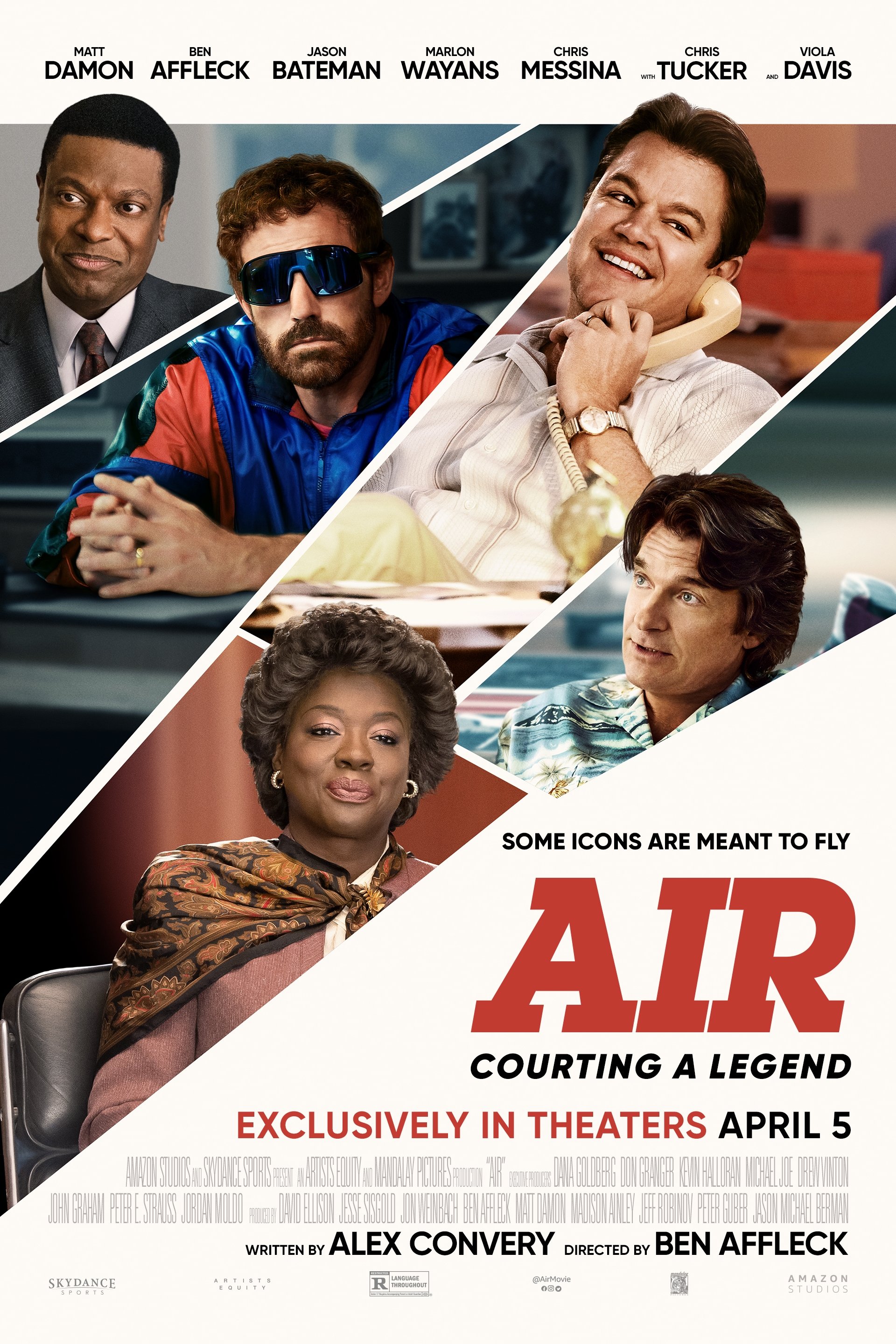
Air
Struggling Nike basketball division scout convinces company to pursue Michael Jordan despite budget constraints and player's Adidas preference, bypasses agent to appeal to player's mother, accepts unprecedented royalty structure giving athlete sales percentage, generates $162 million first-year sales transforming Nike into global brand.
Air — Plot Summary
Crisis at Nike
Oregon, 1984. Nike, Inc., based in Oregon, faces a potential crisis: the company is on the verge of shutting down its basketball shoe division due to persistently low sales. Nike has established itself successfully in running shoes, but its basketball division is failing to compete against dominant brands like Adidas and Converse in the basketball market.
In response to this existential threat to their basketball division, Marketing Vice President Rob Strasser and company co-founder and CEO Phil Knight task Sonny Vaccaro, Nike's basketball talent scout, with finding a solution. They need Vaccaro to identify a new spokesperson for Nike basketball shoes—someone who can transform the division's fortunes and prevent its closure.
The 1984 Draft
Vaccaro begins evaluating basketball players selected in the 1984 NBA draft, considering which athletes might serve as effective endorsers for Nike's struggling basketball line. Nike's executives review the top prospects, but there is consensus among them that Michael Jordan—selected third overall in the draft—is completely off limits for several reasons.
First, Jordan is known to be a fan of Adidas and prefers that brand over Nike. Second, and more critically, signing Jordan would be far too expensive for the basketball division's meager budget. The division simply cannot afford to compete for a top-tier talent like Jordan when they are already facing potential closure due to financial underperformance.
The Vision
However, Vaccaro has a transformative realization while watching Jordan's basketball highlights in conjunction with an Arthur Ashe commercial for Head rackets. The juxtaposition of Jordan's extraordinary athletic ability and the way Ashe's personality elevated the tennis racket brand creates a vision in Vaccaro's mind.
Vaccaro becomes convinced that Nike should pursue Jordan despite all the obstacles. Vaccaro sees Jordan as a generational talent—an athlete whose transcendent abilities and marketability come along once in a generation. More importantly, Vaccaro envisions a symbiotic relationship where both the brand and the athlete build off each other, with each elevating the other to unprecedented heights. Rather than simply an endorsement where Nike pays a player to wear their shoes, Vaccaro imagines a true partnership.
Building Support
Vaccaro has dinner with his friend George Raveling, who coached Jordan during the Olympic tournament and has a personal relationship with the player and his family. Vaccaro asks Raveling for his support in courting Jordan, recognizing that insider advocacy will be crucial to winning over the star player and his family.
Armed with Raveling's support, Vaccaro travels to Wilmington, North Carolina—Jordan's hometown—to meet directly with Jordan's family. Rather than going through Jordan's agent or following standard protocol, Vaccaro makes a direct appeal to the family.
Crucially, Vaccaro convinces Michael's mother Deloris Jordan that Nike would give her son all the individual attention and focus that he would not receive from his preferred brands Adidas and Converse. At those larger, more established basketball brands, Jordan would be just another endorser among many. At Nike, struggling and desperate, Jordan would be the centerpiece of their entire basketball strategy.
Agent's Displeasure
After Vaccaro's unauthorized contact with Jordan's family, he receives a negative phone call from David Falk, Jordan's agent. Falk is angry that Vaccaro bypassed him and contacted his client's family directly—a violation of standard industry protocol where all communications should go through the agent who negotiates on behalf of the player.
Despite Falk's displeasure, Vaccaro learns that his gambit worked: the Jordan family has scheduled a meeting at Nike's headquarters in Beaverton, Oregon, for the following Monday. Vaccaro's direct appeal to Deloris Jordan has succeeded in getting Nike a meeting they would never have secured through conventional channels.
Preparation
Vaccaro and Strasser begin preparing their pitch presentation for the critical Monday meeting. They request that Peter Moore, Nike's shoe designer, prepare a prototype shoe specifically for Jordan.
Moore creates a distinctive design and names it "Air Jordan" after Nike's Air Sole technology—a cushioning system using pressurized air pockets in the sole. The name "Air Jordan" combines Nike's technological innovation with Jordan's personal brand, creating a product identity centered entirely around the individual athlete.
Meanwhile, Phil Knight makes an extraordinary financial decision. He agrees to assign the basketball division's entire annual budget—$250,000—to signing Jordan alone. This all-or-nothing bet means that if they fail to sign Jordan, or if the endorsement doesn't work, the basketball division will have no resources left for any other endorsements or marketing initiatives.
The Meeting and Counteroffer
The Monday meeting with Jordan and his parents takes place at Nike's Beaverton headquarters. Vaccaro, Strasser, and the Nike team present their vision for how Jordan would be the centerpiece of their entire basketball strategy, with a signature shoe line bearing his name.
The meeting is successful, and the Jordans respond positively to Nike's pitch. However, after the meeting, Vaccaro learns devastating news: Adidas has matched Nike's financial offer and sweetened the deal by adding a Mercedes-Benz 380SL—a luxury car worth tens of thousands of dollars in addition to the endorsement money.
Vaccaro thinks the deal will not go through. Nike's superior pitch and vision cannot compete with Adidas's established basketball brand reputation plus the luxury car incentive. It seems that Vaccaro's gamble has failed and the basketball division's entire budget has been spent pursuing a deal that will ultimately go to a competitor.
Deloris's Call
However, Vaccaro receives an unexpected phone call from Deloris Jordan, Michael's mother. She tells Vaccaro that Michael will sign with Nike—but on one unprecedented condition.
Deloris demands that Jordan earn a percentage of every Air Jordan shoe sold. Rather than a flat endorsement fee or salary, Jordan would receive royalties based on sales—a share of the revenue generated by products bearing his name.
This royalty structure is completely unprecedented in the athletic shoe industry. The standard industry model involves paying athletes flat fees or salaries for endorsements, with the company keeping all revenue from product sales. No shoe company has ever given an athlete a percentage of sales because it would set a precedent that could fundamentally alter the economics of athlete endorsements across the industry.
The Decision
Vaccaro himself thinks Nike's higher-ups will never accept Deloris's royalty condition due to the dangerous industry precedent it would establish. If Nike gives Jordan a percentage of sales, every other athlete and agent will demand the same terms, potentially transforming the entire business model of athletic endorsements.
However, Phil Knight, Nike's CEO, makes the decision to accept Jordan's royalty condition. Knight deems it necessary to ensure the endorsement goes through, recognizing that without Jordan, Nike's basketball division will likely be shut down anyway. Knight is willing to break industry precedent and potentially transform the economics of athlete endorsements because the alternative is the division's closure.
Nike and Jordan sign the deal with the unprecedented royalty structure included.
Epilogue
An epilogue reveals the extraordinary success of the Air Jordan line. Phil Knight had expected that if the Air Jordan line performed well, it might generate $3 million in sales—a modest success that would justify keeping the basketball division open.
Instead, Air Jordan earned $162 million in sales in its first year—more than fifty times Knight's optimistic projection. The Air Jordan line became a cultural phenomenon that transcended basketball and athletic footwear, becoming a fashion statement and status symbol.
The epilogue reveals that Air Jordan became a steady source of income for Nike, transforming the company from a struggling athletic shoe manufacturer into a dominant global brand. The royalty deal that seemed so risky and precedent-breaking made Jordan extraordinarily wealthy while also aligning his interests with Nike's success—creating exactly the symbiotic relationship Vaccaro had envisioned where brand and athlete elevated each other.
Air — Ending Explained
The ending validates Vaccaro's vision that athlete and brand could build off each other in unprecedented ways, with the $162 million first-year sales demonstrating that authentic partnership created exponentially more value than traditional endorsement structures. Knight's willingness to break industry precedent and give Jordan sales royalties created alignment of interests that motivated Jordan to actively promote Air Jordans rather than passively wear them.
The massive success vindicated several risky decisions: Vaccaro's unauthorized contact with Jordan's family, Knight's allocation of the entire basketball budget to one player, and most significantly, agreeing to royalty structure that violated industry norms. The ending suggests that transformative success requires breaking rules and established practices rather than following conventional wisdom.
Deloris Jordan's role as the architect of the royalty demand establishes her as the unsung visionary who fundamentally altered athlete compensation—recognizing her son's value entitled him to share in the wealth his name and performance would generate. The film positions her demand as both fair compensation and shrewd business strategy, rejecting the industry model where companies captured all product revenue while athletes received fixed fees regardless of sales success.
The $3 million expectation versus $162 million reality demonstrates how completely Nike underestimated Jordan's cultural impact and marketability, suggesting even those willing to break precedent and bet everything on Jordan didn't fully comprehend his generational transcendence. The Air Jordan line became larger than basketball or athletic footwear, transforming into cultural phenomenon that redefined the relationship between sports, celebrity, and consumer products.
The film's conclusion that Air Jordan became a "steady source of income" for Nike is dramatic understatement—the line has generated billions of dollars over decades and fundamentally transformed Nike into a global brand built on athlete partnerships. The ending frames the 1984 deal as the inflection point that created modern Nike and established the template for athlete endorsements across all sports.
Air — FAQ
How accurate is the film's portrayal of Nike's situation in 1984?
The film accurately depicts Nike's basketball division struggling while Converse and Adidas dominated the basketball shoe market. However, Nike as a company was not on the verge of collapse—only the basketball division faced potential closure. The film dramatizes internal tensions and the all-or-nothing nature of the Jordan pursuit for narrative effect, though the essential facts about Nike's basketball struggles and the unprecedented Jordan deal are accurate.
Did Sonny Vaccaro really visit the Jordan family at home?
The direct home visit is somewhat dramatized. While Vaccaro did cultivate relationships with players' families and was known for personal outreach that other scouts didn't attempt, the specific details of his Jordan family contact have been disputed. George Raveling later claimed greater credit for connecting Nike with Jordan, though Vaccaro's role in championing Jordan within Nike is well-documented.
Was the royalty structure really unprecedented?
Yes. Giving athletes a percentage of shoe sales rather than flat endorsement fees was genuinely unprecedented in 1984 and established a new model for athlete compensation. The royalty structure has made Jordan extraordinarily wealthy—his Nike earnings have exceeded his NBA career salary many times over—and created the template that superstar athletes now expect for endorsement deals.
Does Michael Jordan appear in the film?
No. The film depicts Jordan only from behind or in shadow, never showing his face. This creative decision keeps focus on the Nike executives' perspective and vision of Jordan rather than attempting to portray the actual person. Jordan himself was not directly involved in the film's production, though he reportedly gave his approval for the project.