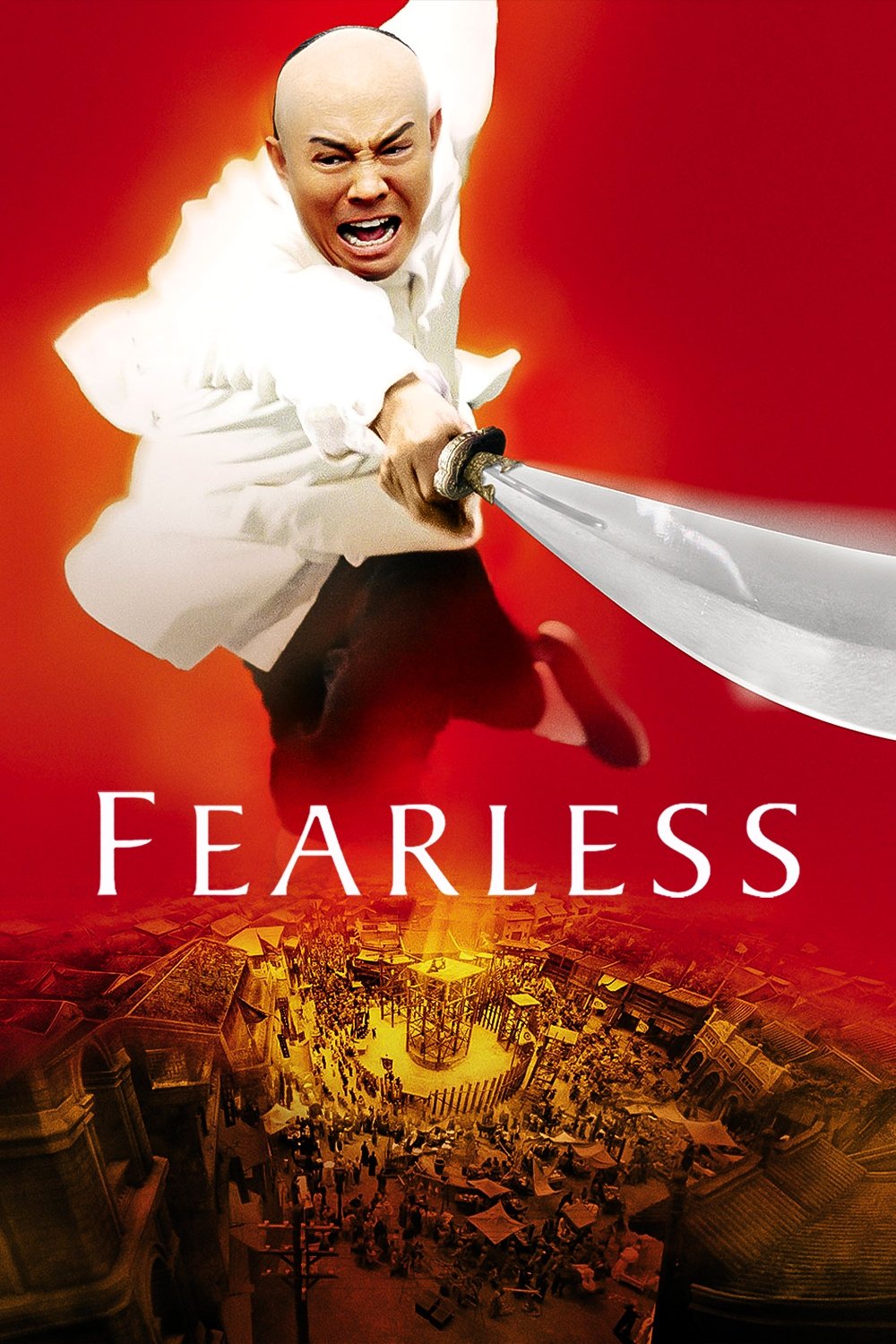
Fearless
Chinese martial artist kills rival in arrogance leading to family's murder, wanders before farming village teaches humility, returns to found ethical martial arts school, defeats foreign challengers restoring national pride, poisoned before final match but defeats Japanese opponent while sparing his life before dying as martyr.
Fearless — Plot Summary
The Tournament and Reflection
Shanghai, 1910. Chinese martial artist Huo Yuanjia stands victorious at an international tournament, having defeated three foreign challengers. As he awaits his fourth and final match, Huo reflects on the journey that brought him to this moment—a life marked by triumph, tragedy, and transformation.
Childhood and Vow
As a child, Huo secretly learns martial arts despite his father's strong objections. His father forbids training because Huo suffers from asthma, which makes the physical demands of martial arts dangerous. However, Huo's determination drives him to practice in secret.
Young Huo witnesses his father lose a martial arts match but conduct himself with honor and dignity in defeat. Despite this honorable loss, Huo himself suffers humiliation from other children and martial artists who mock his family. These experiences instill in young Huo a burning desire to restore the Huo family's reputation and prove their martial arts prowess.
Following his father's death, adult Huo becomes a prominent lei tai fighter in Tianjin—a champion in the raised platform fighting competitions that test martial artists' skills. Huo earns considerable fame and wealth through his victories, becoming one of Tianjin's most celebrated fighters.
However, success corrupts Huo's character. He grows arrogant and reckless, believing his martial skill makes him superior to others. He squanders his wealth on gambling, drinking, and excess. His behavior alienates his close friend Nong Jinsun, who tries unsuccessfully to counsel Huo toward moderation and responsibility.
Tragedy
Huo's arrogance leads to catastrophe. He kills a rival martial artist named Qin Lei during a fight. The killing may have been avoidable or excessive, representing Huo's loss of control and disregard for the sanctity of life. Martial arts, which should cultivate discipline and respect, has instead become a vehicle for Huo's ego and violence.
Qin Lei's godson seeks revenge for his godfather's death. He retaliates by murdering Huo's mother and young daughter—innocent victims killed to punish Huo for his actions. The murders destroy Huo's family and shatter his world.
Devastated by grief and consumed by guilt over the consequences of his arrogance, Huo realizes that his pursuit of fame and his family's honor has actually destroyed his family. He leaves Tianjin, abandoning his martial arts career and wealth, and begins wandering aimlessly through rural China.
Redemption and Learning
After months of wandering as a broken man, Huo is taken in by Granny Sun and her blind granddaughter Yueci in a remote farming village. The family offers him shelter and acceptance despite knowing nothing about his past or his crimes.
Huo lives with them as a simple farmer, working the land and experiencing manual labor far removed from martial arts competition. The simple, honest life helps Huo recover both physically from his self-destructive lifestyle and spiritually from his moral collapse.
Through his time with Granny Sun and Yueci, Huo learns humility, compassion, and the value of human connection beyond fame or victory. Yueci's blindness becomes a metaphor—she cannot see Huo's past glory or current shame, only his present character and actions. Her acceptance helps Huo rebuild his sense of self-worth based on who he is rather than what he has achieved.
Living as a farmer teaches Huo that true strength comes from discipline, respect for life, and contributing to community rather than from defeating opponents or accumulating trophies.
Return to Tianjin
In 1907, Huo returns to Tianjin after years away. The city has changed dramatically—it is now heavily influenced by foreign powers who have established economic and political control over parts of China. The foreign presence represents China's humiliation and loss of sovereignty during this historical period.
Huo's return is marked by symbolic acts of repentance. He burns his martial arts trophies—the physical symbols of his former arrogance and the achievements that led to his family's destruction. By destroying these trophies, Huo rejects his past values and the ego-driven martial arts he once practiced.
Huo seeks out people he had wronged during his arrogant years, asking for their forgiveness. He reconciles with his former friend Nong Jinsun, rebuilding the friendship his behavior had destroyed. These acts demonstrate Huo's genuine transformation rather than mere performance of remorse.
National Pride
An Irish wrestler named Hercules O'Brien arrives in Tianjin and publicly humiliates Chinese fighters, defeating them easily and mocking Chinese martial arts as inferior to Western fighting methods. O'Brien's victories and his contemptuous treatment of Chinese fighters become symbols of foreign domination and Chinese weakness.
Huo challenges O'Brien to restore national pride and demonstrate that Chinese martial arts, properly practiced, can compete with foreign fighting styles. Crucially, Huo fights not from arrogance or personal glory but from responsibility to his country and culture.
Huo defeats O'Brien honorably—conducting himself with respect and dignity rather than humiliating his opponent as O'Brien had humiliated Chinese fighters. The victory restores Chinese confidence and demonstrates that martial arts rooted in ethical principles rather than mere violence can triumph.
Following this success, Huo helps found the Jingwu School (also known as Chin Woo Athletic Association) in Shanghai. The school's mission is promoting martial arts as moral self-cultivation and physical development rather than merely as fighting technique. Huo teaches that martial arts should build character, discipline, and national strength rather than serving individual egos.
The Final Challenge
Foreign businessmen who control Shanghai's economic interests become alarmed by Huo's success and the growing Chinese martial arts movement. They view Chinese cultural pride and physical prowess as threats to their control. These businessmen arrange a final challenge tournament where Huo must fight four foreign champions representing different fighting styles.
One of these four fighters is Tanaka Anno, a Japanese martial artist. Unlike the arrogant challengers, Tanaka respects Huo and his philosophy. The two men develop mutual respect and friendship despite being scheduled opponents, recognizing in each other dedication to martial arts as spiritual practice rather than mere violence.
The story returns to the 1910 tournament where the film began. Tanaka is revealed as Huo's fourth and final opponent. Their first round involves weapons combat and ends in a draw, with both men demonstrating equal skill and restraint.
Before the second round of unarmed combat, Huo is secretly poisoned—likely by the foreign businessmen or their agents who fear he will win all four matches and further inspire Chinese resistance to foreign control. The poison begins affecting Huo's health, weakening him and causing internal damage.
Despite his failing health and the poison coursing through his body, Huo continues fighting Tanaka with full commitment. During the match, Huo deliberately spares Tanaka's life when he has the opportunity to deliver a killing blow. This mercy demonstrates that Huo's martial arts philosophy has completely transformed from his earlier days when he killed Qin Lei unnecessarily.
Huo defeats Tanaka through superior technique while showing respect and restraint. After the match concludes, Huo collapses from the poison's effects. As Huo lies dying, Tanaka declares Huo the rightful victor of the tournament and acknowledges him as a true martial arts master.
Huo Yuanjia dies from the poisoning, becoming a martyr who gave his life defending Chinese martial arts and national pride against foreign domination.
Epilogue
In the film's epilogue, Yueci—the blind woman who helped save Huo during his darkest period—envisions Huo's spirit practicing martial arts peacefully in the afterlife. The vision suggests that Huo has finally achieved the inner peace and spiritual perfection that eluded him during his arrogant youth, and that his true legacy is the philosophy of martial arts as moral cultivation rather than his victories in combat.
Fearless — Ending Explained
The ending validates Huo's transformation from arrogant fighter to enlightened martial artist by having him spare Tanaka despite being poisoned, demonstrating that his philosophy of respect and mercy has become genuine conviction rather than merely strategic behavior. His deliberate choice not to kill when killing would be both justified and easier proves that redemption transformed his fundamental nature rather than just his public conduct.
The poisoning by foreign businessmen represents their recognition that Huo's cultural influence threatens colonial control more than any military resistance could, suggesting that cultural pride and moral authority pose greater threats to domination than physical force alone. The villains' need to cheat through poison acknowledges they cannot defeat Huo's philosophy legitimately, validating the power of his transformed martial arts approach.
Tanaka's declaration of Huo as rightful victor despite Tanaka surviving the match emphasizes that true victory in martial arts comes from character and philosophy rather than merely defeating opponents. His acknowledgment from a respected foreign martial artist provides cross-cultural validation that Huo's values transcend nationalism and represent universal martial arts ideals.
Huo's death as martyr transforms his personal redemption into national inspiration, with his sacrifice for Chinese dignity becoming the founding myth for the Jingwu School and broader martial arts movement. The ending suggests that his death matters less than the legacy of ethical martial arts he established, making his influence permanent rather than contingent on his continued life.
Yueci's vision of Huo's spirit practicing peacefully suggests that his soul has achieved the serenity that his living body, always challenged by competition and conflict, could never fully realize. The peaceful practice in death contrasts with the violence and struggle of his life, implying that enlightenment comes through overcoming earthly attachments to victory, fame, and even national pride.
Fearless — FAQ
Is Huo Yuanjia a real historical figure?
Yes. Huo Yuanjia (1868-1910) was a real Chinese martial artist who founded the Chin Woo Athletic Association in Shanghai. While the film dramatizes and fictionalizes many aspects of his life, the basic facts are historical: he was a lei tai champion from Tianjin, he did challenge foreign fighters to defend Chinese martial arts, and he died in 1910 under circumstances that many believed involved poisoning by Japanese agents, though this was never conclusively proven.
Did Huo really kill a rival and lose his family?
The film's depiction of Huo killing Qin Lei and subsequently losing his mother and daughter is heavily fictionalized for dramatic purposes. Historical records about Huo's early life are limited and often contradictory. The film uses these tragic events as narrative devices to explain Huo's transformation from arrogant fighter to humble philosopher, though the specific details are not historically verified.
What is lei tai fighting?
Lei tai is a traditional Chinese martial arts competition fought on a raised platform (usually about 3-4 feet high). Fighters could use various kung fu styles, and victory was achieved by throwing an opponent off the platform, knocking them down, or forcing submission. Lei tai competitions were popular in late Qing Dynasty China and served as tests of different martial arts schools' effectiveness.
What happened to the Jingwu School after Huo's death?
The Chin Woo Athletic Association (Jingwu School) that Huo co-founded in 1910 became one of the most influential martial arts organizations in modern Chinese history. It expanded throughout China and internationally, establishing branches worldwide. The school promoted martial arts as both physical cultivation and moral education, emphasizing Huo's philosophy that martial arts should build character and national strength rather than merely teach fighting techniques.