Hotel Rwanda
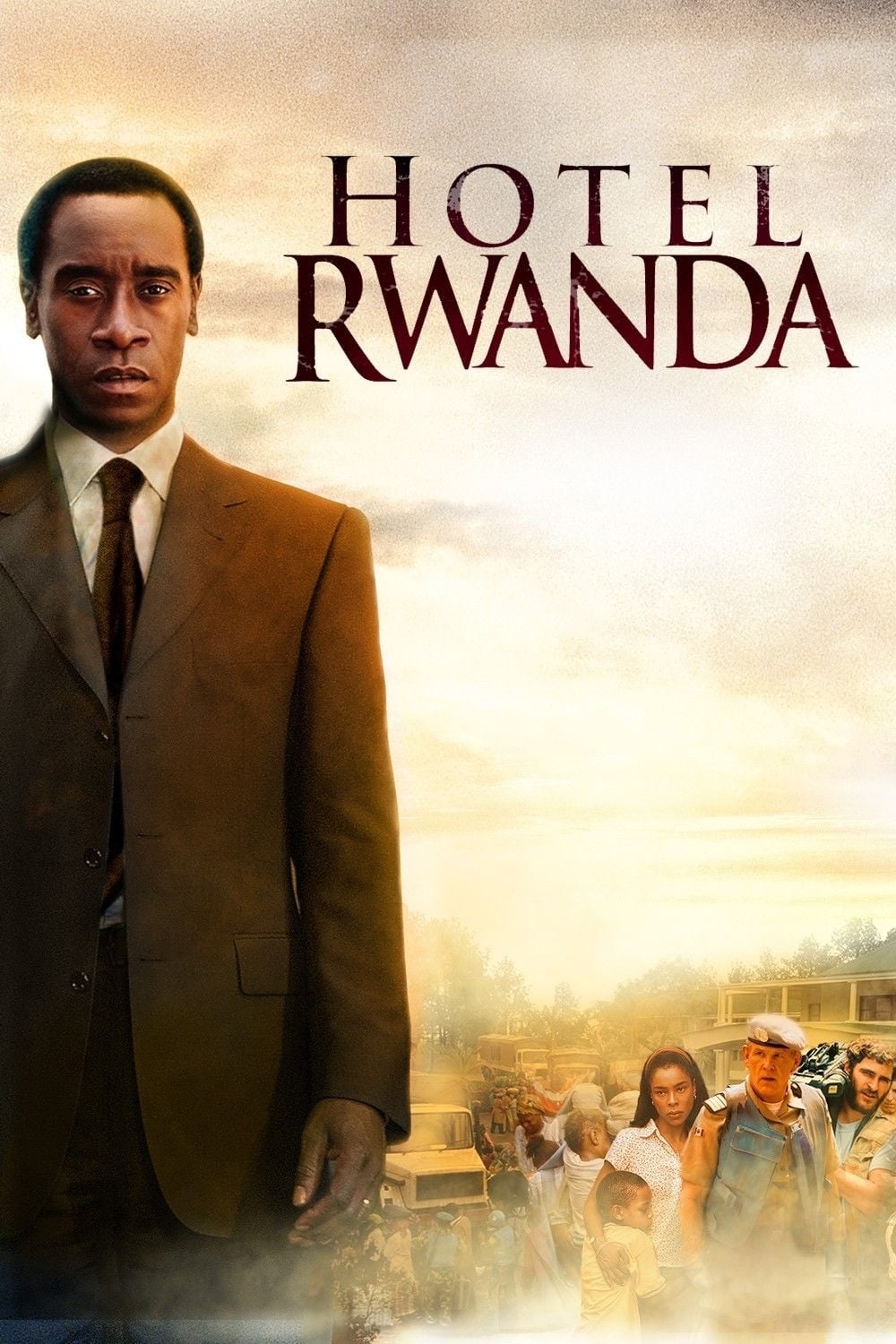
During the 1994 Rwandan genocide, a hotel manager shelters more than a thousand refugees inside a luxury hotel as ethnic violence spreads across the country. Diplomacy, courage, and quick thinking become his only weapons while the world hesitates to intervene in the unfolding humanitarian catastrophe.
Hotel Rwanda — Plot Summary
Fragile Peace
Rwanda, April 1994. The nation is engulfed in civil war between the Hutu-controlled government and Tutsi rebel forces. In the capital city of Kigali, Paul Rusesabagina manages the Belgian-owned Hôtel des Mille Collines, a luxury establishment serving international guests and Rwanda's elite. Paul lives with his Tutsi wife Tatiana and their children, navigating the ethnic tensions that permeate Rwandan society.
Hutu extremist voices, particularly the RTLM radio station, broadcast inflammatory propaganda characterizing the Tutsi minority as an infestation threatening Rwanda's Hutu majority. Georges Rutaganda, a Hutu extremist who supplies goods to the hotel, represents the growing radicalization among Rwanda's Hutu population. Paul maintains a carefully cultivated relationship with Rwandan Army General Augustin Bizimungu, who favors Hutu interests and wields significant power.
United Nations peacekeeping forces, led by Canadian Colonel Oliver, oversee implementation of the Arusha Accords—a peace agreement between the Rwandan Army and the Tutsi Rwandan Patriotic Front designed to end the civil war. However, concerns persist about continuing civil unrest despite the official peace process.
Tatiana's brother Thomas warns Paul that the situation will deteriorate dramatically. Thomas recognizes the extremist rhetoric and militia preparations as harbingers of impending catastrophe. Paul, however, maintains faith in the UN peacekeepers and the international community's commitment to preventing violence. His position as manager of an internationally-owned hotel makes him believe powerful forces will intervene to protect both the hotel and Rwanda's citizens.
Assassination and Massacre
News spreads that the Hutu president has been assassinated. His death triggers the collapse of the Arusha Accords and unleashes planned reprisal massacres. Hutu extremists use the assassination as justification for systematic violence against Tutsi civilians and moderate Hutus who oppose genocide.
Rwandan Army soldiers and Interahamwe militia members begin executing Tutsis throughout Kigali. When a Rwandan Army Captain threatens Paul and his Tutsi neighbors with immediate execution, Paul desperately negotiates for their safety, offering bribes and appealing to the Captain's greed. He successfully secures temporary protection and brings his neighbors to the hotel for refuge.
At the hotel, Paul discovers his insolent receptionist Gregoire occupying the presidential suite. Gregoire threatens to expose all Tutsi refugees sheltering at the hotel unless he is exempted from working. The threat reveals how quickly social order has collapsed into opportunistic exploitation.
Colonel Oliver's UN forces are strictly prohibited from intervening in the genocide by their mandate and orders from headquarters. The peacekeepers can protect themselves but cannot use force to prevent massacres of civilians. This restriction renders them largely ineffective witnesses to atrocities.
Paul's boss, the hotel's Belgian owner living safely in Belgium, apologizes over the phone but admits he cannot arrange safe passage for Paul or his family. The international community evacuates foreign nationals—white Europeans and Americans—but leaves Rwandans behind to face the violence.
Sanctuary Under Siege
The Hôtel des Mille Collines receives refugees from the overburdened UN refugee camp, Red Cross facilities, and various orphanages. The hotel population swells to approximately 800 people—both Tutsis seeking protection and moderate Hutus opposed to genocide.
Tatiana desperately searches for her brother Thomas, his wife, and their two young nieces, fearing they have been killed in the massacres sweeping Kigali. The uncertainty torments her while she attempts to maintain normalcy for other refugees.
As violence intensifies, Paul must simultaneously divert Hutu soldiers and militia members, care for hundreds of refugees with limited resources, protect his own family, and maintain the appearance of a functioning four-star hotel. The facade of normalcy is essential—if the hotel appears to be merely a refugee shelter, the army may storm it and massacre everyone inside.
Paul forces Gregoire to work, leveraging his relationship with General Bizimungu to compel the receptionist's cooperation. The arrangement demonstrates Paul's skill at manipulating power relationships even amid genocide.
Confronting Reality
Low on critical supplies, Paul and Gregoire drive to collect provisions from Georges Rutaganda. During this trip, they witness Interahamwe militia members raping Tutsi hostages held in a building. Georges explains to Paul that "rich cockroaches" like Paul—Tutsi sympathizers with money—will find their wealth worthless because all Tutsis will soon be dead. The comment reveals the genocidaires' systematic planning and their confidence in completing total extermination.
On the return journey, Paul and Gregoire take a riverside road through fog that Georges recommended. As the fog lifts, they discover the road is carpeted with corpses—hundreds or thousands of murdered Tutsis dumped along the route. The sight traumatizes both men, confronting them with the genocide's horrifying scale.
Betrayal and Bribery
When UN forces prepare to evacuate a group of refugees, including Paul's family, Gregoire betrays them to the Interahamwe. He provides information about the evacuation route and timing, allowing militia members to set up roadblocks. RTLM radio broadcasts coordinate the ambush, directing militia to intercept the convoy.
The Interahamwe stop the vehicles and prepare to massacre the refugees. Paul, thinking rapidly, offers General Bizimungu all remaining valuables and bottles of expensive Scotch whisky from his office safe in exchange for protecting the refugees. Paul also admonishes Bizimungu for his genocidal apathy, warning him that the international community will eventually hold perpetrators accountable. Paul promises to testify on Bizimungu's behalf about the General's help if Bizimungu intervenes now.
Bizimungu, persuaded by the combination of immediate bribes and Paul's promise of future testimony, orders soldiers to allow the refugees to continue. The intervention saves hundreds of lives temporarily but does not address the larger genocide engulfing Rwanda.
Escape to Safety
Paul's family and the hotel refugees finally evacuate the besieged Hôtel des Mille Collines in a UN convoy. The vehicles travel through chaos—masses of refugees fleeing in one direction while Interahamwe militia move in the other, hunting victims. The convoy must navigate checkpoints where militia members inspect vehicles for Tutsis.
Eventually, they reach territory controlled by Tutsi rebel forces of the Rwandan Patriotic Front. Behind rebel lines, relative safety exists. At the refugee camp, Paul and Tatiana are reunited with their two young nieces, who survived the massacres that killed their parents. The reunion brings both joy and profound grief—the children are alive, but Thomas and his wife were murdered.
Aftermath
Textual epilogue reveals the fates of key figures. Paul Rusesabagina saved at least 1,200 Tutsi and Hutu refugees through his actions at the hotel. He and Tatiana adopted their orphaned nieces and relocated the entire family to Belgium, finding safety in exile. Thomas and his wife were never found—their bodies presumably among the estimated 800,000 to 1,000,000 victims of the genocide.
Georges Rutaganda and General Augustin Bizimungu were both tried for war crimes in international tribunals. Georges received a life sentence for his role organizing and participating in genocide. Bizimungu received a prison sentence for his complicity, though Paul's promised testimony about his last-minute intervention may have influenced his sentencing.
The epilogue contextualizes Paul's heroism within the larger tragedy. While he saved over 1,200 people—an extraordinary achievement—the genocide claimed hundreds of thousands of lives. The international community's failure to intervene enabled systematic murder that could have been prevented through decisive action by UN peacekeepers or Western military forces.