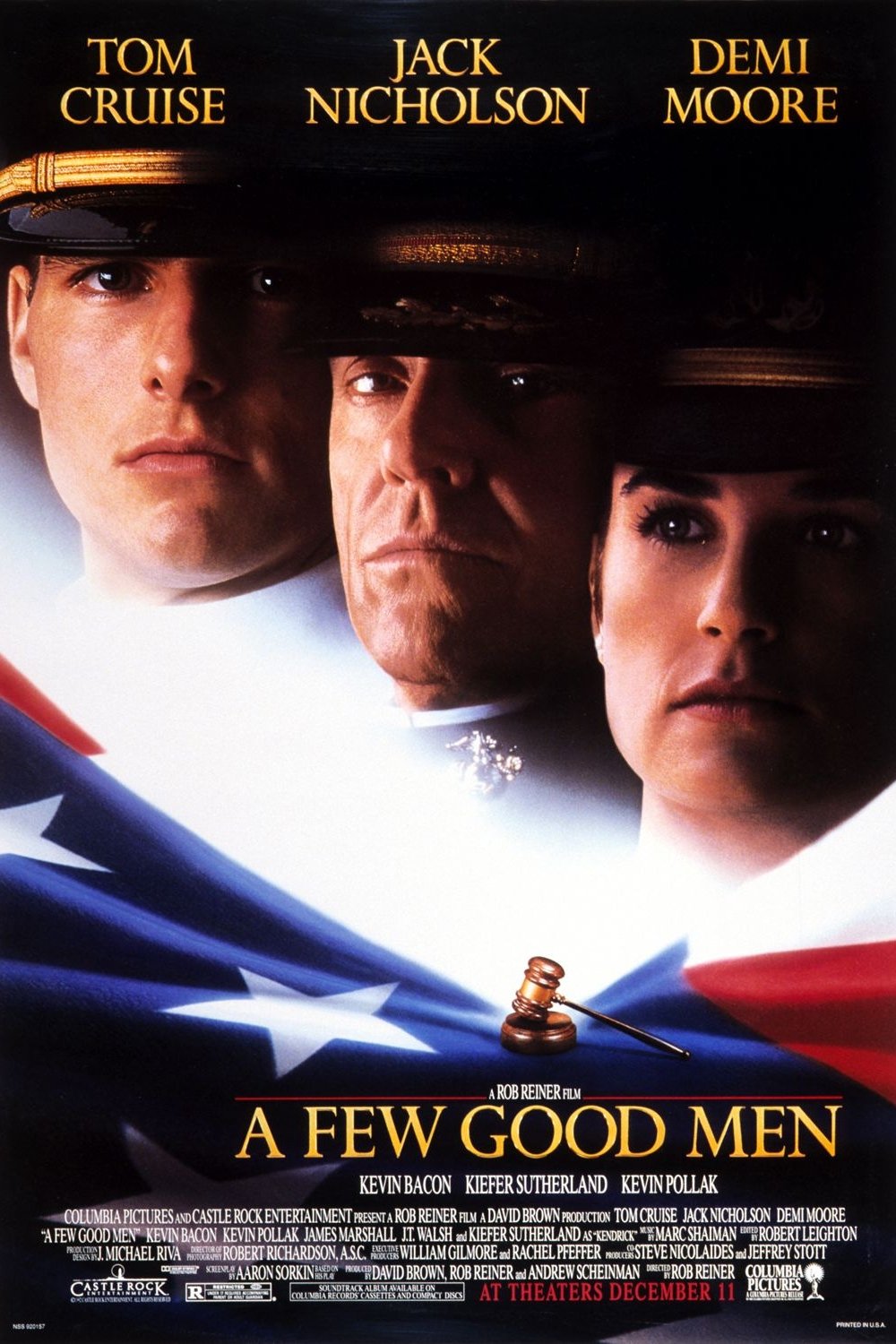
A Few Good Men
A Navy lawyer with no trial experience defends two Marines accused of murdering a fellow soldier at Guantanamo Bay, uncovering a coverup involving illegal punishment orders while confronting an arrogant base commander whose testimony reveals the truth about command responsibility and honor.
A Few Good Men — Plot Summary
Death at Guantanamo
Guantanamo Bay Naval Base, Cuba. In the middle of the night, Private William Santiago, a United States Marine, is tied up and violently beaten by fellow Marines in his barracks. The assault is brutal and prolonged. When Santiago is discovered the following morning, he is dead. The beating has killed him, transforming what may have been intended as punishment into homicide.
Military authorities quickly arrest two Marines: Lance Corporal Harold Dawson and Private First Class Louden Downey. Both are accused of Santiago's murder and face court-martial proceedings that could result in severe sentences including life imprisonment or potentially the death penalty. The case requires defense counsel from the Judge Advocate General's Corps.
The military assigns the defense to Lieutenant Daniel Kaffee, a Navy JAG attorney whose professional reputation is built on efficiency rather than courtroom prowess. Kaffee has developed an impressive track record by negotiating plea bargains that resolve cases quickly without going to trial. He has never actually argued a case in court, instead relying on his ability to negotiate favorable deals that save time for everyone involved.
Suspicions and Resistance
Lieutenant Commander Joanne Galloway, another JAG attorney and Kaffee's superior officer, suspects something improper occurred in Santiago's death. She has reviewed the circumstances and believes the case deserves more thorough investigation than a quick plea bargain would allow. Santiago had broken the chain of command shortly before his death by requesting a transfer away from Guantanamo Bay. His request went directly to higher authorities rather than through proper channels, suggesting desperation.
Lieutenant Colonel Matthew Markinson had advocated for Santiago's transfer to be approved, recognizing the young Marine was struggling and might benefit from reassignment. However, Base Commander Colonel Nathan Jessep rejected the transfer request and instead ordered Santiago's platoon commander, Lieutenant Jonathan Kendrick, to "train" Santiago more rigorously. Jessep's position was that Santiago's substandard performance reflected poorly on the entire platoon, and therefore everyone shared responsibility for improving him.
Galloway suspects that Dawson and Downey carried out what Marines call a "code red"—a violent extrajudicial punishment administered by fellow service members to enforce discipline outside official channels. These unofficial punishments, while strictly prohibited, allegedly occur with some frequency in military units.
Galloway is bothered by Kaffee's blasé approach to the case. He seems more interested in negotiating a quick resolution than investigating potential injustice. Kaffee, meanwhile, resents Galloway's interference in what he considers his case to handle as he sees fit.
Investigation and Plea Bargain
Kaffee and Galloway travel to Guantanamo Bay to question Colonel Jessep and other personnel involved. They are met with open contempt from Jessep, who views their questions as impertinent challenges to his authority and command decisions. The colonel makes clear he considers Santiago's death unfortunate but ultimately the result of the deceased Marine's own inadequacies.
Kaffee negotiates a plea bargain with the military prosecutor, US Marine Judge Advocate Captain Jack Ross. The proposed deal would have Dawson and Downey plead guilty to involuntary manslaughter, carrying a sentence of two years with only six months actually served. Given that conviction at trial could result in life imprisonment or execution, the bargain offers significant leniency.
However, Dawson and Downey refuse the plea bargain despite its obvious advantages. They insist that Lieutenant Kendrick gave them the "code red" order directly, that they were following orders from a superior officer, that they never intended to kill Santiago, and that accepting a plea bargain would be dishonorable. They believe they did nothing wrong by following what they understood to be lawful orders.
Commitment to Defense
Initially, Kaffee hoped to be removed as defense counsel, uncomfortable with clients who refuse sensible plea bargains. However, at the arraignment, he unexpectedly pleads not guilty on behalf of both defendants. Kaffee has realized that he was specifically chosen to handle this case because his reputation for plea bargains meant the matter would be resolved quietly without embarrassing scrutiny of command decisions at Guantanamo Bay.
Deciding he will not be manipulated into suppressing potential injustice, Kaffee commits to mounting an actual defense. Lieutenant Colonel Markinson secretly meets with Kaffee and provides crucial information: Colonel Jessep never actually ordered Santiago's transfer despite what official records might suggest. This contradicts Jessep's testimony and suggests a coverup.
During trial preparation, the defense establishes several relevant facts. Dawson had received a negative performance review from Lieutenant Kendrick and been denied promotion. His infractions involved smuggling food to another Marine who had been restricted to consuming only water and vitamins as punishment. Dawson was disciplined for disobeying what he considered an illegal order—he believed starving a fellow Marine violated regulations even if ordered by a superior officer.
Through Downey's testimony, the defense proves that illegal "code red" punishments had been ordered at Guantanamo Bay on previous occasions, establishing a pattern of such conduct.
Setbacks and Doubt
However, under cross-examination by Captain Ross, Downey admits a critical weakness in the defense: he was not actually present when Dawson allegedly received the "code red" order from Kendrick. His testimony about the order is hearsay rather than firsthand knowledge.
Lieutenant Colonel Markinson, ashamed that he failed to protect a Marine under his command and unwilling to testify against his longtime friend Colonel Jessep, commits suicide before he can provide testimony. His death eliminates a crucial witness who could have corroborated that Jessep never intended to transfer Santiago and may have deliberately endangered him.
Without Markinson's testimony, Kaffee believes the case has become unwinnable. Returning home after this devastating setback, Kaffee gets drunk and laments his decision to fight the case at all. He risked long sentences for Dawson and Downey when he could have accepted the lenient six-month plea bargain. His attempt to pursue justice may result in his clients spending life in prison.
Galloway encourages Kaffee to take a final risk: call Colonel Jessep as a witness. Doing so carries enormous danger—challenging a high-ranking officer's testimony without concrete evidence could result in Kaffee himself facing court-martial for conduct unbecoming an officer. However, Galloway believes Jessep's arrogance might cause him to reveal the truth if properly provoked.
The Truth
At the Washington Navy Yard court, Colonel Jessep takes the stand. He spars verbally with Kaffee's questioning, treating the young attorney with barely concealed contempt. However, Kaffee springs a trap by pointing out a critical inconsistency in Jessep's testimony.
Jessep has claimed that Guantanamo Bay Marines would never disobey an order, specifically an order to "not touch Santiago." Yet Jessep also testified that he ordered Santiago off the base because he feared for Santiago's safety—suggesting he did not trust his Marines to obey the order to leave Santiago alone.
Kaffee also challenges Jessep's claim that Santiago was scheduled to be transferred on the first available flight. If Santiago was truly being transferred imminently, why would Jessep fear for his safety during a brief remaining period at the base?
Frustrated by Kaffee's persistent questioning and attitude, Jessep extols the military's importance to national security and his own crucial role in defending American interests. He exclaims, "You can't handle the truth!" in defense of his command decisions.
Kaffee directly challenges Jessep's indignation by pointedly asking whether Jessep ordered the "code red" punishment. Jessep, his composure finally breaking under Kaffee's relentless questioning and his own arrogance, admits he ordered it.
Attempting to leave the courtroom after this admission, Jessep is arrested before he can depart. He tries to physically assault Kaffee but is restrained by military police and read his rights.
Verdict and Honor
Dawson and Downey are cleared of murder and conspiracy charges based on Jessep's admission. However, they are convicted of "conduct unbecoming" Marines. The verdict acknowledges they followed orders but holds them accountable for not recognizing those orders were illegal. Both will be dishonorably discharged from the Marine Corps.
Downey does not understand what they did wrong—they followed orders from a superior officer. Dawson explains that they failed in their duty to defend those unable to fight for themselves. Marines are supposed to protect the weak, and Santiago was weak. Instead of protecting him, they participated in his abuse.
Kaffee tells Dawson that it is not necessary to wear a uniform or military insignia to possess honor. True honor exists independently of official status. Dawson, acknowledging Kaffee's integrity and service, renders a formal salute—treating Kaffee as a genuine officer worthy of respect.
Kaffee and Captain Ross exchange pleasantries before Ross departs. His next assignment is arresting Lieutenant Kendrick, who gave the illegal "code red" order that set these tragic events in motion.