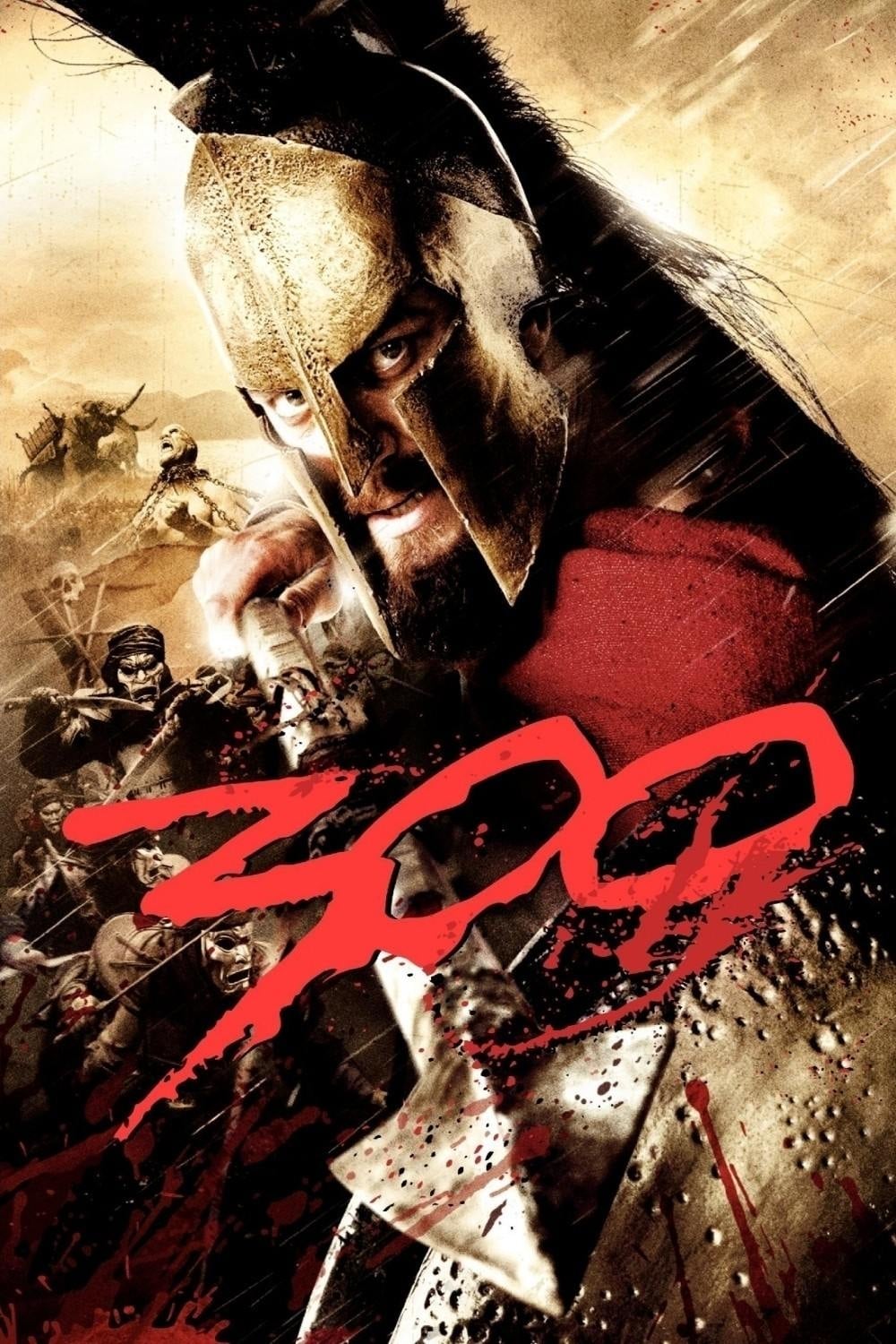
300
King Leonidas and 300 Spartans stand against the massive Persian army, showcasing epic battles, legendary courage, and stunning visuals in this historical action film.
300 — Plot Summary
The Making of a Spartan King
The film opens with narration by Dilios, a Spartan hoplite warrior, who recounts the legendary story of King Leonidas I and the Battle of Thermopylae. The narration begins with Leonidas's childhood, describing the brutal Spartan child-rearing system known as the agoge.
Young Leonidas, like all Spartan boys, was taken from his mother at age seven and subjected to years of harsh military training designed to create the world's most fearsome warriors. The training was merciless—boys were beaten, starved, forced to fight each other, and taught that weakness meant death.
As part of his final trial to prove himself worthy of kingship, young Leonidas was sent alone into the wilderness to survive and hunt a monstrous wolf that had been terrorizing the countryside. Armed with only a spear, the boy tracked and killed the massive beast, proving his worthiness to become Sparta's king. This victory demonstrated the courage, skill, and ruthlessness that would define his reign.
Years later, Leonidas has become king of Sparta, ruling alongside his wife Queen Gorgo, a strong and intelligent woman who serves as his trusted advisor and equal partner.
The Persian Demand
The peace of Sparta is shattered when a Persian herald arrives at the city with a message from Xerxes I, the self-proclaimed God-King of Persia who commands the largest empire the world has ever seen.
The herald delivers Xerxes' ultimatum: Sparta must offer "earth and water" as tokens of submission to Persian authority. This symbolic gesture would make Sparta a vassal state of the Persian Empire, ending its independence and forcing Spartan soldiers to serve Persian interests.
The herald delivers this demand with arrogance and contempt, even insulting Queen Gorgo when she dares to speak in the political assembly—something shocking to Persians, whose women have no public voice.
Leonidas's response is immediate and uncompromising. Rather than submitting to Persian dominance, Leonidas and his soldiers seize the herald and his envoys and throw them into a bottomless pit, shouting "This is Sparta!" as the herald falls to his death screaming.
This act of defiance is effectively a declaration of war against the most powerful empire on Earth. Sparta, a small city-state with perhaps 8,000 warriors, has just challenged an empire that can field hundreds of thousands of soldiers.
The Ephors' Refusal
Understanding that war with Persia is now inevitable, Leonidas develops a strategic plan. He proposes leading Sparta's army to Thermopylae—the "Hot Gates"—a narrow coastal pass where the mountains meet the sea. By funneling the massive Persian army through this bottleneck, the heavily armored and highly trained Spartan infantry could neutralize Persia's numerical superiority. In the narrow pass, the Persians' light infantry and cavalry would be unable to use their numbers effectively against the superior Greek phalanx formation.
However, Leonidas cannot simply march to war on his own authority. He must first consult the Ephors—ancient, diseased priests who serve as religious authorities in Sparta and whose approval is required for major military campaigns.
Leonidas visits the Ephors in their temple, a grotesque place where these corrupt, deformed old men live surrounded by sickness and depravity. He presents his plan to fight the Persians at Thermopylae.
The Ephors refuse permission, declaring that Sparta must not wage war during the upcoming Carneia, a sacred religious festival when military campaigns are forbidden. They order Leonidas to consult the Oracle—a young woman kept in drug-induced trances to deliver prophecies—who confirms that Sparta should not march to war.
Leonidas departs angrily, frustrated by religious restrictions when his country faces existential threat. As he leaves, the film reveals the corruption behind the Ephors' decision: an agent of Xerxes appears alongside Theron, a treacherous Spartan politician, rewarding the Ephors with Persian gold for their covert support. The religious leaders have been bribed to ensure Sparta does not interfere with the Persian invasion.
The 300
Denied official permission to mobilize Sparta's full army, Leonidas finds a loophole. He cannot take Sparta to war, but he can take his personal bodyguard on a "walk"—a supposedly peaceful march that just happens to be fully armed and heading toward Thermopylae.
Leonidas selects 300 of Sparta's finest warriors—all men who have sons to carry on their family names, ensuring their bloodlines will continue even if they die. These are not young recruits but seasoned warriors in their prime, each a veteran of countless battles.
As the 300 prepare to depart, Theron and members of the Spartan Council confront Leonidas, accusing him of defying the Ephors' religious decree. Leonidas denies that he is going to war—he and his men are simply going for a walk. The transparent fiction allows Leonidas to technically obey the Ephors' restriction while still defending Greece.
Shortly after this confrontation, the 300 Spartans march toward the Hot Gates.
The Greek Alliance
The Spartans are joined at Thermopylae by several thousand Arcadians led by their commander Daxos, along with contingents from other Greek city-states. While these allied Greeks are not trained to Spartan standards, they bolster the defensive force to around 7,000 men total.
As they establish their position at the narrow pass, they witness a massive storm at sea that sinks many Persian naval vessels in the Aegean. The Greeks interpret this as a favorable sign from the gods.
The Spartans scout the massive Persian encampment in the distance—an army of hundreds of thousands stretching as far as the eye can see, representing dozens of conquered nations forced to serve Xerxes. When Persian scouts approach the Greek position, the Spartans kill them and use their bodies to construct a wall, sending a clear message to Xerxes about Greek defiance.
Ephialtes
While preparing their defenses, Leonidas encounters Ephialtes, a hunchbacked Spartan whose parents fled Sparta years earlier to spare him from the infanticide that Spartan law demanded for deformed infants. Ephialtes has lived in exile his entire life but still identifies as Spartan and wishes to fight for his homeland.
Ephialtes warns Leonidas of a secret goat path through the mountains that the Persians could potentially use to outflank and surround the Spartan position. He then requests permission to join Leonidas's army, hoping to redeem his family's name and prove his worth as a Spartan despite his deformity.
Leonidas is sympathetic to Ephialtes's desire to serve, but he must make a practical military decision. He asks Ephialtes to demonstrate that he can raise his shield high enough to maintain the phalanx formation—the locked-shield wall that makes Spartan warriors nearly invincible in close combat.
Ephialtes cannot. His twisted spine and deformed body make it physically impossible for him to hold his position in the phalanx without creating a gap that enemies could exploit. One weakness in the formation could get every man killed.
Leonidas gently but firmly rejects Ephialtes's request, explaining that he cannot compromise the phalanx. He offers Ephialtes another role—helping tend the wounded or carrying supplies—but for a man who has dreamed of being a Spartan warrior his entire life, this consolation is crushing.
Ephialtes leaves devastated, his hopes destroyed by the very body that has cursed him since birth.
The First Day
The battle begins when Persian envoys approach the Greek position and demand that the Spartans lay down their weapons. Leonidas's response is defiant: "Come and take them."
The Persian army attacks, sending wave after wave of soldiers toward the narrow pass where the Spartans wait in perfect phalanx formation. The confined space of the Hot Gates works exactly as Leonidas predicted—the Persians cannot bring their numerical superiority to bear.
The Spartans fight with brutal efficiency, their interlocking shields and long spears creating an impenetrable wall of bronze and iron. Persian soldiers are slaughtered by the hundreds as they funnel helplessly into the killing zone. The Spartans suffer no casualties during these initial assaults, proving the superiority of heavy infantry in confined terrain.
After the Persians' repeated failures, Xerxes himself approaches the battlefield aboard an enormous mobile throne carried by slaves. The God-King—a tall, androgynous figure covered in gold piercings and jewelry—offers to meet with Leonidas personally.
Xerxes attempts to seduce Leonidas with promises of wealth, power, and position within the Persian Empire. He offers to make Leonidas a general commanding vast armies and controlling rich territories if he will only kneel and submit.
Leonidas rejects the offer with contempt, mocking the quality of Xerxes's warriors who died so easily despite their overwhelming numbers. He makes clear that Spartans will never kneel to anyone, and that freedom is worth more than all the gold in Persia.
Enraged by this defiance, Xerxes sends in his elite troops—the Immortals, legendary Persian warriors who are supposedly unbeatable in combat, led by a monstrous warrior called the Über Immortal who towers over normal men.
The Greeks fight fiercely against these superior troops and emerge victorious once again, though they suffer their first casualties. Even Xerxes's best warriors cannot break the Spartan phalanx.
The Second Day
On the second day of battle, Xerxes unleashes even more exotic and terrifying units from his vast empire: war elephants from India, bombardiers hurling explosives and flaming projectiles, and even an armored rhinoceros.
Despite the spectacle and terror of these weapons, the disciplined Spartans adapt and overcome each new threat, continuing to hold the pass against impossible odds.
Meanwhile, the embittered Ephialtes—rejected by Leonidas and consumed by resentment—makes a fateful decision. He travels to the Persian camp and defects to Xerxes, offering to reveal the secret goat path through the mountains in exchange for wealth, women, and a Persian uniform that will let him finally be a warrior.
Xerxes accepts Ephialtes's betrayal eagerly, now possessing the intelligence he needs to destroy the Greek force.
During the day's fighting, tragedy strikes the Spartan ranks. Astinos, the eldest son of Leonidas's loyal captain Artemis, is decapitated during combat. The grieving father breaks formation in a vengeful rage, charging the Persians alone and killing many before returning to the ranks.
This moment of emotional weakness—understandable but dangerous—demonstrates how even Spartan discipline can fracture under the weight of personal loss.
The Betrayal
That evening, the Greeks learn of Ephialtes's betrayal and realize that Persian forces are already using the mountain path to encircle their position. By morning, they will be surrounded and annihilated.
The Arcadians and other Greek allies decide to retreat while escape is still possible, refusing to die in what has become a hopeless battle.
The Spartans, however, choose to stay. Death in battle defending Greece is exactly what they were trained for since childhood. Retreat would be shameful and contrary to Spartan law, which forbids warriors from abandoning their shields or positions.
Leonidas makes a strategic decision: he orders Dilios, one of his finest warriors, to return to Sparta despite Dilios's protests. Dilios has been wounded but could still fight, and he desperately wants to die alongside his brothers.
However, Leonidas needs someone to survive and tell Sparta what happened at Thermopylae. He needs a witness who can inspire the Greek city-states to unite against Persia. Dilios must live to tell the story of the 300.
Reluctantly, Dilios departs, carrying the terrible burden of survival while his friends prepare to die.
Gorgo's Plea
Back in Sparta, Queen Gorgo attempts to rally political support to send reinforcements to aid the 300. She approaches Theron, the influential politician, seeking his help in persuading the Spartan Council.
Theron agrees to support her plea before the Council, but demands payment: he rapes Queen Gorgo in exchange for his promised assistance.
Gorgo submits to this violation, believing that saving the 300 requires this terrible sacrifice.
However, the following day when Gorgo makes her impassioned plea to the Council, Theron betrays her completely. He publicly accuses her of adultery, claiming she seduced him and attempting to destroy her credibility before the assembly.
Enraged by this treachery after suffering his assault, Gorgo draws a blade and kills Theron in front of the entire Council. As his body falls, a bag of Persian gold coins spills from his robes, revealing his treason.
The Council, understanding that Theron was a Persian agent working to undermine Spartan resistance, unanimously agrees to send reinforcements to continue the war against Persia. Gorgo's sacrifice and courage have united Sparta against the invaders.
The Last Stand
On the third day of battle, the Persians—guided by Ephialtes—have successfully traversed the mountain path and encircled the Spartan position. The 300 are now surrounded by hundreds of thousands of enemy soldiers.
A Persian general approaches under a flag of truce and demands the Spartans' surrender one final time.
The Spartans' response comes from a young warrior named Stelios, who hurls a spear that kills the general instantly.
Xerxes, watching from his throne, is outraged by this final defiance. He orders his entire army to attack the surrounded Spartans.
Before the final assault begins, Leonidas performs one last act of defiance. He hurls his spear with all his strength toward Xerxes's throne. The weapon slices across the God-King's face, drawing blood and proving that Xerxes is mortal, not divine.
Then the Persians attack from all sides.
The Spartans fight with extraordinary courage, killing hundreds more Persians in brutal close combat. But they are hopelessly outnumbered, and one by one, the warriors fall.
When the Spartans are reduced to a final handful of survivors around Leonidas, Xerxes orders his archers to fire. Thousands of arrows darken the sky, falling like rain.
Leonidas and the last of the 300 are killed by the arrow barrage, fighting until their final breath.
The Battle of Plataea
The film returns to Dilios, whose narration has been telling this story to the Spartan army. One year has passed since Leonidas's sacrifice at Thermopylae.
Inspired by the courage of the 300 and the unity that Queen Gorgo's testimony created in Sparta, the Greek city-states have mobilized a massive army to face Persia in open battle.
Dilios, now wearing the distinctive red cape of a Spartan officer, stands before thousands of Greek hoplites assembled on the plains of Plataea. He delivers a rousing speech honoring King Leonidas and the 300 warriors who sacrificed everything to defend Greece and buy time for this army to gather.
He reminds them that Leonidas and the 300 showed the world that even the God-King bleeds, that Persian might can be resisted, and that free men fighting for their homes are worth more than slaves fighting for a tyrant.
As Dilios finishes his speech, he raises his spear and leads the Greek charge against the Persian army. Tens of thousands of warriors surge forward, crashing into the Persian lines in the Battle of Plataea—the decisive engagement that will ultimately drive Xerxes's forces from Greece and preserve Western civilization.
The film ends with the Greeks charging into battle, their victory inspired by the sacrifice of 300 Spartans who held the line at Thermopylae and proved that courage and freedom could triumph over tyranny.
300 — Ending Explained
The ending's transition from Thermopylae's defeat to Plataea's imminent victory demonstrates that military sacrifice can achieve strategic success through inspiration rather than tactical victory, with the 300's deaths buying time for Greek unity and proving Persian vulnerability. Leonidas's failure to hold the pass becomes victory through martyrdom that galvanizes resistance.
Dilios surviving to narrate validates Leonidas's decision to send a witness rather than let all 300 die anonymously, positioning storytelling and propaganda as essential weapons alongside spears and shields. The film's entire narrative structure—Dilios recounting events before battle—frames history as tool for motivating present action.
Xerxes being wounded by Leonidas's spear proving the "God-King bleeds" transforms physical injury into ideological defeat, demonstrating that autocratic power depends on mystique of invincibility that one successful strike can shatter. The blood on Xerxes's face destroys claims of divinity more effectively than killing thousands of soldiers.
Gorgo killing Theron and exposing his Persian gold uniting the Spartan Council shows that betrayal from within posed greater threat than Persian armies, with internal corruption nearly defeating Sparta where external force failed. Her political victory at home complements military sacrifice abroad.
The film ending on the charge rather than showing Plataea's outcome leaves viewers with image of unified Greek resistance rather than historical aftermath, prioritizing mythological inspiration over documentary accuracy. The freeze-frame of warriors charging emphasizes eternal struggle for freedom over specific battle results.
300 — FAQ
Is 300 historically accurate?
The film is based on Frank Miller's graphic novel, which took significant creative liberties with the historical Battle of Thermopylae (480 BCE). While the core facts are real—Leonidas did lead 300 Spartans and allied Greeks to hold the pass, Ephialtes did betray them, and they died buying time for Greece—the film exaggerates extensively. The Persian army numbered tens of thousands (not millions), didn't include rhinoceroses or deformed giants, and Xerxes was not a pierced giant but a normal-sized king.
Why did only 300 Spartans fight?
Historically, religious festivals did restrict Sparta's full army mobilization, though around 7,000 total Greeks (including the 300 Spartans) fought at Thermopylae. The film focuses on the 300 Spartans specifically because they were all full Spartan citizens who chose to stay for the final stand when allies retreated. The "300" represents Sparta's warrior elite making the ultimate sacrifice.
What happened after Thermopylae?
The Battle of Plataea (479 BCE), shown at the film's end, saw a united Greek army decisively defeat the Persians and drive them from Greece permanently. Combined with the naval victory at Salamis, these battles ended the Persian invasion and preserved Greek independence, allowing Greek culture and democratic ideals to develop and eventually influence Western civilization.
Did Queen Gorgo really address the Spartan Council?
Historically, Spartan women had unusual freedom and influence compared to other Greek city-states, with control over property and respected voices in politics, so Gorgo's political involvement is plausible. However, the specific events depicted—particularly Theron's assault and betrayal—are fictional creations not found in historical sources.