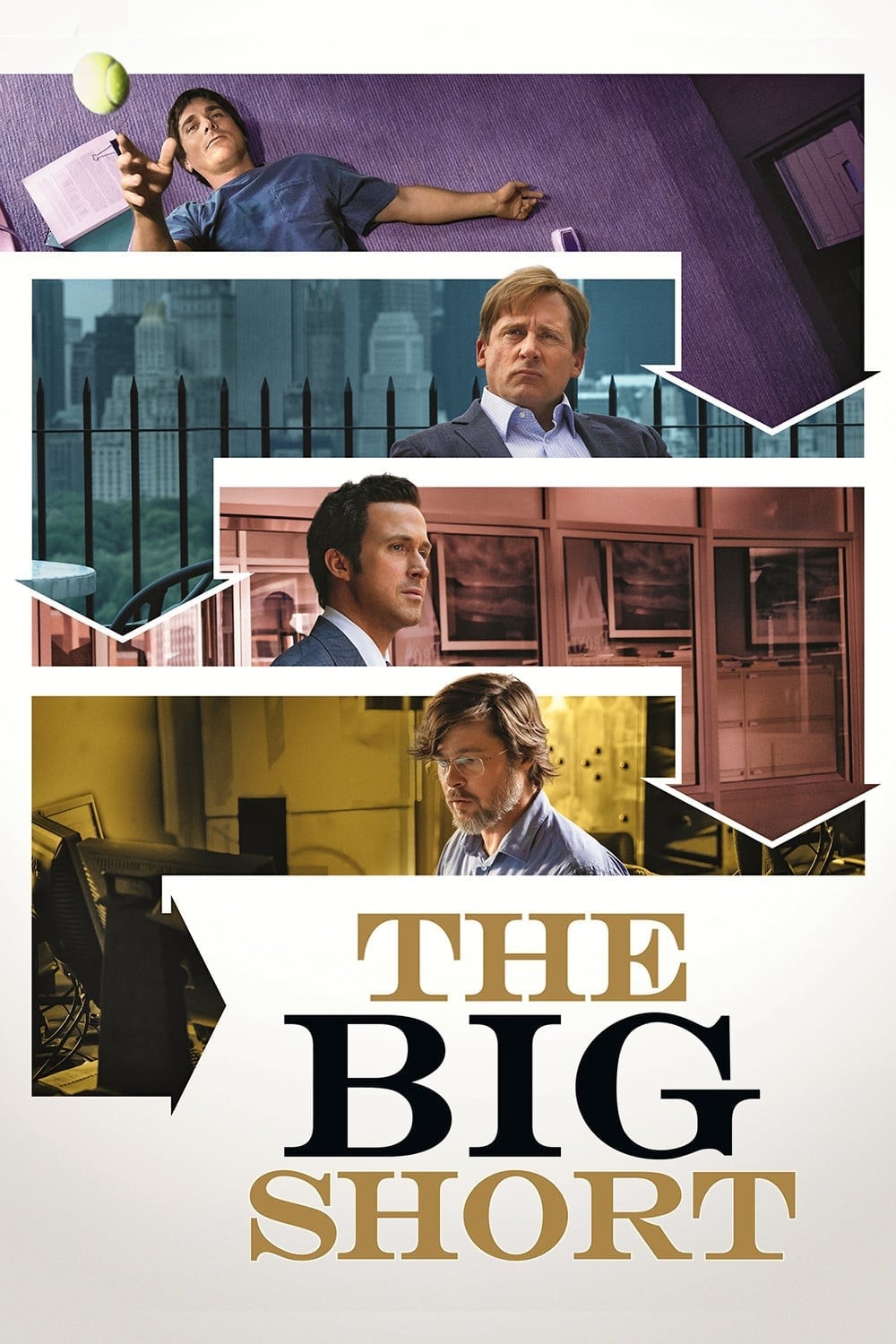
The Big Short
The 2008 financial crisis unfolds as a group of outsiders bets against the banks in this gripping financial drama based on true events.
The Big Short — Plot Summary
Scion Capital
The year 2005. Michael Burry, an eccentric hedge fund manager at Scion Capital, makes an alarming discovery while analyzing housing market data. The United States housing market, which appears stable on the surface, is actually built on a foundation of extremely high-risk subprime loans—mortgages given to borrowers with poor credit who are unlikely to be able to repay them.
Burry's analysis leads him to an unprecedented conclusion: the housing market will collapse in the second quarter of 2007, when adjustable-rate mortgages reset to higher interest rates that borrowers cannot afford. Homeowners will default en masse, causing the entire system to crash.
Recognizing an opportunity to profit from this inevitable disaster, Burry proposes creating an entirely new financial instrument: a credit default swap (CDS) market for mortgage-backed securities (MBSs). Essentially, Burry wants to purchase insurance policies betting against the housing market—he will profit when the supposedly "safe" mortgage bonds fail.
Burry approaches major investment and commercial banks including Goldman Sachs with his unusual proposal. The banks, confident that the housing market will remain strong, eagerly accept his bets, viewing Burry's position as easy money. They sell him credit default swaps totaling over $1 billion.
However, Burry's strategy requires paying substantial monthly premiums on these insurance policies while waiting for the market to collapse. As months pass with no sign of the predicted crash, Burry's main investor, Lawrence Fields, accuses him of "wasting" capital. Many of Burry's other clients demand that he reverse his position and sell the CDSs, cutting their losses.
Burry refuses, maintaining his conviction despite mounting pressure. Under intense scrutiny from angry investors, he makes a controversial decision: he restricts withdrawals from his fund, preventing clients from pulling their money out. This action enrages investors, and Fields sues Burry for mismanagement.
Eventually, in 2008, the financial crisis Burry predicted finally arrives. The housing market collapses exactly as his models forecasted. His fund's value increases by 489%, generating an overall profit of over $2.69 billion even after accounting for the massive premiums he paid over the years. Fields alone receives $489 million from the fund's returns.
FrontPoint Partners
Jared Vennett, an executive in charge of global asset-backed securities trading at Deutsche Bank, becomes one of the first bankers to understand Burry's analysis. He learns about Burry's strategy from one of the bankers who sold Burry an early credit default swap.
Using his quantitative analyst to verify the data, Vennett confirms that Burry is most likely correct about the coming collapse. Vennett decides to enter the market himself, purchasing his own credit default swaps to profit from the crash.
However, like Burry, Vennett faces the burden of large monthly premiums on his CDSs. To reduce the size of his position and offset these costs, he begins looking for buyers to whom he can sell portions of his credit default swaps.
Through a misplaced phone call—literally dialing the wrong number—Vennett accidentally connects with Mark Baum, a hedge fund manager at FrontPoint Partners. Baum, who has a deep cynicism about banks' ethics and business models stemming from personal experiences and industry knowledge, becomes intrigued by Vennett's proposal.
During a meeting, Vennett explains the fundamentals of the housing market's fragility. He describes how subprime mortgages—risky loans to unqualified borrowers—are being packaged together into collateralized debt obligations (CDOs) and given AAA ratings by credit agencies. These AAA ratings falsely suggest the CDOs are as safe as government bonds, when in reality they are filled with loans destined to default. This fraudulent packaging system guarantees the eventual collapse of the entire market.
Baum and his FrontPoint team conduct a field investigation in South Florida to verify Vennett's claims. What they discover is shocking: mortgage brokers are deliberately seeking out unqualified borrowers and giving them loans they cannot possibly afford. These brokers profit by selling their toxic mortgage deals to Wall Street banks, which actually pay higher margins for the riskiest mortgages because they can be packaged into complex derivatives that hide the risk. The banks are incentivizing the creation of bad loans, deliberately inflating a housing bubble.
This firsthand evidence convinces the FrontPoint team to purchase credit default swaps from Vennett, betting against the housing market alongside Burry.
The Market Defies Logic
Early 2007. Subprime loans begin defaulting exactly as predicted—homeowners cannot make their payments and begin losing their homes in increasing numbers. However, something impossible appears to be happening: despite these widespread defaults, the prices of CDOs somehow rise instead of falling. Additionally, the ratings agencies refuse to downgrade the bond ratings, maintaining that the toxic mortgage packages are still AAA-quality investments.
Baum investigates this contradiction and discovers the truth through an acquaintance working at Standard & Poor's, one of the major credit rating agencies. The agencies face massive conflicts of interest—they are paid by the very banks whose products they are supposed to objectively rate. The agencies give favorable ratings to maintain their lucrative business relationships, prioritizing profits over accurate risk assessment.
Vennett invites Baum's team to the American Securitization Forum in Las Vegas, an industry conference. There, Baum has a conversation with a CDO manager that reveals the full horror of the situation.
The CDO manager explains that the market for insuring mortgage bonds—including "synthetic CDOs," which are essentially bets in favor of the already-faulty mortgage bonds—is exponentially larger than the market for the actual mortgage loans themselves. Financial institutions have created derivatives of derivatives, building a massive inverted pyramid of bets on top of a relatively small foundation of actual mortgages.
Baum realizes with horror that the entire global economy is set to collapse. The problem is not confined to the U.S. housing market—the interconnected financial system means the coming crash will destroy economies worldwide.
Morgan Stanley's Dilemma
As subprime mortgage bonds continue falling in value, Baum discovers another troubling fact: Morgan Stanley, the parent company under whose umbrella FrontPoint operates, has also taken short positions against mortgage derivatives. However, to hedge their risk and offset the monthly premiums, Morgan Stanley simultaneously sold short positions in higher-rated mortgage derivatives, betting that these supposedly safer investments would remain stable.
Now that even the higher-rated mortgage securities are collapsing—proving that the entire housing market is contaminated, not just the subprime sector—Morgan Stanley faces severe liquidity problems. The bank is at risk of collapse.
Baum's staff pressures him to sell their profitable CDS positions immediately before Morgan Stanley fails and takes their profits down with it. However, Baum refuses to sell. He waits until the economy is visibly on the verge of complete collapse, finally selling and making over $1 billion profit from their credit default swaps.
Despite this financial success, Baum expresses despair about the future. He predicts that the banks responsible for the crisis will never admit what they did. Instead of accepting blame for creating fraudulent financial products and inflating an unsustainable bubble, the banks and government will scapegoat "immigrants and poor people," blaming the victims rather than the perpetrators.
Brownfield Fund
Charlie Geller and Jamie Shipley are young investors running a small firm called Brownfield Fund. They accidentally discover a marketing presentation by Jared Vennett sitting on a coffee table in the lobby of JPMorgan Chase. (The characters break the fourth wall to tell the audience that in reality, they heard about Vennett's plan through word-of-mouth from friends and industry publications, not through finding a literal document in a bank lobby.)
The presentation convinces Geller and Shipley that purchasing credit default swaps fits perfectly with their investment strategy of buying cheap insurance with potentially massive payouts. However, they face a significant obstacle: they are far below the capital threshold required for an ISDA Master Agreement, which is necessary to enter into the types of derivative trades that Burry and Baum are making.
To overcome this barrier, they enlist the help of Ben Rickert, Shipley's neighbor. Rickert is a retired securities trader who previously worked in Singapore and understands the complex world of derivatives. With Rickert's credentials and connections, they gain access to the CDS market.
Discovery of Fraud
When bond values and CDO prices rise despite increasing mortgage defaults, Geller becomes suspicious. The mathematics don't make sense—if loans are defaulting, the securities based on those loans should be falling in value. He suspects the banks are actively committing fraud to hide the crisis.
The trio attends the American Securitization Forum, where they make a shocking discovery: the Securities and Exchange Commission (SEC), the government agency responsible for regulating financial markets, has no regulations whatsoever to monitor mortgage-backed security activity. The entire market operates in an unregulated shadow economy with no oversight.
Geller, Shipley, and Rickert successfully profit by shorting higher-rated AA mortgage securities. They target these instead of the obviously risky subprime bonds because AA-rated securities were considered highly stable by the market, meaning they carried much higher payout ratios if they failed.
The Big Freeze
As home mortgage defaults increase throughout 2007, the price of their CDSs inexplicably does not rise, nor does the price of the underlying mortgage bonds drop. The market appears frozen despite widespread evidence of failure.
The trio realizes what is happening: the banks and ratings agencies are secretly and illegally freezing the reported prices of their CDOs. This fraud allows them to sell these toxic assets and take short positions themselves before the inevitable public crash, offloading the risk onto unsuspecting buyers while securing their own profits.
Outraged at this blatant market manipulation and fraud, Geller and Shipley attempt to alert the press about the impending disaster and the rampant criminal activity in the financial sector. They contact a reporter from The Wall Street Journal whom they have known since college and whom they consider principled and trustworthy.
However, the reporter declines to write the story. He explains that publishing such an article would damage his professional relationships with Wall Street investment banks—relationships he needs to maintain to continue his career in financial journalism. The conflict of interest in financial media prevents the truth from reaching the public.
The Collapse
The market finally begins its inevitable collapse. Ben Rickert, who is on vacation in England when the crash accelerates, sells their credit default swaps at the optimal moment.
Ultimately, Geller and Shipley turn their initial $30 million investment into $80 million—a massive return. However, their faith in the financial system is utterly broken. Rickert explains to them the severe consequences that the general public will face: millions will lose their homes, their jobs, and their retirement savings. The profits they made came at the cost of ordinary people's financial destruction.
Epilogue
The film reveals the fates of its main characters and the aftermath of the crisis:
Jared Vennett receives a personal bonus of $47 million for the profits generated by his credit default swap positions.
Mark Baum, affected by witnessing the human cost of the financial collapse, becomes more gracious and thoughtful. His staff continues operating their fund.
Charlie Geller and Jamie Shipley attempt unsuccessfully to sue the credit ratings agencies for their role in the fraud. They eventually go their separate ways. Jamie continues running the fund, while Charlie moves to Charlotte, North Carolina to start a family.
Ben Rickert returns to his peaceful retirement, having helped his young colleagues profit from the crisis.
Michael Burry closes his fund after facing public backlash for profiting from the crash and enduring multiple IRS audits. He shifts his investment focus exclusively to water securities, anticipating future resource scarcity.
The film's narration reveals a devastating truth: none of the bank personnel responsible for creating the crisis faced any legal consequences for their actions. The single exception was one low-level trader, Kareem Serageldin, who served as a scapegoat while executives and senior managers escaped accountability entirely.
Finally, the film notes that as of 2015—just seven years after the crisis that nearly destroyed the global economy—banks have resumed selling CDOs again under a new euphemistic label: "Bespoke Tranche Opportunity." The same fraudulent financial instruments that caused the 2008 crash are being repackaged and sold, suggesting that nothing fundamental has changed and another crisis is inevitable.
The Big Short — Ending Explained
The ending's revelation that only one low-level trader faced prosecution demonstrates systemic protection of financial elites, with institutions considering banks "too big to fail" and executives too powerful to prosecute despite causing global economic catastrophe. The lack of accountability validates predictions that without consequences, the behavior will repeat.
The return of CDOs under the rebranded name "Bespoke Tranche Opportunity" proves that financial institutions learned nothing except better marketing from the crisis, continuing to prioritize short-term profits over systemic stability. The repackaging demonstrates that when fraud proves profitable and unpunished, it becomes standard business practice rather than criminal aberration.
Baum's prediction that banks and government will blame "immigrants and poor people" rather than accept responsibility reflects how power structures deflect accountability by scapegoating the vulnerable, with subprime borrowers portrayed as irresponsible rather than victims of predatory lending. The political aftermath of the crisis validated this prediction through rhetoric blaming individual homeowners rather than institutional fraud.
The protagonists' varied responses to their profits—Burry facing audits, Geller and Shipley's failed lawsuit, Baum's growing cynicism, Rickert's retirement—demonstrate that profiting from others' suffering provides no satisfaction even when the system deserved to fail. Their disillusionment suggests that being right about corruption doesn't prevent participation in exploiting it.
The film's conclusion that billions in profits were made by a handful of investors while millions lost homes positions the crisis as wealth transfer rather than economic accident, with sophisticated traders extracting value from a system designed to enrich insiders at public expense. The unequal distribution of consequences reveals that financial markets redistribute wealth upward even during catastrophic failure.
The Big Short — FAQ
Is The Big Short based on a true story?
Yes, the film is based on Michael Lewis's 2010 non-fiction book "The Big Short: Inside the Doomsday Machine," which documents real investors who predicted and profited from the 2008 financial crisis. Michael Burry, Steve Eisman (renamed Mark Baum), and the Cornwall Capital founders (renamed Geller and Shipley) are real people whose trades are documented through financial records and interviews.
What is a credit default swap (CDS)?
A CDS is essentially insurance on a bond or loan. The buyer pays regular premiums to the seller, and if the underlying debt defaults, the seller pays the buyer the full value. Burry and others purchased CDSs on mortgage-backed securities, betting that homeowners would default. When the housing market collapsed, their CDSs became extremely valuable as the "insured" mortgage bonds failed.
Why did the banks accept Burry's bets against the housing market?
The banks genuinely believed the housing market was stable and that Burry was wrong, viewing his premium payments as easy profit. Additionally, the banks could package and sell Burry's CDSs to other investors, collecting fees while offloading risk. The banks' arrogance and profit incentive blinded them to the actual risks Burry identified.
What happened to the people responsible for the crisis?
No senior banking executives faced criminal prosecution for their roles in causing the 2008 financial crisis, despite widespread fraud in mortgage origination, securities packaging, and ratings manipulation. Banks paid civil fines (ultimately covered by shareholders and taxpayers rather than individuals), but the executives who designed and profited from fraudulent systems faced no personal legal consequences, receiving bonuses and golden parachutes instead.